Introduction
Imagine stepping into a world bathed in soft light, where hues of silver, grey, and pearl dance across canvas and time. This is the realm of 'Gainsboro' tones – a palette evoking elegance, refinement, and a subtle emotional depth that has captivated art lovers for centuries. These aren’t simply paintings *in* shades of grey; they are masterpieces that use grey to unlock profound narratives, explore delicate textures, and capture fleeting moments with breathtaking sensitivity.
The influence of Thomas Gainsborough, the 18th-century English portrait and landscape painter, extends far beyond his own prolific output. His mastery of light, particularly his ability to render atmospheric effects and subtle gradations of tone, established a visual language that resonated deeply with subsequent generations of artists. While not every painting on our list directly imitates Gainsborough’s style, they all share an affinity for this nuanced palette – a shared sensibility rooted in the Rococo and Romantic movements, where emotional expression and natural beauty were paramount.
Historically, these tones reflected a shift away from the bolder, more declarative colors of earlier periods. They spoke to a growing appreciation for introspection, subtlety, and the complexities of human experience. The cultural context often involved aristocratic patronage – portraits commissioned to convey status and refinement – but the power of these works transcends their origins. The delicate brushwork and atmospheric effects invite viewers into intimate spaces, fostering a connection with the subjects and scenes depicted.
Today, these paintings continue to resonate because they offer a respite from the clamor of modern life. They remind us of the beauty in quiet moments, the power of suggestion, and the enduring allure of artistic skill. They are not about grand gestures or dramatic narratives; they are about capturing the essence of a feeling, a memory, or a fleeting impression.
Prepare to embark on a journey through ten iconic artworks where 'Gainsboro' tones reign supreme – paintings that will invite you to slow down, observe closely, and discover the profound beauty hidden within shades of grey.
Light of Iris - Georgia O'Keeffe
 Light of Iris - Georgia O'Keeffe
Before us unfolds a quiet revelation – a world distilled to its most essential forms and bathed in an ethereal glow. This is Light of Iris (1924) by Georgia O’Keeffe, a painting that transcends the boundaries of botanical illustration and enters the realm of pure emotion.
Emerging from the Precisionist movement, O'Keeffe’s work offered a radical intimacy. She didn’t depict landscapes; she invited us into them, or rather, into the heart of a single blossom. This particular iris, rendered in delicate watercolor washes, is not merely observed but felt – its petals unfolding with a gentle grace that seems to breathe on the canvas.
The painting’s inclusion among our 'Gainsboro' tones isn’t about literal shades of grey, but rather the masterful manipulation of light and shadow to create an atmosphere of subtle refinement. The pastel lavender, soft blues, and pearlescent whites evoke a similar sense of quiet elegance found in Gainsborough’s portraits. The fluid brushwork and close-up perspective heighten our awareness of texture and form, revealing the flower's delicate structure with breathtaking precision.
Light of Iris remains profoundly meaningful today because it reminds us to slow down, to appreciate the beauty in simplicity, and to find wonder in the natural world. It’s a testament to O’Keeffe’s unique vision – her ability to transform a single flower into a symbol of hope, faith, and enduring grace, bringing a touch of serenity to any space it inhabits.
All Saints day I - Wassily Kandinsky
 All Saints day I - Wassily Kandinsky
Imagine a world where color isn’t merely seen but *felt* – a vibrant explosion of spirit and form that transcends representation. This is the essence of All Saints Day I (1911) by Wassily Kandinsky, a pivotal work in the birth of abstract expressionism.
Painted during a period of intense artistic experimentation, this canvas isn’t a depiction *of* All Saints' Day, but rather an attempt to capture its emotional resonance – a celebration of communal joy and spiritual awakening. Kandinsky, alongside Franz Marc in Der Blaue Reiter group, sought to unlock the power of color and form as independent languages, free from the constraints of literal imagery.
Its inclusion within our exploration of 'Gainsboro' tones might seem surprising at first glance, given its bold palette. However, look closer. The underlying structure – the layering of forms, the subtle gradations in color intensity, and the way light seems to emanate from a central source – create an atmospheric depth reminiscent of Gainsborough’s masterful use of chiaroscuro. While Kandinsky employs vibrant hues, he does so with a sensitivity that evokes a similar sense of refinement.
The painting's enduring power lies in its ability to bypass the intellect and speak directly to the emotions. It is a testament to Kandinsky’s revolutionary vision – his belief that art could be a conduit for spiritual experience, transforming spaces and inviting viewers into a world of pure feeling.
City Building (Study for America Today) - Thomas Hart Benton
 City Building (Study for America Today) - Thomas Hart Benton
Feel the pulse of a nation building – the relentless energy of progress captured in a whirlwind of form and color. This is City Building (Study for America Today) by Thomas Hart Benton, a dynamic snapshot of urban life that resonates with both ambition and anxiety.
Created as a preparatory sketch for his monumental mural series, this painting isn’t simply a depiction of construction; it's an embodiment of the American spirit in the early 20th century. Benton’s Regionalist style, characterized by bold brushwork and simplified forms, captures the raw vitality of labor and industry.
Its inclusion among our 'Gainsboro' tones lies not in a literal palette, but in the masterful use of light to create depth and atmosphere. While Benton employs vibrant reds and oranges, he balances them with cooler blues and purples – creating subtle gradations that evoke a similar sense of refinement found in Gainsborough’s landscapes. The interplay of light and shadow emphasizes the figures and their activities, drawing us into the heart of the scene.
City Building remains profoundly meaningful today because it reminds us of the human effort behind every structure, every innovation. It is a testament to Benton's unique vision – his ability to transform a bustling construction site into a powerful symbol of American resilience and progress, bringing a touch of dynamic energy to any space.
Torpedo los - Roy Lichtenstein
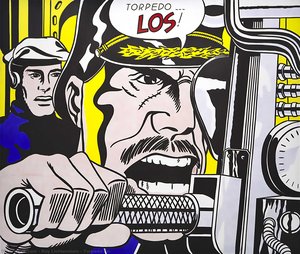 Torpedo los - Roy Lichtenstein
A moment suspended – a captain’s gaze fixed on the periscope, the urgent command “TORPEDO…LOS!” echoing in the silence. This is Torpedo...Los! (1963) by Roy Lichtenstein, a vibrant explosion of Pop Art that captures both the drama and the detachment of the Cold War era.
Lichtenstein’s masterful appropriation of comic book imagery wasn't merely about replicating style; it was about questioning the very nature of representation. His signature Ben-Day dots, bold outlines, and primary colors create a graphic intensity that is both captivating and unsettling.
Its inclusion among our 'Gainsboro' tones might seem unexpected, yet look closer. The underlying structure – the careful layering of forms, the strategic use of white space, and the way light seems to emanate from the flat planes of color – create a subtle refinement reminiscent of Gainsborough’s portraits. While Lichtenstein employs bold hues, he does so with a precision that evokes a similar sense of visual harmony.
Torpedo...Los! remains profoundly meaningful today because it reminds us of the power of art to reflect and critique our culture. It is a testament to Lichtenstein’s unique vision – his ability to transform everyday imagery into a powerful symbol of anxiety, heroism, and the complexities of modern life, bringing a touch of dynamic energy to any space.
Odol - Stuart Davis
 Odol - Stuart Davis
Observe a world distilled to its most essential forms – a still life imbued with unexpected vibrancy and a subtle undercurrent of commentary. This is Odol by Stuart Davis, a painting that captures the spirit of American Modernism through the lens of everyday objects.
Davis’s bold graphic style, influenced by jazz rhythms and commercial art, wasn't about replicating reality; it was about celebrating the energy and dynamism of modern life. The simplified shapes, clean lines, and flat planes of color create a striking visual impact that is both playful and sophisticated.
Its inclusion among our 'Gainsboro' tones lies in its masterful use of light to create depth and atmosphere. While Davis employs vibrant hues, he balances them with subtle gradations and strategic white space – evoking a similar sense of refinement found in Gainsborough’s portraits. The interplay of color and form creates a visual harmony that is both captivating and intellectually stimulating.
Odol remains profoundly meaningful today because it reminds us to find beauty in the mundane, to appreciate the artistry of everyday life, and to question the very nature of representation. It is a testament to Davis’s unique vision – his ability to transform ordinary objects into powerful symbols of American culture, bringing a touch of dynamic energy to any space.
38.La vírgen, 1913 - Gustav Klimt
 38.La vírgen, 1913 - Gustav Klimt
Step into a world where femininity is not merely depicted but *celebrated* – an opulent symphony of form and color that radiates mystery and sensuality. This is 38. La Vírgen (1913) by Gustav Klimt, a masterpiece of the Symbolist movement.
Klimt’s signature style—a harmonious blend of Art Nouveau influences, Byzantine mosaics, and his own unique artistic vision—transcends mere representation. The swirling arrangement of three nude female figures isn't a traditional depiction of the Virgin Mary; rather, it evokes themes of motherhood, fertility, and the sacredness of womanhood.
Its inclusion among our 'Gainsboro' tones lies in its masterful use of light to create depth and atmosphere. While Klimt employs rich golds, oranges, blues, and purples, he balances them with subtle gradations and strategic white space – evoking a similar sense of refinement found in Gainsborough’s portraits. The flowing lines and tactile surface created through impasto contribute to the painting's sense of movement and organic vitality.
La Vírgen remains profoundly meaningful today because it reminds us of the power of art to explore complex emotions, celebrate beauty, and question societal norms. It is a testament to Klimt’s unique vision – his ability to transform the human form into a powerful symbol of life, connection, and enduring grace, bringing a touch of quiet prestige to any space.
8. Battle between Heraclius and Chosroes (detail) (15) - Piero della Francesca
 8. Battle between Heraclius and Chosroes (detail) (15) - Piero della Francesca
Imagine a moment frozen in time – not a glorious celebration of victory, but a stark and unflinching portrayal of conflict’s brutal realities. This is Battle between Heraclius and Chosroes (detail) by Piero della Francesca, a fresco that transcends its historical subject matter to become a profound meditation on power, ambition, and the enduring legacy of human struggle.
Painted during the Early Renaissance, this work exemplifies the period’s burgeoning interest in classical principles of perspective and proportion. But it is Piero's masterful use of light – or rather, the *absence* of dramatic color – that truly sets it apart. The restrained palette dominated by earthy tones evokes a sense of solemnity and timelessness.
Its inclusion among our 'Gainsboro' tones lies in this subtle refinement. While not employing vibrant hues, Piero’s careful gradations of grey, ochre, and brown create an atmospheric depth reminiscent of Gainsborough’s landscapes. The geometric composition and meticulous detail lend a sense of order to the chaos, inviting us to contemplate the complexities of history.
Battle between Heraclius and Chosroes remains profoundly meaningful today because it reminds us that even in moments of conflict, there is beauty to be found – not in the spectacle of war, but in the artistry with which it is depicted. It’s a testament to Piero’s unique vision – his ability to transform a historical narrative into a powerful symbol of human ambition and enduring grace.
Suprematist Drawing 3 - Kazimir Malevich
 Suprematist Drawing 3 - Kazimir Malevich
Imagine a world stripped bare – reduced to its most essential forms and pulsating with an energy that transcends representation. This is Suprematist Drawing 3 by Kazimir Malevich, a foundational document in the history of abstract art.
Executed with charcoal, this piece isn’t about depicting *something*; it's about evoking pure feeling through geometric shapes and dynamic composition. The stark black and white palette belies its emotional depth, offering viewers a direct connection to Malevich’s revolutionary vision.
Its inclusion among our 'Gainsboro' tones lies in the subtle refinement of its monochrome aesthetic. While lacking vibrant hues, the interplay of light and shadow on the textured paper creates an atmospheric depth reminiscent of Gainsborough’s landscapes. The deliberate flattening of the picture plane and rejection of traditional perspective lend a sense of order to the chaos.
Suprematist Drawing 3 remains profoundly meaningful today because it reminds us that art can exist beyond representation, that beauty can be found in simplicity, and that pure feeling is a powerful force. It’s a testament to Malevich’s unique vision – his ability to transform geometric forms into conduits for spiritual experience.
To be looked at (from the Other Side of the Glass) with One Eye, Close to, for Almost an Hour - Marcel Duchamp
 To be looked at (from the Other Side of the Glass) with One Eye, Close to, for Almost an Hour - Marcel Duchamp
Imagine being instructed to *look* – not simply see, but dedicate an hour of focused attention to a seemingly simple object through one eye alone. This is the challenge and invitation presented by Marcel Duchamp’s To Be Looked At (From The Other Side Of The Glass) With One Eye, Close To, For Almost An Hour .
Created in 1918, this work isn't about aesthetic beauty in the traditional sense; it’s a radical provocation designed to disrupt our perceptions and question the very nature of art. While seemingly minimalist, its impact is profound – a foundational piece in Conceptual Art that continues to resonate today.
Its inclusion among our 'Gainsboro' tones lies not in color but in the subtle refinement of its intellectual challenge. The work’s muted palette and geometric forms create an understated elegance reminiscent of Gainsborough’s portraits, drawing attention to form and composition rather than overt spectacle. This deliberate restraint invites contemplation – a quiet prestige that elevates it beyond mere visual experience.
To Be Looked At remains profoundly meaningful because it reminds us that art is not simply about what we see, but how we perceive it. It’s a testament to Duchamp’s unique vision – his ability to transform an ordinary object into a powerful symbol of intellectual inquiry and enduring grace.
Santiago El Grande - Salvador Dalí
 Santiago El Grande - Salvador Dalí
Imagine a landscape suspended between reality and dream – a world where symbols hold profound meaning and the subconscious takes form. This is Santiago El Grande by Salvador Dalí, a surrealist masterpiece that invites us to question our perceptions of time, space, and existence.
Created in 1957, this monumental oil painting isn’t about depicting a specific event; it's about evoking the emotional resonance of faith, power, and the human condition. Its inclusion among our 'Gainsboro' tones lies in the subtle interplay of light and shadow across its vast canvas, creating an atmospheric depth reminiscent of Gainsborough’s landscapes.
While Dalí is renowned for his vibrant colors, Santiago El Grande employs a more restrained palette – muted ochres, grays, and blues that lend the work a sense of solemnity and timelessness. This deliberate choice draws attention to the intricate details and symbolic imagery, inviting contemplation rather than immediate spectacle.
Santiago El Grande remains profoundly meaningful today because it reminds us of the power of art to explore the depths of the human psyche. It’s a testament to Dalí’s unique vision – his ability to transform complex concepts into a captivating and enduring symbol of surrealist expression.
Conclusion
As the light fades, casting long shadows across our imagined gallery walls, we’re left with more than just a list of ten paintings. We carry with us echoes of Piero della Francesca's solemn geometry, Malevich’s radical simplicity, and Dalí’s dreamlike landscapes – each work a testament to the enduring power of human creativity.
These masterpieces are not frozen relics of the past; they are living forces that continue to whisper beauty, emotion, and meaning into modern life. They remind us that art is not merely about what we see, but how it makes us *feel* – a connection to something larger than ourselves, a glimpse into the depths of the human spirit.
And perhaps most importantly, these artworks are accessible. Through faithful reproductions, their emotional resonance can grace your own walls, transforming your living space into a sanctuary of beauty and inspiration. Explore our full collection and discover the timeless power of 'Gainsboro' tones to elevate your home and enrich your life.