Under the Hammer
Acrylic On Canvas
WallArt
Early Modernism
1914
19th Century
637.0 x 637.0 cm
Walker Art Gallery
Hand Made Oil Reproduction
Hand-painted oil on canvas in your size and frame, made to order by our artists.
P118B $10
P118H $10
P118W $10
P438Z $10
P508JH $12
P508YH $12
P805H $10
P805Z $10
P919BZ $10
P919G $10
P919XJ $10
P959ZH $10
P968JZ $12
W106C $8
W218G $10
W218JH $8
W218Y $10
W307PJ $10
W316G $10
W316PJ $8
W316Y $10
W398PJ $8
W4111J $10
W500HY $15
W500JH $15
W692G $12
W849H $8
W940BG $15
W953PJ $8
Pick from our preset sizes that match the artwork's original proportions.
You may enter your own dimensions to fit a specific frame or space. If your selected size does not match the original image's proportions, we will either crop the artwork or extend the painting with additional hand-painted elements. A digital mockup will be sent for your approval before production begins.

Please note that the on-screen preview does not reflect the actual cropping or extension. Only the mockup will accurately show the final composition.
While custom sizes are available, we recommend selecting a dimension from the predefined list to preserve the original proportions.
After order, OriginalUniqueArt.com team will email client for instructions and provide a mockup preview
Worldwide Delivery () in 3/4 weeks instead of standard 5 weeks. (23 July). No compromise on quality.
Free Worldwide Express Shipping
High-Quality Linen Canvas
Full Shipping Insurance
Customs Tax Refund Guarantee
True Color Matching Guarantee
60-Day Return Policy (Defects Only)
100% Money-Back Guarantee
Bulk Discount Offer
Under the Hammer
Reproduction Medium
Reproduction Size
-
Total Price
-
Artwork Description
Robert Polhill Bevan’s ‘Under the Hammer’: A Window into Early Modern British Art
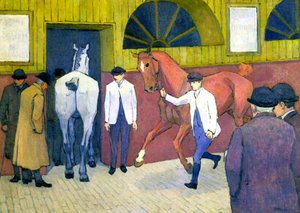
Under the Hammer, painted in 1914 by Robert Polhill Bevan, is more than just a depiction of a crowded room; it's a meticulously observed snapshot of a pivotal moment in British art history. Measuring an impressive 637 x 637 cm, this black and white composition captures a scene brimming with quiet intensity – a gathering seemingly centered around a horse, likely within the context of an auction or appraisal. Bevan’s work stands as a crucial bridge between the Impressionistic tendencies prevalent at the turn of the century and the burgeoning radicalism that would define British Modernism.
- Subject Matter: The central focus is undeniably the horse, positioned with deliberate prominence within the room's architecture. However, it’s the surrounding figures – a diverse group of men, many in formal attire suggesting an upper-class setting – that truly imbue the painting with its narrative weight.
- Style & Technique: Bevan employs a restrained yet remarkably detailed technique, characteristic of his time. The tonal range is carefully controlled, utilizing subtle gradations of gray to create depth and volume. His brushwork is precise, particularly evident in the rendering of clothing textures and the horse’s musculature, reflecting a commitment to observational accuracy rather than purely expressive color.
A Quaker Banker's Artistic Rebellion
Robert Polhill Bevan’s biography itself is fascinating. Born into a banking family – his parents were Richard Alexander Bevan and Laura Maria Polhill – he initially seemed destined for a life of finance, influenced by his Quaker upbringing. Yet, defying expectations, Bevan embraced an artistic path, fueled by a restless intellectual curiosity and a desire to push the boundaries of representation. His formative years in Paris at the Académie Julian proved transformative, exposing him to the innovative ideas circulating amongst artists like P.
This influence is palpable in ‘Under the Hammer’. The composition’s slightly awkward perspective, the deliberate lack of idealized beauty, and the focus on capturing a specific moment in time – rather than presenting an allegorical or romanticized scene – are hallmarks of Bevan's engagement with European modernism. He wasn't simply copying trends; he was actively participating in a dialogue about how art could represent the world around him.
Symbolic Layers and Emotional Resonance
While seemingly straightforward, ‘Under the Hammer’ is rich in symbolic potential. The horse itself can be interpreted as representing wealth, status, and perhaps even judgment – fitting for an auction setting. The figures surrounding it are equally significant; their expressions, postures, and interactions suggest a complex interplay of observation, speculation, and negotiation. The inclusion of details like books and cups adds layers of domesticity and intellectual engagement to the scene.
Bevan’s ability to evoke a sense of quiet contemplation is remarkable. Despite the bustling activity implied by the gathering, there's an underlying stillness that draws the viewer in. This emotional resonance, combined with the artist’s masterful technical skill, elevates ‘Under the Hammer’ beyond a mere depiction of a scene; it becomes a poignant meditation on observation, value, and the human condition.
A Legacy for Collectors & Interior Design
This hand-painted reproduction captures not only the visual elements of Bevan's original work but also its historical significance and artistic merit. Its size (637 x 637 cm) makes it a commanding presence, suitable for grand spaces or as a focal point within a sophisticated interior design scheme. The monochrome palette lends itself beautifully to a variety of styles – from classic British interiors to contemporary minimalist settings. ‘Under the Hammer’ is an investment in art history and a testament to Bevan's pioneering role in shaping modern British art.
Artist Biography
A Pioneer of British Modernism: The Life and Art of Robert Polhill Bevan
Robert Polhill Bevan, born in Hove in 1865, occupies a pivotal yet often understated position within the narrative of early 20th-century British art. Emerging from a Quaker background steeped in banking connections – his parents were Richard Alexander Bevan and Laura Maria Polhill – he defied conventional expectations to become a daring innovator, a key figure in the transition from Impressionism towards more radical explorations of color and form. His journey was one of constant experimentation, absorbing influences from across Europe while forging a distinctly personal artistic vision that would profoundly impact the development of modern art in Britain. Bevan’s early education at Westminster School of Art under Fred Brown provided a solid foundation, but it was his subsequent studies at the Académie Julian in Paris that truly ignited his creative spark. There, he encountered a constellation of rising stars – Paul Sérusier, Pierre Bonnard, Édouard Vuillard, and Maurice Denis – artists who were challenging academic conventions and embracing new approaches to painting. These encounters proved formative, exposing Bevan to the principles of synthetism and laying the groundwork for his future explorations.Brittany, Fauvism, and the Search for Pure Color
The impact of Brittany on Bevan’s artistic development cannot be overstated. Two significant journeys in 1890 and 1891 immersed him in the atmosphere of Pont-Aven, a small coastal town that had become a magnet for artists seeking an alternative to Parisian salon culture. The bold colors and simplified forms championed by artists like Gauguin resonated deeply with Bevan, influencing his early drawings and prints. However, it was around 1904 that Bevan truly began to distinguish himself, embarking on a path of experimentation with pure color that anticipated the emergence of Fauvism on the continent. His painting “Courtyard” stands as a remarkable example of this proto-Fauvist approach, demonstrating a willingness to abandon naturalistic representation in favor of expressive chromatic intensity – a boldness that set him apart from many of his British contemporaries. This exploration didn’t remain static; Bevan subsequently adopted a divisionist or pointillist technique, evident in works like “Ploughing on the Downs” and “The Turn-Rice Plough,” showcasing his commitment to exploring different methods of applying color and capturing light. Throughout this period, the influence of masters such as Velázquez and Goya remained palpable, alongside more immediate guidance from Renoir regarding the depiction of horses – a testament to Bevan’s broad artistic curiosity and willingness to learn from diverse sources.Collective Visions: The Camden Town Group and Beyond
Bevan was not an artist who worked in isolation. He actively sought connection with like-minded individuals, playing a crucial role in the formation of several influential art groups. As a founding member of the Camden Town Group, he joined forces with artists determined to depict modern urban life and challenge established artistic norms. This collective spirit extended to his involvement with the London Group and the Cumberland Market Group, further demonstrating his commitment to progressive artistic movements. A particularly significant relationship was forged in 1908 when Bevan joined Walter Sickert’s Fitzroy Street group. Sickert's encouragement to focus on everyday subjects proved invaluable, steering Bevan towards a more grounded and socially engaged approach to art. The first Allied Artists’ Association exhibition in 1908 provided another important platform for Bevan, introducing him to the burgeoning world of international modernism – most notably, through his encounter with Wassily Kandinsky. These affiliations were not merely social; they fostered a dynamic exchange of ideas that shaped Bevan's artistic trajectory and contributed to the broader evolution of British art.Landscapes, Urban Scenes, and Lasting Legacy
While Bevan’s subject matter was diverse, encompassing portraits – including notable depictions of his wife, Stanislawa de Karłowska – and urban scenes documenting the decline of the horse cab trade (“The Cab Horse”), he is perhaps best known for his landscapes. His paintings of Sussex and Brittany are imbued with a vibrant energy, capturing the essence of rural life through expressive brushwork and bold color palettes. Works like “In the Downs near Lewes,” “The Chestnut Tree,” and “Landscape in the Blackdown Hills, Devon” exemplify this mastery, showcasing his ability to convey both the physical beauty and emotional resonance of the natural world. Robert Polhill Bevan’s legacy extends far beyond his individual paintings. He is rightfully recognized as a pioneer of modern British art, particularly for his early adoption of Fauvist principles and his fearless experimentation with color. His influence on subsequent generations of painters is undeniable, and his contribution to the Camden Town Group was instrumental in shaping the development of modern art in Britain. A retrospective exhibition at Colnaghi’s in 1961 served as a crucial moment of recognition, solidifying his place in art history and ensuring that his innovative spirit continues to inspire artists today. He remains a vital figure for understanding the complex evolution of British painting in the early twentieth century.Robert Polhill Bevan
1865 - 1925 , United Kingdom
Quick Facts
- Artistic Movement Or Style: Fauvism, Divisionism
- Artists Or Movements Influenced By This Artist: ['Modern British Art']
- Artists Who Influenced This Artist:
- Paul Gauguin
- Velázquez
- Goya
- Renoir
- Date Of Birth: 1865
- Date Of Death: 1925
- Full Name: Robert Polhill Bevan
- Nationality: British
- Notable Artworks:
- The Farmhouse
- Ploughing on the Downs
- Queen's Grove
- The Cab Horse
- Place Of Birth: Hove, United Kingdom

Glass option is only available in size under 110 CM