

 Preview
 Send
Send Share
Share
 Details
 Guide
Guide

 Download
 Similars
 X-Ray
X-Ray Diaporama
 Stats
StatsDemonstration Drawings


 Read More
The artwork displayed on this page is protected by copyright law, which means we cannot legally create or sell an identical reproduction. This protection is enforced under international agreements such as the Berne Convention and by national laws, including those outlined by the U.S. Copyright Law - Title 17.
As a respectful and legal alternative, we offer custom, hand-painted artworks inspired by the original. Our skilled and professional artists carefully study the original's style, mood, and artistic essence to create a new, unique piece that evokes the same feeling - while remaining an original creation in its own right.
This method fully complies with copyright regulations because it does not involve copying or duplicating the protected artwork. Instead, it is a creative reinterpretation - a new painting that is influenced by the original but not identical to it.
Hand Made Oil Reproduction
Hand-painted oil on canvas in your size and frame, made to order by our artists. ( Switch to Print Switch to Digital Image)




P118B $10

P118H $10

P118W $10

P438Z $10

P508JH $12

P508YH $12

P805H $10

P805Z $10

P919BZ $10

P919G $10

P919XJ $10

P959ZH $10

P968JZ $12

W106C $8

W218G $10

W218JH $8

W218Y $10

W307PJ $10

W316G $10

W316PJ $8

W316Y $10

W398PJ $8

W4111J $10

W500HY $15

W500JH $15

W692G $12

W849H $8

W940BG $15

W953PJ $8




Pick from our preset sizes that match the artwork's original proportions.

Type the width and the height you need, to fit your frame or your wall. This is hand-painted, so for a size with a different shape the artist can paint a bit more around the picture, or cut a bit — you choose. We send you a digital mockup to approve before the painting starts. The picture shown on this page does not show the real result — only the mockup does.
After order, OriginalUniqueArt.com team will email client for instructions and provide a mockup preview
Worldwide Delivery () in 3/4 weeks instead of standard 5 weeks. (26 October). No compromise on quality.

Free Worldwide Express Shipping

High-Quality Linen Canvas

Full Shipping Insurance

Customs Tax Refund Guarantee

True Color Matching Guarantee

100-Day Return Policy (Defects Only)

100% Money-Back Guarantee

Bulk Discount Offer
 Glass option is only available in size under 110 CM

Demonstration Drawings
Reproduction Medium
Reproduction Size
-


Total Price
$ 300
Demonstration Drawings - Rirkrit Tiravanija: A Dialogue Between Art and Life
Rirkrit Tiravanija’s Demonstration Drawings represent more than just visual art; they embody a profound philosophical stance—a belief that creativity thrives in collaboration and that artistic expression should actively engage with the everyday experiences of its audience. Born in Buenos Aires, Argentina, in 1961, Tiravanija's journey through diverse cultural landscapes – Thailand, Ethiopia, Canada, and the United States – profoundly shaped his artistic vision, propelling him toward a singular approach centered on fostering social interaction and communal engagement. This ethos isn’t merely stylistic; it’s the bedrock upon which his entire oeuvre rests.The Conceptual Core: Challenging Traditional Boundaries
At its heart, Tiravanija's work rejects conventional notions of art as an isolated object destined for passive contemplation. Instead, he champions a “relational aesthetics,” pioneered by Nicolas Bourriaud, where artistic endeavors prioritize the exchange between artist and viewer—a dynamic process that seeks to transform alienating labor into something more humane and enriching. This perspective is vividly illustrated in his early installations of cooking meals for gallery visitors, mirroring his childhood memories of his grandmother’s garden restaurant and highlighting the importance of shared experiences as catalysts for personal connection. As Tiravanija eloquently stated, “bringing people together” isn't just a goal; it’s an imperative—a recognition that art possesses the capacity to spark relationships and inspire action beyond the confines of the exhibition space.A Visual Echo of Sociopolitical Movements
The drawings themselves serve as a powerful visual manifestation of this conceptual framework. Tiravanija commissioned Thai artists to translate photojournalistic images documenting mass uprisings against power, oppression, and global capital—specifically those published in the International Herald Tribune. These depictions capture moments of collective resistance and underscore the significance of spontaneous organization within communities confronting injustice. The medium chosen – graphite on paper – lends itself perfectly to conveying immediacy and capturing the essence of these pivotal historical events. Furthermore, Tiravanija’s use of MDF frames elevates the drawings beyond mere visual representation, transforming them into tangible objects that invite contemplation and dialogue.Symbolism Embedded in Everyday Objects
Beyond their sociohistorical context, Demonstration Drawings are laden with symbolic resonance. The selection of commonplace items—backpacks, cooking utensils, maps—reflects Tiravanija’s fascination with transforming ordinary materials into vehicles for artistic expression. These objects aren't simply decorative; they embody memories of past projects and serve as prompts for imaginative engagement. Notably, the inclusion of “Ne Travaillez Jamais” – “Never Work”—a slogan originating from the May 1968 protests in Paris—directly confronts the anxieties surrounding labor alienation, mirroring Tiravanija’s broader critique of capitalist structures.A Reflection on Family and Community
Finally, Tiravanija's decision to distribute the bricks among participants expands upon the intimacy of the family home and opens it up to a wider community. This gesture symbolizes a reimagining of domestic space as a site for social interaction—a deliberate challenge to traditional notions of privacy and ownership. The number 14,086 – representing the bricks needed to construct a modest house in China – underscores Tiravanija’s commitment to addressing pressing societal concerns while simultaneously celebrating the beauty and potential inherent in collaborative endeavors. Demonstration Drawings stand as a testament to Tiravanija's unwavering belief that art can contribute meaningfully to shaping our understanding of the world and fostering connections between individuals.Questions & Answers
How can I view "Demonstration Drawings" by Rirkrit Tiravanija as a slideshow?
"Demonstration Drawings" by Rirkrit Tiravanija can be viewed as a slideshow on the artwork's Diaporama page.
What stage of Rirkrit Tiravanija's career does "Demonstration Drawings" (2015) belong to?
Given its 2015 date, "Demonstration Drawings" falls in Rirkrit Tiravanija's Contemporary Realism.
Is "Demonstration Drawings" by Rirkrit Tiravanija a painting, a drawing or a print?
"Demonstration Drawings" by Rirkrit Tiravanija is classified as wall art. The category describes the kind of artwork the original is.
Artist Biography
The Art of Shared Experience: The Life and Vision of Rirkrit Tiravanija
To encounter the work of Rirkrit Tiravanija is to step away from the silent, sterile halls of traditional galleries and into a living, breathing space of human connection. Born in Buenos Aires, Argentina, in 1961, Tiravanija’s identity was forged through a nomadic childhood that spanned the diverse landscapes of Thailand, Ethiopia, and Canada. This global upbringing instilled in him a profound understanding of cultural fluidity and the universal language of shared existence. His artistic journey, while academically rooted in history and fine arts—spanning institutions from Carleton University to the School of the Art Institute of Chicago—eventually transcended the boundaries of the canvas and the sculpture to embrace the very essence of social interaction.
Tiravanija’s practice is famously defined by the concept of Relational Aesthetics, a term coined by curator Nicolas Bourriaud to describe art that takes as its theoretical horizon the realm of human interactions and its social context. Rather than producing static objects for passive observation, Tiravan andija creates environments that function as stages for living. His work rejects the idea of the artwork as an isolated commodity, instead prioritizing the ephemeral magic that occurs when strangers become participants in a shared moment. Through his lens, art is not something to be looked at, but something to be lived, tasted, and felt.
Breaking Bread: The Radicalism of the Everyday
The early 1990s marked a seismic shift in contemporary art with the arrival of Tiravanija’s groundbreaking installations. In his seminal work, “Pad Thai,” presented at the Paula Allen Gallery, he famously abandoned the traditional gallery object entirely. Instead of hanging paintings or placing pedestals, he transformed the exhibition space into a communal kitchen, preparing and serving Pad Thai to visitors. This audacious act of hospitality turned the gallery into a site of nourishment and dialogue, blurring the line between the artist’s labor and the audience's experience. This practice was not merely a performance but an invitation to engage with the conviviality of the everyday.
This theme of culinary connection continued through subsequent projects, such as his 1995 Carnegie International exhibition, where he provided instructions for cooking South-East Asian green curry. By utilizing familiar, domestic tasks like cooking and eating, Tiravanija strips away the pretension often associated with high art, replacing it with a sense of ritual and intimacy. His work serves as a powerful reminder that the most profound artistic experiences can be found in the simplest acts of togetherness, echoing his childhood memories of his grandmother’s garden restaurant where food was always a catalyst for community.
A Legacy of Connection and Social Dialogue
Beyond the sensory delights of shared meals, Tiravanija’s work carries a deep sociopolitical resonance. His more recent endeavors, such as his “Demonstration Drawings,” showcase a different facet of his practice—one that uses visual imagery to reflect on mass uprisings, power, and global capital. By commissioning Thai artists to translate photojournalistic images into drawings, he bridges the gap between historical documentation and contemporary social critique, proving that his commitment to "bringing people together" also extends to fostering critical awareness of the world around us.
The historical significance of Rirkrit Tiravanija lies in his ability to redefine the role of the artist from a creator of objects to a facilitator of experiences. His influence can be seen across generations of artists who seek to dismantle the walls between art and life. As he continues to work between New York, Berlin, and Chiang Mai, his practice remains an enduring testament to the power of relationality—a belief that in an increasingly fragmented world, the most radical act an artist can perform is to create a space where we might truly encounter one another.

Rirkrit Tiravanija
1961 -
Quick Facts
- Artistic Movement Or Style: Relational Aesthetics
- Artists Or Movements Influenced By This Artist: ['Social Sculpture']
- Artists Who Influenced This Artist:
- Minimalism
- Conceptual Art
- Date Of Birth: 1961
- Full Name: Rirkrit Tiravanija
- Nationality: Thai
- Notable Artworks:
- Pad thai
- Untitled (free/still)
- Tom kha soup
- Place Of Birth: Buenos Aires, Argentina
Related Articles
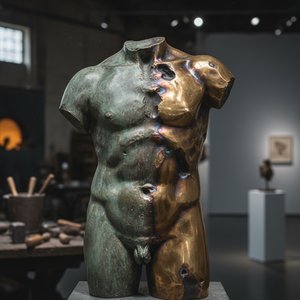
The Enduring Legacy of Bronze Sculpture: History, Techniques & Contemporary Interpretations
Explore the rich history & enduring appeal of bronze sculpture. Learn about casting techniques, iconic artists, collecting tips, & contemporary interpretations. Expert insights for discerning art collectors.

The Enduring Form: Sculpture Across History, Technique & Emotional Resonance
Explore the rich history of sculpture with OriginalUniqueArt. Discover key techniques, influential artists & investment potential for discerning collectors. Expert insights into valuing and collecting timeless masterpieces.

Bronze Sculptures That Defined Art History | OriginalUniqueArt
Journey through art history with our Top 10 bronze sculptures! Explore masterpieces by Rodin, Michelangelo & more. Discover stories behind iconic statues and find museum-quality reproductions for your home decor at OriginalUniqueArt.com.

The Enduring Form: Exploring Themes & Techniques in Sculpture Across Historical Periods
Explore the rich history of sculpture from ancient masterpieces to contemporary innovations. Discover key techniques, influential artists & investment potential for discerning art collectors.

Bronze Age to Modern Masters: 10 Sculptures That Redefined Art | OriginalUniqueArt
Journey through art history with 10 legendary bronze sculptures – from Michelangelo's David to Rodin’s Thinker. Explore the stories, techniques & timeless beauty of these masterpieces. Find museum-quality reproductions & elevate your home decor on OriginalUniqueArt.com.


