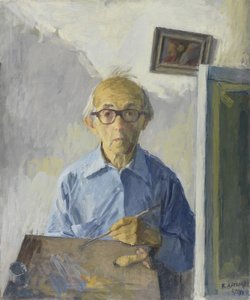
Self portrait (Raphael Soyer)
Raphael Soyer (1899–1987) made Self portrait.

 Preview

 Hand Made Oil Painting
 Send
 Share
 Guide


 Download
 Similars
 X-Ray
 Diaporama
 Q&A

 Stats
Self portrait: the essentials
- Title
- Self portrait
- Artist
- Raphael Soyer (1899–1987)
- Artist born in
- Borisoglebsk, Russia
- Subject
- portraits
Self portrait in high resolution
Raphael Soyer, Self portrait.
Questions about Self portrait
How light is "Self portrait" overall?
Overall, "Self portrait" is recorded as shadow. Perceived brightness describes how light or dark the work appears.
Who created "Self portrait"?
"Self portrait" is attributed to Raphael Soyer.
How is the color composition of "Self portrait" by Raphael Soyer built?
The color analysis of "Self portrait" by Raphael Soyer records a serene contrast and a discordant palette harmony.
What orientation does "Self portrait" by Raphael Soyer have?
The format of "Self portrait" is square. This is useful when planning where a reproduction will be placed.
Where can I download "Self portrait" by Raphael Soyer?
"Self portrait" by Raphael Soyer can be downloaded from the artwork's Download page, as a high-resolution digital image download.
Does "Self portrait" have an augmented reality preview?
The AR Preview page of "Self portrait" by Raphael Soyer uses augmented reality to show the artwork in your own space, on a compatible device.
How do the colors of "Self portrait" relate to each other?
The color harmony of "Self portrait" is recorded as discordant palette.
Is there a factsheet about "Self portrait" by Raphael Soyer for students?
The guide to "Self portrait" is the artwork's Guide page - a printable factsheet showing the artwork with its caption, credit line and identity table (artist, dates, medium, original size, collection).
Can I see an X-ray view of "Self portrait" by Raphael Soyer?
The X-Ray view of "Self portrait" by Raphael Soyer is on the artwork's X-Ray page: an interactive examination of the image through eleven optical layers.
About the artist, Raphael Soyer
1899–1987, Russia
Raphael Soyer
The Soul of the City: The Life and Legacy of Raphael Soyer In the bustling, often indifferent landscape of twentieth-century New York, few artists captured the quiet, melancholic pulse of urban humanity as tenderly as Raphael Soyer. Born in 1899 in Borisoglebsk, Russia, Soyer’s journey was one defined by migration, resilience, and an unwavering commitment to the representational truth. Alongside his identical twin brother, Moses, Raphael was raised in a household where intellect and artistry were paramount. His father, Abraham, a Hebrew scholar and teacher, fostered an environment of deep academic pursuit that would later provide the intellectual scaffolding for Raphael’s social commentary.
Also by Raphael Soyer
 Farewell to Lincoln Square (Pedestrians)1959
 Soyer, Moses, Portrait Of1965
 The Artist's Parents1932
 Portrait of Mina1932
Essays around Self portrait
 Reflecting the Self: A History of Portraiture & Psychological InsightExplore the fascinating history of self-portraiture from Renaissance masters like Dürer & Rembrandt to modern interpretations. Discover the…
 Masterpieces of Raphael: The Top 25 Essential Artworks of the High RenaissanceExplore 25 iconic Raphael masterpieces of the High Renaissance. Discover timeless beauty and curated art on OriginalUniqueArt.com.
 Egon Schiele's Top 25 Masterpieces: The Raw Power of ExpressionismExplore 25 iconic Egon Schiele masterpieces of Austrian Expressionism. Discover the raw emotion behind each work on OriginalUniqueArt.com.