Preview
 Send
Send Share
Share
 Details
 Guide
Guide

 Download
 Similars
 X-Ray
X-Ray Diaporama
 Q&A
Q&A Stats
StatsCard players

 Read More
Giclée / Art Print
Museum-quality giclée or canvas print with fast production and flexible finish options. ( Buy Hand Made Painting Switch to Digital Image)




































Pick from our preset sizes that match the artwork's original proportions.

Type the width and the height you need, to fit your frame or your wall. A print can only be cut, never made bigger than the picture, so a size with a different shape loses a part of the image. We send you a digital mockup to approve before we print anything. The picture shown on this page does not show the real cut — only the mockup does.
Worldwide Delivery () in 2 weeks instead of standard 4/5 weeks. (5 November)

Free Worldwide Express Shipping

High-Quality Linen Canvas

Full Shipping Insurance

Customs Tax Refund Guarantee

True Color Matching Guarantee

100-Day Return Policy (Defects Only)

100% Money-Back Guarantee

Bulk Discount Offer
 Glass option is only available in size under 110 CM

Card players
Giclée / Art Print
Reproduction Size
-


Total Price
$ 81
Rafael Barradas' "Card Players": A Fragmented Glimpse of Modern Life
- Artist: Rafael Barradas
- Birth Year: 1890
- Death Year: 1929
- Origin: Montevideo, Uruguay
Rafael Barradas, a significant Uruguayan modernist painter and graphic artist, masterfully captures the essence of early 20th-century life in his work "Card Players." Born in Montevideo in 1890, Barradas' artistic journey was shaped by a family steeped in creativity—his sister a pianist and composer, and his brother a poet. His unique style blends traditional Uruguayan elements with the burgeoning modernist influences sweeping across Europe, resulting in a captivating visual experience.
Analytical Cubism and the Deconstruction of Form
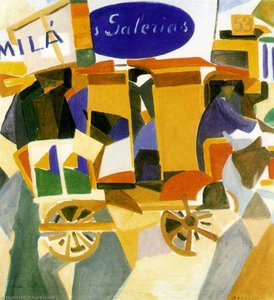
"Card Players" exemplifies Analytical Cubism, a revolutionary art movement pioneered by Pablo Picasso and Georges Braque. This painting isn't about realistic representation; it’s an intellectual exploration of form and perspective. Barradas breaks down the figures of the card players—along with the table, cards, and surrounding space—into geometric shapes: cubes, rectangles, and triangles. These fragments are then reassembled on the canvas in a non-naturalistic way, presenting multiple viewpoints simultaneously. This technique creates a sense of spatial ambiguity and disorientation, challenging traditional notions of depth and perspective.
A Restrained Palette, Dynamic Composition
The color palette employed by Barradas is deliberately restrained yet impactful. Dominated by blues, oranges, browns, and whites, the colors are applied in broad blocks rather than blended smoothly, further emphasizing the fractured appearance of the composition. The contrast between warm and cool tones creates visual tension and draws the viewer's eye across the canvas. The composition itself is dynamic; figures overlap and intersect, creating a loose arrangement within the frame that avoids any sense of static order. A central table dominates the scene, showcasing playing cards—the focal point of this fragmented social gathering.
Symbolism and Emotional Resonance
While "Card Players" lacks overt symbolism, its fractured nature evokes profound feelings of alienation, uncertainty, and intellectual inquiry. The abstracted figures can be interpreted as representing the complexities of human interaction in a rapidly changing world. The painting’s style reflects the anxieties and uncertainties of the early 20th century—a period marked by rapid industrialization, social upheaval, and the questioning of traditional values. Barradas' work invites viewers to contemplate the nature of perception, representation, and the fragmented experience of modern life.
Technique and Materials
Barradas’ technique involved a systematic deconstruction of forms followed by their reassembly in a non-naturalistic manner—a hallmark of Analytical Cubism. The visible brushstrokes, though not overly emphasized, contribute to the painting's textured surface. The artwork was likely created using oil paint on canvas, a common medium for paintings of this period. This combination of materials and technique allows for a rich depth of color and texture, enhancing the overall visual impact of "Card Players."
Questions & Answers
How harmonious are the colors of "Card players" by Rafael Barradas?
The color harmony of "Card players" is recorded as softly mixed palette.
What level of contrast does "Card players" by Rafael Barradas show?
The light-dark contrast of "Card players" is recorded as statement. Contrast describes how strongly light and dark areas differ.
Can I use augmented reality to see "Card players" by Rafael Barradas in my room?
"Card players" has an augmented reality preview: the artwork's AR Preview page shows it in your own space on a compatible device.
Artist Biography
A Life Immersed in Vibration: The Artistic Journey of Rafael Barradas
Born in Montevideo, Uruguay, in 1890, Rafael Pérez Giménez Barradas emerged as a pivotal figure in the burgeoning modernist movement of the early 20th century. His story is one of restless artistic exploration, a vibrant fusion of Uruguayan roots and European avant-garde sensibilities. From his earliest days, surrounded by a family steeped in artistic expression – a pianist sister, a poet brother, and a painter father – Barradas absorbed an aesthetic sensibility that would define his life’s work. Though largely self-taught, he honed his skills as an illustrator for newspapers and magazines in both Montevideo and Buenos Aires, laying the groundwork for a unique visual language. A turning point arrived in 1913 with a journey to Europe, a voyage that irrevocably altered his artistic trajectory. Immersing himself in the dynamic energy of Italy’s Futurist movement and briefly experiencing the radical deconstruction of Cubism in Paris, Barradas began to formulate an aesthetic vision that was both innovative and deeply personal.The Birth of Vibrationism: A Synthesis of Influences
Settling in Spain, primarily in Barcelona and Madrid, Barradas quickly became a central figure within avant-garde circles. It was here, amidst the intellectual ferment of Spanish artistic life, that he developed his signature style – *Vibrationism*. This wasn’t merely an imitation of Futurist dynamism or Cubist fragmentation; it was a synthesis, a deliberate attempt to capture the very essence of modern urban existence through intense color palettes and dynamic compositions. Vibrationism sought to convey not just what was seen, but how it *felt* to experience the accelerating pace and sensory overload of the modern city. He experimented with various media, illustrating for publications like *La Esquella de Torratxa* and *Paraninfo*, demonstrating a remarkable versatility that extended beyond painting. The core tenets of Vibrationism – its emphasis on intense chromatic expression, fractured forms suggesting movement, and depictions of urban scenes – marked a significant departure from traditional artistic conventions. It was an attempt to translate the energy of modernity onto canvas, a visual equivalent of the machine age’s relentless pulse.From Portraits to Magnificents: A Diverse Oeuvre
Barradas's artistic output was remarkably diverse, reflecting his constant experimentation and evolving vision. Early works like “The Tango” (1913) reveal a fascination with modern themes and a developing mastery of form and color. However, it was the series *Los Magníficos* that truly cemented his reputation. These monumental portraits of popular Spanish figures were rendered in bold geometric shapes, transforming everyday individuals into iconic representations of their time. This period also saw the emergence of “Clownism,” an expressionistic style characterized by vibrant depictions of urban life and a playful yet poignant exploration of human emotion. Beyond these signature styles, Barradas demonstrated his skill as a portraitist, capturing the likenesses of prominent figures like Joaquín Torres García and Ignacio Zuloaga with both sensitivity and modernist flair. His ability to seamlessly blend traditional portraiture techniques with avant-garde aesthetics underscored his unique artistic talent. Notable works such as “Gypsy Encampment” (1918) and "Man in a Tavern" (1922) exemplify the maturity of his style, showcasing his mastery of color, composition, and emotional depth.A Legacy Cut Short: Influence and Historical Significance
Tragically, Rafael Barradas’s life was cut short by illness at the age of 39 in 1929. Despite this premature end, he left an indelible mark on Uruguayan art history and contributed significantly to the broader modernist movement. His unique blend of Uruguayan heritage and European avant-garde influences established him as a distinctive voice in early 20th-century art. Barradas’s work profoundly influenced contemporaries like Joaquín Torres García, who incorporated elements of Vibrationism into his own “Constructive Universalism.” Today, his paintings are housed in prestigious collections such as the Museo Nacional de Artes Visuales in Montevideo, ensuring his continued recognition and appreciation by generations to come. He is celebrated for his innovative approach to color, form, and subject matter, a testament to his artistic vision and enduring legacy. His work remains a powerful reminder of the transformative potential of art and its ability to capture the spirit of an era.Key Characteristics of Barradas’s Style
- Vibrationism: A unique style blending Futurism, Orfism, and Cubism, focused on capturing dynamism.
- Intense Color Palettes: Bold and expressive use of color to convey emotion and energy.
- Geometric Forms: Frequent use of geometric shapes to deconstruct and reconstruct reality.
- Urban Themes: Depiction of modern city life, including scenes of cafes, streets, and industrial landscapes.
- Portraits & Figures: Skillful portrayal of individuals, often rendered in a stylized and monumental manner.

Rafael Barradas
1890 - 1929 , Uruguay
Quick Facts
- Full Name: Rafael Pérez Giménez Barradas
- Nationality: Uruguayan
- Date Of Birth: 1890
- Date Of Death: 1929
- Place Of Birth: Montevideo, Uruguay
- Notable Artworks:
- The Tango
- Gypsy Encampment
- Man in a Tavern
- Artistic Movement Or Style: Modernism, Vibrationism
- Artists Who Influenced This Artist:
- Futurists
- Cubism
- Artists Or Movements Influenced By This Artist:
- Joaquín Torres García
- Constructive Universalism
Related Articles
Cubism Unveiled: How Picasso and Braque Redefined Reality Through Geometric Abstraction
Explore the revolutionary world of Cubism. Discover how masters Pablo Picasso and Georges Braque dismantled reality through geometric abstraction to redefine modern art history.
Rafael Barradas: Bridging Brazilian Modernism with European Influences
Explore the life & art of Rafael Barradas, a pioneering Uruguayan modernist who blended European influences with vibrant local heritage. Discover his unique 'Vibrationism' style and investment potential.

Geometric Abstraction's 10 Defining Masterpieces | Art for Your Home - OriginalUniqueArt
Explore 10 defining masterpieces of Geometric Abstraction! Discover Kandinsky, Mondrian & Malevich’s iconic works. Find museum-quality art reproductions and curated decor ideas to elevate your home at OriginalUniqueArt.com.

Cubism Unveiled: How Picasso and Braque Redefined Modern Art through Geometric Revolution
Explore the revolutionary world of Cubism. Discover how Pablo Picasso and Georges Braque dismantled perspective to redefine modern art through geometric innovation and analytical mastery. An essential guide for art students, collectors, and history enthusiasts.

Mastering Form: The 25 Greatest Paintings by Paul Cézanne
Explore 25 iconic Paul Cézanne masterpieces and his Post-Impressionist legacy. Discover the full collection online at OriginalUniqueArt.com.