 Read More


 For artworks or reproductions larger than 105 cm (approximately 41 inches) on any side, the frame will be shipped as a kit, disassembled. This method ensures safe delivery and prevents damage during transport.


More about this painting
Text size

() ·
A painting made for you, by hand
Hand Made Oil Reproduction
Hand-painted oil on canvas in your size and frame, made to order by our artists. ( Switch to Print Switch to Digital Image)
Artist Biography
Explore the sculptures of Pietro Tacca (1577-1640), a master sculptor bridging Mannerism & Baroque styles. Discover his Medici commissions, bronze masterpieces & iconic works like the Porcellino.
from ·
Chapter 1
How large should it be?
Slide to change the size; the picture on the left shows the frame at its real width. The proportions of the original are kept.
Standard
custom
CM
INCH
Pick from our preset sizes that match the artwork's original proportions.
Loading sizes...

width
height
Type the width and the height you need, to fit your frame or your wall. This is hand-painted, so for a size with a different shape the artist can paint a bit more around the picture, or cut a bit — you choose. We send you a digital mockup to approve before the painting starts. The picture shown on this page does not show the real result — only the mockup does.
Chapter 2
How should it arrive?
Choose the edges of the stretched canvas
Choose your frame

White $1

Blurside $1

Extended $1

P118B $10

P118H $10

P118W $10

P438Z $10

P508JH $12

P508YH $12

P805H $10

P805Z $10

P919BZ $10

P919G $10

P919XJ $10

P959ZH $10

P968JZ $12

W106C $8

W218G $10

W218JH $8

W218Y $10

W307PJ $10

W316G $10

W316PJ $8

W316Y $10

W398PJ $8

W4111J $10

W500HY $15

W500JH $15

W692G $12

W849H $8

W940BG $15

W953PJ $8

H24-GOLD $30

H24-SILVER $30

H36-GOLD $45

H36-SILVER $45
Framed
Moulding: . Overall size with the frame: .
Chapter 3
Who paints it, and should anything change?
Examples of what can be changed: Replace face with customer photo; Add pet (e.g., replace cat with dog); Include hidden message in background; Change background landscape or elements.
After order, OriginalUniqueArt.com team will email client for instructions and provide a mockup preview
After order, OriginalUniqueArt.com team will email client for instructions and provide a mockup preview
Worldwide Delivery () in 3/4 weeks instead of standard 5 weeks. (10 November). No compromise on quality.
Chapter 4
The finishing touches
A nameplate, as in a museum?
Engraved Bronze Plaque Details
This elegant plaque features the artist's name and the title of the artwork, finely engraved for a timeless presentation.
It is made from bronze with a refined, elegant finish. The text is precisely laser-engraved for a sharp and permanent result. Measuring 9x2 cm, the plaque is compact yet easy to read. It's built to be durable and scratch-resistant, offering a professional, museum-quality look. Mounting is simple thanks to the included adhesive backing.
Transparent Acrylic Plaque Details
The plaque includes essential engraved details such as the artist's name, the title of the artwork, the date it was created, the type of media used-like oil on canvas or watercolor-a brief description of the piece, and a QR code that links to the complete artwork information.
It is crafted from clear acrylic, offering a sleek, modern appearance. The text is UV-engraved in black to ensure strong visual contrast. With a size of 10x15 cm, it ensures optimal readability. It comes equipped with two metal hooks for secure wall mounting. The plaque is designed to be weather-resistant, making it suitable for various environments, and it includes interactive features that work seamlessly with smartphone scanning.
Black Acrylic Plaque Details
This elegant plaque includes engraved information such as the artist's name, the title of the artwork, the date it was created, the type of media used (like oil on canvas or watercolor), a short description of the artwork, and a QR code for quick access to more information.
The plaque itself is made from refined black acrylic with a premium finish. The text is laser-engraved in white for high contrast and readability. Its size is 10x15 cm, designed to be easy to read. It comes with two metal hooks for professional mounting. The design is sleek and fits any interior style. It is also weather-resistant and durable, with built-in digital integration for mobile compatibility.
A protective varnish?
When do you need it?
Chapter 5
Your painting, as you ordered it
Slave
Reproduction Medium
Reproduction Size
-
Elite Senior Artist
More detail, finesse, and extra production time
-
Reproduction Frame
-
-
For artworks or reproductions larger than 105 cm (approximately 41 inches) on any side, the frame will be shipped as a kit, disassembled. This method ensures safe delivery and prevents damage during transport.
Professional assembly required - this is not a DIY product.
The kit must be assembled and the canvas stretched by an experienced professional framer, using wood glue (not supplied), a canvas stretching plier and clamps to hold the bars square while the glue dries. Incorrect assembly or uneven canvas tension can permanently damage the artwork and is not covered by our warranty.
All solid wood bars are included, precisely cut to size.
Assembled with the screws provided, plus wood glue for the corner joints, which is not supplied and must be sourced by your framer.
Professional tools are required and not included: a canvas stretching plier (tensioner) and clamps to hold the bars square while the glue dries.
Important:
The corner joints require wood glue, the bars must be held with clamps until the glue is fully dry, and tightening the canvas on the assembled frame requires a canvas stretching plier. None of these are included in the kit. Please arrange an experienced professional framer before ordering this size.
Nameplate
-
-
Protective Varnish
Glossy Varnish (enhances colors, protects against light/moisture)
-
Customize My Artwork
Examples of what can be changed: Replace face with customer photo; Add pet (e.g., replace cat with dog); Include hidden message in background; Change background landscape or elements.
-
Urgent
Worldwide Delivery () in 3/4 weeks instead of standard 5 weeks. (10 November). No compromise on quality.
-
Express Shipping
Worldwide Delivery () in 5 weeks. (17 November).
Included
Total Price
$ 300
Glass option is only available in size under 110 CM
Included with every order
- Free Worldwide Express Shipping
- High-Quality Linen Canvas
- Full Shipping Insurance
- Customs Tax Refund Guarantee
- True Color Matching Guarantee
- 100-Day Return Policy (Defects Only)
- 100% Money-Back Guarantee
- Bulk Discount Offer
 Preview
 Send
Send Share
Share
 Details
 Guide
Guide

 Download
 Similars
 X-Ray
X-Ray Diaporama
 Q&A
Q&A Stats
StatsIn numbers
- 1615the year it was painted
- 29frames to choose from
- standard sizes, in its own proportions
- 5weeks to paint and deliver it
About the original


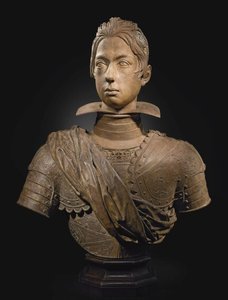
Pietro Tacca
1577 - 1640, Italy
Quick facts about Pietro Tacca
- Full Name: Pietro Tacca
- Nationality: Italian
- Date Of Birth: 1577
- Date Of Death: 1640
- Place Of Birth: Carrara, Italy
- Notable Artworks:
- Monument of the Four Moors
- Equestrian Monument to Philip IV
- Porcellino Florence
- Artistic Movement Or Style: Baroque & Mannerism
- Artists Who Influenced This Artist: ['Giambologna']
- Artists Or Movements Influenced By This Artist: ['Louis XIV']
Artist Biography
The Sculptural Legacy of Pietro Tacca
In the heart of Tuscany, where the white marble of Carrara meets the golden light of Florence, the life of Pietro Tacca unfolded as a bridge between two monumental eras of art history. Born in 1577, Tacca emerged from a lineage of craftsmen to become a defining voice in the transition from the elegant, often artificial complexities of Mannerism to the visceral, dramatic energy of the Baroque. His journey was not merely one of personal ambition but a profound evolution of form, where the controlled grace of his predecessors gave way to a new, breathing realism that captured the very essence of movement and emotion.
The foundation of Tacca’s genius was laid within the legendary workshop of Giambologna. Entering the atelier in 1592, the young sculptor became more than just an apprentice; he became a custodian of a sophisticated aesthetic language. Under Giambologna’s watchful eye, Tacca mastered the intricate art of bronze casting and the delicate balance of asymmetrical compositions. While his early works retained the stylized elegance and elongated proportions characteristic of Mannerist tradition, there was an emerging hunger in his work for something more tangible, more human, and infinitely more dynamic.
The Medici Court and the Bronze Masterpieces
Following the passing of his mentor in 1608, Tacca ascended to the prestigious position of court sculptor for the Medici Grand Dukes. This appointment was a transformative milestone, granting him the resources and the monumental scale required to execute works of immense historical significance. As the favored artist of the Florentine elite, he navigated the demands of powerful patrons with a skill that blended political prestige with artistic innovation. His ability to translate the grandeur of the Medici dynasty into permanent, bronze reality helped define the visual identity of Florence during this golden age.
One of his most enduring contributions to the city's landscape is perhaps found in his mastery of smaller-scale bronze works that possessed a life of their own. The famous Porcellino, a bronze boar that has become a beloved icon of Florentine folklore, exemplifies his ability to infuse even a single subject with charm and vitality. Beyond these charming figures, Tacca’s work on equestrian statues—such as the tribute to Ferdinand I de' Medici—demonstrated his capacity for monumental storytelling, capturing the power and authority of the ruling class through sweeping gestures and muscular tension.
A Synthesis of Drama and Realism
As Tacca’s career progressed, the influence of the Baroque style became increasingly undeniable. He moved away from the intellectualized puzzles of Mannerist sculpture toward a more direct engagement with the viewer's emotions. His later works, such as the poignant Tarquinius and Lucretia, showcase a profound command over narrative tension and psychological depth. In these pieces, the metal seems to lose its rigidity, adopting the softness of skin and the heavy drape of fabric, creating a sense of theatricality that was revolutionary for his time.
The historical significance of Pietro Tacca lies in this very synthesis of styles. He did not simply abandon the lessons of Giambologna; rather, he expanded them to accommodate a world that was beginning to crave realism and emotional resonance. His legacy is etched into the bronze and marble of Italy, representing a moment in time when art moved from the cerebral to the visceral, ensuring that the sculptural traditions of Florence would continue to pulse with life long after his death in 1640.
Related Articles
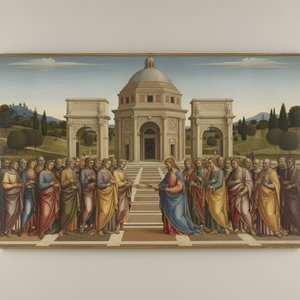
Pietro Perugino: Umbrian Master of Serenity & Precursor to Raphael's High Renaissance
Explore the life & art of Pietro Perugino, a pivotal Renaissance master and Raphael’s influential teacher. Discover his serene compositions, Sistine Chapel frescoes, and lasting legacy with OriginalUniqueArt.
Explore artworks organized by themes, styles, and characteristics.


