Text size

() ·

A painting made for you, by hand

Mill in the sun

Hand Made Oil Reproduction

Hand-painted oil on canvas in your size and frame, made to order by our artists. ( Switch to Print Switch to Digital Image)

Collectible Description

Experience Piet Mondrian's 'Mill in the Sun'! This vibrant oil painting captures a rural Dutch landscape with bold colors and geometric forms, showcasing his Neoplastic style & pioneering abstract art.

Artist Biography

Piet Mondrian pioneered Neoplasticism with works like Broadway Boogie Woogie. Discover the beauty of his geometric abstractions today.

from ·

Chapter 1

How large should it be?

Slide to change the size; the picture on the left shows the frame at its real width. The proportions of the original are kept.

Standard
custom
CM
INCH

Pick from our preset sizes that match the artwork's original proportions.

width
height

Type the width and the height you need, to fit your frame or your wall. This is hand-painted, so for a size with a different shape the artist can paint a bit more around the picture, or cut a bit — you choose. We send you a digital mockup to approve before the painting starts. The picture shown on this page does not show the real result — only the mockup does.

Chapter 2

How should it arrive?

Choose the edges of the stretched canvas

Choose your frame

Corner sample of the WhiteWrap canvas edge finish, stretched on solid wood bars
White $1
Corner sample of the BlurSideWrap canvas edge finish, stretched on solid wood bars
Blurside $1
Corner sample of the ExtendedWrap canvas edge finish, stretched on solid wood bars
Extended $1
Corner sample of the P118B picture frame: moulded polystyrene, 5 cm wide and 3 cm thick
P118B $10
Corner sample of the P118H picture frame: moulded polystyrene, 5 cm wide and 3 cm thick
P118H $10
Corner sample of the P118W picture frame: moulded polystyrene, 5 cm wide and 3 cm thick
P118W $10
Corner sample of the P438Z picture frame: moulded polystyrene, 5.5 cm wide and 3.5 cm thick
P438Z $10
Corner sample of the P508JH picture frame: moulded polystyrene, 7 cm wide and 3.5 cm thick
P508JH $12
Corner sample of the P508YH picture frame: moulded polystyrene, 7 cm wide and 3.5 cm thick
P508YH $12
Corner sample of the P805H picture frame: moulded polystyrene, 5 cm wide and 3.5 cm thick
P805H $10
Corner sample of the P805Z picture frame: moulded polystyrene, 5 cm wide and 3.5 cm thick
P805Z $10
Corner sample of the P919BZ picture frame: moulded polystyrene, 7 cm wide and 3.5 cm thick
P919BZ $10
Corner sample of the P919G picture frame: moulded polystyrene, 7 cm wide and 3.5 cm thick
P919G $10
Corner sample of the P919XJ picture frame: moulded polystyrene, 7 cm wide and 3.5 cm thick
P919XJ $10
Corner sample of the P959ZH picture frame: moulded polystyrene, 5 cm wide and 3 cm thick
P959ZH $10
Corner sample of the P968JZ picture frame: moulded polystyrene, 6 cm wide and 4 cm thick
P968JZ $12
Corner sample of the W106C picture frame: solid wood, 5 cm wide and 3 cm thick
W106C $8
Corner sample of the W218G picture frame: solid wood, 5 cm wide and 3 cm thick
W218G $10
Corner sample of the W218JH picture frame: solid wood, 5 cm wide and 3 cm thick
W218JH $8
Corner sample of the W218Y picture frame: solid wood, 5 cm wide and 3 cm thick
W218Y $10
Corner sample of the W307PJ picture frame: solid wood, 6 cm wide and 3 cm thick
W307PJ $10
Corner sample of the W316G picture frame: solid wood, 6 cm wide and 3 cm thick
W316G $10
Corner sample of the W316PJ picture frame: solid wood, 6 cm wide and 3 cm thick
W316PJ $8
Corner sample of the W316Y picture frame: solid wood, 6 cm wide and 3 cm thick
W316Y $10
Corner sample of the W398PJ picture frame: solid wood, 5 cm wide and 3 cm thick
W398PJ $8
Corner sample of the W4111J picture frame: solid wood, 6.5 cm wide and 3.5 cm thick
W4111J $10
Corner sample of the W500HY picture frame: solid wood, 7 cm wide and 5 cm thick
W500HY $15
Corner sample of the W500JH picture frame: solid wood, 7 cm wide and 5 cm thick
W500JH $15
Corner sample of the W692G picture frame: solid wood, 8 cm wide and 4 cm thick
W692G $12
Corner sample of the W849H picture frame: solid wood, 5 cm wide and 3 cm thick
W849H $8
Corner sample of the W940BG picture frame: solid wood, 7.5 cm wide and 4.5 cm thick
W940BG $15
Corner sample of the W953PJ picture frame: solid wood, 6 cm wide and 3.5 cm thick
W953PJ $8
Corner sample of the H24-GOLD picture frame: carved wood with gesso, 10 cm wide and 6 cm thick
H24-GOLD $30
Corner sample of the H24-SILVER picture frame: carved wood with gesso, 10 cm wide and 6 cm thick
H24-SILVER $30
Corner sample of the H36-GOLD picture frame: carved wood with gesso, 15 cm wide and 6.5 cm thick
H36-GOLD $45
Corner sample of the H36-SILVER picture frame: carved wood with gesso, 15 cm wide and 6.5 cm thick
H36-SILVER $45
Frame preview
Framed

Moulding: . Overall size with the frame: .

Chapter 3

Who paints it, and should anything change?

Examples of what can be changed: Replace face with customer photo; Add pet (e.g., replace cat with dog); Include hidden message in background; Change background landscape or elements.
After order, OriginalUniqueArt.com team will email client for instructions and provide a mockup preview

Worldwide Delivery () in 3/4 weeks instead of standard 5 weeks. (8 November). No compromise on quality.

Chapter 4

The finishing touches

A nameplate, as in a museum?

Engraved Bronze Plaque Details

This elegant plaque features the artist's name and the title of the artwork, finely engraved for a timeless presentation.

It is made from bronze with a refined, elegant finish. The text is precisely laser-engraved for a sharp and permanent result. Measuring 9x2 cm, the plaque is compact yet easy to read. It's built to be durable and scratch-resistant, offering a professional, museum-quality look. Mounting is simple thanks to the included adhesive backing.

Transparent Acrylic Plaque Details

The plaque includes essential engraved details such as the artist's name, the title of the artwork, the date it was created, the type of media used-like oil on canvas or watercolor-a brief description of the piece, and a QR code that links to the complete artwork information.

It is crafted from clear acrylic, offering a sleek, modern appearance. The text is UV-engraved in black to ensure strong visual contrast. With a size of 10x15 cm, it ensures optimal readability. It comes equipped with two metal hooks for secure wall mounting. The plaque is designed to be weather-resistant, making it suitable for various environments, and it includes interactive features that work seamlessly with smartphone scanning.

Black Acrylic Plaque Details

This elegant plaque includes engraved information such as the artist's name, the title of the artwork, the date it was created, the type of media used (like oil on canvas or watercolor), a short description of the artwork, and a QR code for quick access to more information.

The plaque itself is made from refined black acrylic with a premium finish. The text is laser-engraved in white for high contrast and readability. Its size is 10x15 cm, designed to be easy to read. It comes with two metal hooks for professional mounting. The design is sleek and fits any interior style. It is also weather-resistant and durable, with built-in digital integration for mobile compatibility.

A protective varnish?

When do you need it?

Chapter 5

Your painting, as you ordered it

Mill in the sun

Reproduction Medium

Reproduction Size

-

Elite Senior Artist

More detail, finesse, and extra production time

-

Reproduction Frame

-

-

For artworks or reproductions larger than 105 cm (approximately 41 inches) on any side, the frame will be shipped as a kit, disassembled. This method ensures safe delivery and prevents damage during transport.

Professional assembly required - this is not a DIY product.
The kit must be assembled and the canvas stretched by an experienced professional framer, using wood glue (not supplied), a canvas stretching plier and clamps to hold the bars square while the glue dries. Incorrect assembly or uneven canvas tension can permanently damage the artwork and is not covered by our warranty.

  • All solid wood bars are included, precisely cut to size.

  • Assembled with the screws provided, plus wood glue for the corner joints, which is not supplied and must be sourced by your framer.

  • Professional tools are required and not included: a canvas stretching plier (tensioner) and clamps to hold the bars square while the glue dries.

Important:
The corner joints require wood glue, the bars must be held with clamps until the glue is fully dry, and tightening the canvas on the assembled frame requires a canvas stretching plier. None of these are included in the kit. Please arrange an experienced professional framer before ordering this size.

Nameplate

-

-

Protective Varnish

Glossy Varnish (enhances colors, protects against light/moisture)

-

Customize My Artwork

Examples of what can be changed: Replace face with customer photo; Add pet (e.g., replace cat with dog); Include hidden message in background; Change background landscape or elements.

-

Urgent

Worldwide Delivery () in 3/4 weeks instead of standard 5 weeks. (8 November). No compromise on quality.

-

Express Shipping

Worldwide Delivery () in 5 weeks. (15 November).

Included

Total Price

$ 300

Total Price $ 300

Glass option is only available in size under 110 CM

Included with every order

  • Free Worldwide Express Shipping
  • High-Quality Linen Canvas
  • Full Shipping Insurance
  • Customs Tax Refund Guarantee
  • True Color Matching Guarantee
  • 100-Day Return Policy (Defects Only)
  • 100% Money-Back Guarantee
  • Bulk Discount Offer

The Genesis of Abstraction: Exploring ‘Mill in the Sun’

Piet Mondrian's “Mill in the Sun,” painted in 1908, isn’t merely a depiction of a Dutch windmill; it’s a pivotal moment in the birth of modern art. This vibrant canvas, housed today at the Gemeentemuseum Den Haag, represents a dramatic shift away from the representational landscapes that initially defined Mondrian's artistic journey. Initially trained as a landscape painter, influenced by the Hague School and Dutch Impressionism – evidenced in early works like “The Red Mill” – he began to feel constrained by the limitations of mirroring nature. He sought instead to distill the essence of reality, to capture not its outward appearance but its underlying geometric structure and emotional core. ‘Mill in the Sun’ embodies this nascent ambition, a stepping stone towards his revolutionary Neoplastic style.

  • Early Influences: The painting echoes the tonalism of Dutch Impressionists like Van Gogh, yet Mondrian quickly moved beyond mere imitation.
  • The Turning Point: This work marks a decisive break from naturalistic representation, foreshadowing his later commitment to pure abstraction.

Deconstructing Reality: The Principles of Neoplasticism

“Mill in the Sun” is a prime example of Mondrian’s developing Neoplasticism – a philosophy and style he meticulously crafted alongside Theo van Doesburg. Neoplasticism wasn't simply about reducing images to basic shapes; it was a profound attempt to express universal harmony through geometric abstraction. Mondrian believed that art should transcend the limitations of the physical world, reaching towards a higher spiritual plane. He achieved this by employing only three primary colors – red, blue, and yellow – along with black, white, and gray, arranged in strict horizontal and vertical lines. The windmill itself becomes a vehicle for exploring these fundamental elements; its form is broken down into simplified geometric shapes, allowing the viewer to perceive the underlying structure of reality rather than its superficial details.

Key to Neoplasticism: The belief that art should represent universal harmony through pure abstraction and the use of primary colors and basic lines.

Color and Light: A Symphony of Simplicity

The painting’s power lies not just in its geometric composition but also in Mondrian's masterful manipulation of color and light. The blazing sunlight, rendered in a vibrant yellow, dominates the scene, bathing the windmill and surrounding fields in an almost ethereal glow. This intense illumination contrasts sharply with the cooler blues and greens of the sky, creating a dynamic tension that draws the eye across the canvas. Notice how Mondrian uses subtle gradations within each color – variations in tone and hue – to suggest depth and volume without resorting to traditional shading techniques. The deliberate limitation of his palette—the strict adherence to red, yellow, and blue—forces him to explore the expressive potential of these colors themselves, creating a visual language that is both precise and profoundly emotive.

Symbolism and Emotional Resonance

Beyond its formal qualities, “Mill in the Sun” carries a potent symbolic weight. The windmill itself has long been associated with industry, progress, and the cyclical nature of time – themes that resonate deeply within Mondrian’s philosophical framework. The painting can be interpreted as an allegory for humanity's striving towards spiritual enlightenment, symbolized by the windmill’s upward trajectory against the backdrop of a serene landscape. The simplicity of the composition invites contemplation, encouraging viewers to engage with the work on a purely emotional level. ‘Mill in the Sun’ is not simply a representation of a rural scene; it’s an invitation to experience the world through the lens of abstraction and find harmony within its essential elements.

Questions & Answers

How do the colors of "Mill in the sun" relate to each other?

The colors of "Mill in the sun" by Piet Mondrian show a balanced harmony harmony. Harmony describes how the colors relate to each other.

At what size is "Mill in the sun" suggested for a living room?

For a living room, the recommended print size of "Mill in the sun" by Piet Mondrian is large.

What other names is Piet Mondrian known by?

Piet Mondrian is also known as Pieter Cornelis Mondriaan, Jr..

More about this painting

Preview AR preview Switch to Print Switch to Digital Image Send
Details Guide Add to favorites Download Similars X-Ray Diaporama Q&A Stats

In numbers

  • 29frames to choose from
  • standard sizes, in its own proportions
  • 5weeks to paint and deliver it
Piet Mondrian

Piet Mondrian

1872 - 1944, Netherlands

Artist Biography

The Architecture of Order

To look at a Mondrian today is to see the blueprint of modern visual culture. We encounter his logic every time we interact with a clean graphic layout or a minimalist building facade. He stripped away the unnecessary until only the essential remained. This was not an act of destruction, but one of extreme distillation. By reducing his vocabulary to straight lines, right angles, and a strict palette of red, blue, and yellow, he removed the distraction of reality to reveal a structural truth.

His early work in the Netherlands followed much more traditional paths. He began with landscapes that captured the windmills and rivers of the Dutch countryside, heavily influenced by the Hague School and Impressionism. Pieces like The Red Mill show an artist focused on naturalistic detail and the soft light of his homeland. However, even in these early years, a drive toward simplification was present. He moved through Pointillism and Fauvism, testing how much color and form could be compressed before the subject disappeared entirely.

The Parisian Shift and Neoplasticism

The move to Paris in 1912 changed everything. Encountering Cubism forced him to deconstruct objects into geometric components. He stopped trying to depict what he saw and began exploring how he saw it. This period was deeply tied to his interest in Theosophy, a mystical philosophy that sought universal principles beneath surface appearances. He believed art could express these hidden truths through pure abstraction.

By 1917, this search resulted in Neoplasticism, or "pure plastic art." Alongside Theo van Doesburg, he co-founded the De Stijl movement to promote a rigid aesthetic of horizontal and vertical lines. The rules were absolute:

  • The use of primary colors: red, blue, and yellow.
  • The use of primary values: black, white, and gray.
  • A focus on right angles and straight lines.

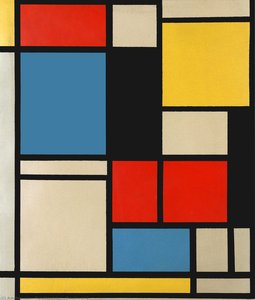
This reduction was a deliberate attempt to manifest spiritual order through visual balance. Works like Composition with Red, Blue and Yellow demonstrate this commitment to geometric purity.

New York and the Final Rhythm

The arrival of World War II forced Mondrian to flee Europe for New York City in 1940. The transition from the organic landscapes of his youth to the rigid grid of Manhattan provided a new, unexpected energy. His late works, such as Broadway Boogie Woogie, show a shift in rhythm. While he maintained his core principles, the lines began to dance with a new, syncopated movement inspired by the city's pulse and jazz music.

His death in 1944 ended a career that had fundamentally altered the trajectory of 20th-century art. He left behind a legacy that moved far beyond the canvas, influencing everything from architecture to fashion, including the famous 1965 collection by Yves Saint Laurent. His work remains a standard for anyone seeking clarity and structural integrity in a chaotic visual age.

Quick Facts

  • Title: Mill in the Sun
  • Notable elements: Primary colors, Geometric
  • Year: 1908
  • Dimensions: 114 x 87 cm
  • Influences: Dutch Impressionism
  • Artist: Piet Mondrian

Art Quiz

There is only one correct answer for each question.

Question 1:
What is the primary subject of Piet Mondrian’s ‘Mill in the Sun’?
Question 2:
The painting ‘Mill in the Sun’ is an example of which art movement?
Question 3:
What color dominates the background of ‘Mill in the Sun’?
Question 4:
Which of the following best describes Piet Mondrian's artistic philosophy as reflected in ‘Mill in the Sun’?
Question 5:
The painting utilizes a limited color palette, primarily consisting of: