Preview
 Send
Send Share
Share
 Details
 Guide
Guide

 Download
 Similars
 X-Ray
X-Ray Diaporama
 Stats
StatsChrysanthemum


 Read More
Giclée / Art Print
Museum-quality giclée or canvas print with fast production and flexible finish options. ( Buy Hand Made Painting Switch to Digital Image)




P118B $10

P118H $10

P118W $10

P438Z $10

P508JH $12

P508YH $12

P805H $10

P805Z $10

P919BZ $10

P919G $10

P919XJ $10

P959ZH $10

P968JZ $12

W106C $8

W218G $10

W218JH $8

W218Y $10

W307PJ $10

W316G $10

W316PJ $8

W316Y $10

W398PJ $8

W4111J $10

W500HY $15

W500JH $15

W692G $12

W849H $8

W940BG $15

W953PJ $8




Pick from our preset sizes that match the artwork's original proportions.

Type the width and the height you need, to fit your frame or your wall. A print can only be cut, never made bigger than the picture, so a size with a different shape loses a part of the image. We send you a digital mockup to approve before we print anything. The picture shown on this page does not show the real cut — only the mockup does.
Worldwide Delivery () in 2 weeks instead of standard 4/5 weeks. (26 October)

Free Worldwide Express Shipping

High-Quality Linen Canvas

Full Shipping Insurance

Customs Tax Refund Guarantee

True Color Matching Guarantee

100-Day Return Policy (Defects Only)

100% Money-Back Guarantee

Bulk Discount Offer
 Glass option is only available in size under 110 CM

Chrysanthemum
Giclée / Art Print
Reproduction Size
-


Total Price
$ 81
A Delicate Bloom: Unveiling Piet Mondrian’s ‘Chrysanthemum’
This exquisite black and white drawing offers a rare glimpse into an early facet of Piet Mondrian's artistic journey – a period often overshadowed by his later, iconic abstract works. Before the grids and primary colors, Mondrian honed his skills through meticulous studies of nature, and *Chrysanthemum* stands as a testament to this foundational practice. The artwork isn’t merely a botanical illustration; it is a deeply considered exploration of form, texture, and light rendered with remarkable sensitivity.Style & Technique: A Bridge Between Realism and Abstraction
Executed in what appears to be charcoal or graphite, the drawing showcases Mondrian's mastery of dry media. The style leans towards realism, yet possesses an expressive quality that hints at the artistic evolution to come. The artist’s deliberate manipulation of line weight is key: thicker lines define the flower’s structure and cast shadows, while a delicate network of thinner lines meticulously details each petal. This technique creates a rich textural experience, inviting the viewer to appreciate the chrysanthemum's complex layers. The composition, slightly off-center, introduces a dynamic energy, preventing the image from feeling static. While largely two-dimensional in perspective, subtle shading suggests an implied light source, adding depth and volume.Historical Context: Early Seeds of Modernism
Created during Mondrian’s formative years in the Netherlands (roughly between 1872-1911), *Chrysanthemum* reflects his initial engagement with the Hague School's naturalistic tradition. This period saw him painting landscapes and still lifes, as evidenced by works like *The Red Mill* and *Trees in Moonrise*. However, even within these early pieces, a growing interest in simplifying forms and exploring underlying structures is apparent – seeds of the abstract style that would later define his career. This drawing can be seen as a crucial stepping stone, demonstrating Mondrian’s developing ability to distill natural forms into their essential elements.Symbolism & Emotional Resonance
The chrysanthemum itself carries significant symbolic weight, particularly within Dutch culture and beyond. Traditionally representing longevity, joy, and optimism, the flower's inclusion suggests a hopeful or celebratory sentiment. However, the drawing’s monochromatic palette and focused composition also evoke a sense of quiet contemplation. It is not simply a depiction *of* beauty, but an exploration *into* it. The meticulous detail invites close observation, fostering a connection between viewer and subject – a moment of peaceful immersion in the natural world.Collecting & Interior Design Considerations
A reproduction of *Chrysanthemum* offers a unique opportunity to introduce a touch of artistic history into any space. Its monochromatic palette makes it incredibly versatile, complementing a wide range of interior styles—from minimalist modern to classic traditional. The drawing’s intricate detail provides visual interest without overwhelming the eye, making it ideal for bedrooms, studies, or living areas.- Its subtle elegance lends itself well to gallery walls alongside other botanical illustrations.
- Consider pairing it with furniture featuring natural materials and textures to enhance its organic feel.
- The artwork’s historical significance adds a layer of intellectual depth, sparking conversation and appreciation.
Questions & Answers
What does "Chrysanthemum" by Piet Mondrian depict?
The themes present in "Chrysanthemum" by Piet Mondrian include abstract art, floral design, geometric form, black and white, piet mondrian, de stijl, line drawing, botanical study. Together they summarize the artwork's subject matter.
Which artist is "Chrysanthemum" attributed to?
The artist behind "Chrysanthemum" is Piet Mondrian. The work is catalogued under Piet Mondrian's name.
Is "Chrysanthemum" available as a fine art print?
A print of "Chrysanthemum" by Piet Mondrian can be ordered directly on its Fine Art Print page: a fine art print on cotton canvas or archival canvas paper.
Artist Biography
The Architecture of Order
To look at a Mondrian today is to see the blueprint of modern visual culture. We encounter his logic every time we interact with a clean graphic layout or a minimalist building facade. He stripped away the unnecessary until only the essential remained. This was not an act of destruction, but one of extreme distillation. By reducing his vocabulary to straight lines, right angles, and a strict palette of red, blue, and yellow, he removed the distraction of reality to reveal a structural truth.
His early work in the Netherlands followed much more traditional paths. He began with landscapes that captured the windmills and rivers of the Dutch countryside, heavily influenced by the Hague School and Impressionism. Pieces like The Red Mill show an artist focused on naturalistic detail and the soft light of his homeland. However, even in these early years, a drive toward simplification was present. He moved through Pointillism and Fauvism, testing how much color and form could be compressed before the subject disappeared entirely.
The Parisian Shift and Neoplasticism
The move to Paris in 1912 changed everything. Encountering Cubism forced him to deconstruct objects into geometric components. He stopped trying to depict what he saw and began exploring how he saw it. This period was deeply tied to his interest in Theosophy, a mystical philosophy that sought universal principles beneath surface appearances. He believed art could express these hidden truths through pure abstraction.
By 1917, this search resulted in Neoplasticism, or "pure plastic art." Alongside Theo van Doesburg, he co-founded the De Stijl movement to promote a rigid aesthetic of horizontal and vertical lines. The rules were absolute:
- The use of primary colors: red, blue, and yellow.
- The use of primary values: black, white, and gray.
- A focus on right angles and straight lines.
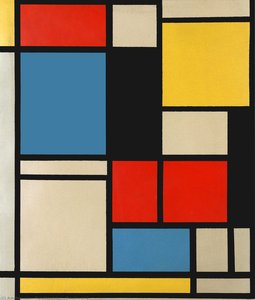
This reduction was a deliberate attempt to manifest spiritual order through visual balance. Works like Composition with Red, Blue and Yellow demonstrate this commitment to geometric purity.
New York and the Final Rhythm
The arrival of World War II forced Mondrian to flee Europe for New York City in 1940. The transition from the organic landscapes of his youth to the rigid grid of Manhattan provided a new, unexpected energy. His late works, such as Broadway Boogie Woogie, show a shift in rhythm. While he maintained his core principles, the lines began to dance with a new, syncopated movement inspired by the city's pulse and jazz music.
His death in 1944 ended a career that had fundamentally altered the trajectory of 20th-century art. He left behind a legacy that moved far beyond the canvas, influencing everything from architecture to fashion, including the famous 1965 collection by Yves Saint Laurent. His work remains a standard for anyone seeking clarity and structural integrity in a chaotic visual age.

Piet Mondrian
1872 - 1944 , Netherlands
Related Articles
De Stijl: Mastering the Art of Pure Abstraction and Geometric Harmony for the Modern Collector
Explore the profound elegance of De Stijl. Discover how Piet Mondrian and the masters of Neoplasticism utilized geometric harmony and primary colors to redefine modern abstraction. An authoritative guide for the discerning collector seeking timeless, structured beauty.
De Stijl Unlocked: The Bold Geometry of Modern Design & Pop Impact
Unlock the power of De Stijl. Explore how the bold geometry and primary colors of Mondrian and Van Doesburg revolutionized modern design, from fine art to pop culture impact. Discover how to bring this high-impact, minimalist aesthetic into your contemporary space.

Geometric Abstraction's 10 Defining Masterpieces | Art for Your Home - OriginalUniqueArt
Explore 10 defining masterpieces of Geometric Abstraction! Discover Kandinsky, Mondrian & Malevich’s iconic works. Find museum-quality art reproductions and curated decor ideas to elevate your home at OriginalUniqueArt.com.

Beyond Form & Color: Geometric Abstraction's Evolution in 20th/21st Century Art
Explore the evolution of geometric abstraction from Cubism to contemporary art. Discover key artists like Malevich & Mondrian, investment insights, and expert collecting advice at OriginalUniqueArt.
Theo van Doesburg: Pioneering De Stijl & the Evolution of Neo-Plasticism
Explore the revolutionary De Stijl movement & Neo-Plasticism with our expert guide. Discover Piet Mondrian, Theo van Doesburg, and the lasting impact of this influential art style. Learn about collecting & investing in De Stijl masterpieces.