Preview
 Send
Send Share
Share
 Details
 Guide
Guide

 Download
 Similars
 X-Ray
X-Ray Diaporama
 Stats
StatsComposition
 Etching
- WallArt
- Contemporary Abstract Expressionism
 Modern
 91.0 x 65.0 cm
 Galleria Civica di Arte Moderna e Contemporanea Torino
 Read More
The artwork displayed on this page is protected by copyright law, which means we cannot legally create or sell an identical reproduction. This protection is enforced under international agreements such as the Berne Convention and by national laws, including those outlined by the U.S. Copyright Law - Title 17.
As a respectful and legal alternative, we offer custom, hand-painted artworks inspired by the original. Our skilled and professional artists carefully study the original's style, mood, and artistic essence to create a new, unique piece that evokes the same feeling - while remaining an original creation in its own right.
This method fully complies with copyright regulations because it does not involve copying or duplicating the protected artwork. Instead, it is a creative reinterpretation - a new painting that is influenced by the original but not identical to it.
Hand Made Oil Reproduction
Hand-painted oil on canvas in your size and frame, made to order by our artists. ( Switch to Print Switch to Digital Image)




P118B $10

P118H $10

P118W $10

P438Z $10

P508JH $12

P508YH $12

P805H $10

P805Z $10

P919BZ $10

P919G $10

P919XJ $10

P959ZH $10

P968JZ $12

W106C $8

W218G $10

W218JH $8

W218Y $10

W307PJ $10

W316G $10

W316PJ $8

W316Y $10

W398PJ $8

W4111J $10

W500HY $15

W500JH $15

W692G $12

W849H $8

W940BG $15

W953PJ $8




Pick from our preset sizes that match the artwork's original proportions.

Type the width and the height you need, to fit your frame or your wall. This is hand-painted, so for a size with a different shape the artist can paint a bit more around the picture, or cut a bit — you choose. We send you a digital mockup to approve before the painting starts. The picture shown on this page does not show the real result — only the mockup does.
After order, OriginalUniqueArt.com team will email client for instructions and provide a mockup preview
Worldwide Delivery () in 3/4 weeks instead of standard 5 weeks. (22 October). No compromise on quality.

Free Worldwide Express Shipping

High-Quality Linen Canvas

Full Shipping Insurance

Customs Tax Refund Guarantee

True Color Matching Guarantee

100-Day Return Policy (Defects Only)

100% Money-Back Guarantee

Bulk Discount Offer
 Glass option is only available in size under 110 CM

Composition
Reproduction Medium
Reproduction Size
-


Total Price
$ 300
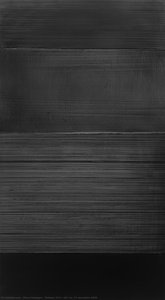
A Dialogue Between Darkness and Light
The surface of this 1957 etching and aquatint breathes with a quiet, rhythmic energy. A large black structure commands the center, acting as a heavy anchor for the eye, while smaller, overlapping forms drift around it to create a sense of depth. There is no attempt at representation here; instead, the work focuses on how light meets pigment. The layers of aquatint plates build a texture that feels both solid and suggestive. As light hits the surface, subtle variations in tonal intensity emerge, revealing that the black is far from empty. It holds a hidden radiance, a flicker of brightness caught within the deep shadows.
The interplay between these dark shapes and the surrounding space creates a tension between solidity and suggestion. One feels the weight of the central form, yet the smaller structures prevent the composition from becoming static. The work exists in a state of constant flux, where the boundaries of each shape seem to shift depending on how much light is projected onto them. It is a study of how darkness can become a luminous presence when it is forced to interact with illumination.
The Language of Outrenoir
This piece embodies the essence of Outrenoir, a method that seeks to go beyond the traditional understanding of black. Rather than treating the color as an absence or a void, the technique treats it as an active participant in the visual experience. Through the meticulous layering of textures, the artist achieves a surface that does much more than simply sit on the paper. The etching process allows for an intricate topography where light can be trapped and reflected.
The approach is deliberate and slow, mirroring a meditative rhythm rather than an impulsive gesture. There is a profound connection to the primordial spirit of prehistoric cave paintings and the heavy, silent presence of Romanesque architecture. By stripping away a conventional color palette, the work focuses entirely on the relationship between shadow and light. The black does not merely cover the surface; it transforms it, turning a monochrome space into a complex field of perception where darkness and light are interdependent elements.
Questions & Answers
Who is "Composition" suggested for as a present, and for what use?
"Composition" by Pierre Soulages is recommended as a gift for corporate gift, especially for accent. A reproduction of the artwork can be given as a present.
What is the overall mood of "Composition" by Pierre Soulages?
"Composition" by Pierre Soulages is described as calm in mood. This classification can help match the work to a setting.
Is "Composition" free of copyright?
Regarding copyright, "Composition" is still protected by copyright.
Artist Biography
Pierre Soulages: A Life in Black and Light
Pierre Soulages (1919-2022) was a French abstract painter, engraver, and sculptor. Celebrated as “the world’s greatest living artist” by François Hollande in 2014, Soulages dedicated his life to exploring the depths of black – not as an absence of color, but as a presence brimming with light and texture.
Early Life and Education
Born in Rodez, Aveyron, France, in 1919, Soulages’ artistic journey began with explorations of museums in Paris before World War II. He sought his vocation amidst the masterpieces of the past. Following military service during the war, he established a studio in Paris and debuted his work at the Salon des Indépendants in 1947. He also briefly worked as a stage set designer.
Artistic Development & The ‘Outrenoir’ Style
Soulages' artistic development was marked by a relentless pursuit of expressing light through the medium of black. He wasn’t interested in black for its somber connotations, but rather for its capacity to reflect and absorb light, creating an interplay of shadow and illumination. This led him to develop his signature style, which he termed ‘Outrenoir’ – literally “beyond black.”
He explained that Outrenoir isn't simply about the color black; it represents a different realm altogether, akin to saying "beyond the Channel" for England or "beyond the Rhine" for Germany. It signifies a space beyond conventional understanding of the color itself.
Technique and Materials
Soulages’ technique involved applying paint in thick layers, often manipulating it with tools like spoons, rakes, and rubber implements to create textured surfaces. These textures were crucial for capturing and reflecting light. He employed scraping, digging, and etching movements to achieve smooth or rough effects, disrupting the uniformity of the black surface.
In his later work, he began experimenting with varying pigment densities – mixing matte and glossy blacks – further enhancing the interplay of light and shadow. He often preferred suspending his paintings like walls in the middle of a room, believing they should “look inside of us” rather than acting as windows to another world.
Major Achievements & Recognition
- 1979: Elected as a foreign honorary member of the American Academy of Arts and Letters.
- 1987-1994: Created 104 stained glass windows for the Romanesque Abbey Church Sainte-Foy in Conques, Aveyron – a monumental achievement.
- 2001: First living artist invited to exhibit at the State Hermitage Museum of St. Petersburg and the Tretyakov Gallery of Moscow.
- 2007: Musée Fabre in Montpellier dedicated an entire room to his work, showcasing a significant donation from the artist.
- 2009-2010: A major retrospective held at the Centre National d'Art et de Culture Georges Pompidou in Paris.
- 2014: Musée Soulages opened in Rodez, France – a museum dedicated to permanently displaying his works and hosting contemporary exhibitions. He donated 500 pieces to the museum.
Influences & Legacy
Soulages’ fascination with black stemmed from an early interest in prehistoric art and a desire for purity and primal expression. He saw parallels between his work and the cave paintings of our ancestors, created using charcoal on dark rock surfaces.
His influence extends to numerous contemporary artists who explore abstraction, texture, and the expressive potential of limited color palettes. He left behind a legacy that challenges conventional perceptions of color and light, demonstrating that even in darkness, profound beauty and luminosity can be found. He is considered a pivotal figure in Tachism, an informal style of abstract expressionism.
Historical Significance
Pierre Soulages’ work represents a significant contribution to post-war abstract art. His unwavering dedication to exploring the nuances of black and light established him as a unique and influential voice in the artistic landscape, captivating audiences worldwide for over seven decades.

Pierre Soulages
1919 -
Quick Facts
- Name: Pierre Soulages
- Movement: Tachism, Abstract Expressionism, Outrenoir
- Birth Date: 1919
- Death Date: 2022
- Birth Place: Rodez, Aveyron, France
- Nationality: French
- Date Of Birth: 1919
- Notable Works:
- Sainte-Foy stained glass windows
- Polyptyques
Related Articles

Top 25 Masterpieces by Christian Noiret: A Journey Through Abstract Texture and Light
Immerse yourself in the profound abstraction of Christian Noiret. Explore 25 iconic works defined by texture, light, and chromatic harmony. Find museum-quality art reproductions and curated decor inspiration for your space. Discover all masterpieces on OriginalUniqueArt.com.

Top 25 Masterpieces by Christian Noiret: A Journey Through Abstract Texture and Light
Immerse yourself in the textured world of Christian Noiret. Explore our curated list of 25 iconic abstract masterpieces, celebrating light, color, and form. Find museum-quality art reproductions for your space. Discover all masterpieces on OriginalUniqueArt.com.

Top 25 Masterpieces by Christian Noiret: A Journey Through Abstract Texture and Light
Immerse yourself in the textured world of Christian Noiret. Explore our curated selection of 25 iconic abstract masterpieces, celebrating light, color, and modern form. Find museum-quality art reproductions for your space. Discover all masterpieces on OriginalUniqueArt.com.

Top 25 Masterpieces by Christian Noiret: A Journey Through Abstract Texture and Light
Immerse yourself in the profound abstraction of Christian Noiret. Explore 25 iconic works defined by texture, light, and chromatic harmony. Find museum-quality art reproductions and curated decor inspiration for your space. Discover all masterpieces on OriginalUniqueArt.com.

25 Masterpieces of David Moreau: The Ultimate Guide to Textured Abstraction
Immerse yourself in the tactile world of David Moreau. Explore our curated selection of 25 iconic textured artworks, celebrating his mastery of impasto and light. Find museum-quality reproductions for your collection. Discover all masterpieces on OriginalUniqueArt.com.