Text size

() ·

A painting made for you, by hand

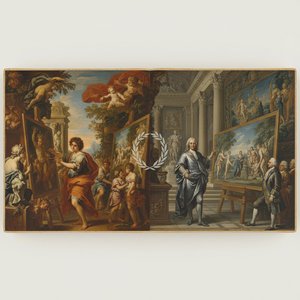
Self-Portrait

Hand Made Oil Reproduction

Hand-painted oil on canvas in your size and frame, made to order by our artists. ( Switch to Print Switch to Digital Image)

Collectible Description

Magnificent Baroque self-portrait by Pierre Mignard (1690). Admire the opulent details & classical grace of this French masterpiece. Hand-painted reproduction available.

Artist Biography

Explore Pierre Mignard (1612-1695), a renowned French Baroque painter celebrated for his elegant portraits & captivating religious/mythological scenes. Discover his legacy!

from ·

Chapter 1

How large should it be?

Slide to change the size; the picture on the left shows the frame at its real width. The proportions of the original are kept.

Standard
custom
CM
INCH

Pick from our preset sizes that match the artwork's original proportions.

width
height

Type the width and the height you need, to fit your frame or your wall. This is hand-painted, so for a size with a different shape the artist can paint a bit more around the picture, or cut a bit — you choose. We send you a digital mockup to approve before the painting starts. The picture shown on this page does not show the real result — only the mockup does.

Chapter 2

How should it arrive?

Choose the edges of the stretched canvas

Choose your frame

Corner sample of the WhiteWrap canvas edge finish, stretched on solid wood bars
White $1
Corner sample of the BlurSideWrap canvas edge finish, stretched on solid wood bars
Blurside $1
Corner sample of the ExtendedWrap canvas edge finish, stretched on solid wood bars
Extended $1
Corner sample of the P118B picture frame: moulded polystyrene, 5 cm wide and 3 cm thick
P118B $10
Corner sample of the P118H picture frame: moulded polystyrene, 5 cm wide and 3 cm thick
P118H $10
Corner sample of the P118W picture frame: moulded polystyrene, 5 cm wide and 3 cm thick
P118W $10
Corner sample of the P438Z picture frame: moulded polystyrene, 5.5 cm wide and 3.5 cm thick
P438Z $10
Corner sample of the P508JH picture frame: moulded polystyrene, 7 cm wide and 3.5 cm thick
P508JH $12
Corner sample of the P508YH picture frame: moulded polystyrene, 7 cm wide and 3.5 cm thick
P508YH $12
Corner sample of the P805H picture frame: moulded polystyrene, 5 cm wide and 3.5 cm thick
P805H $10
Corner sample of the P805Z picture frame: moulded polystyrene, 5 cm wide and 3.5 cm thick
P805Z $10
Corner sample of the P919BZ picture frame: moulded polystyrene, 7 cm wide and 3.5 cm thick
P919BZ $10
Corner sample of the P919G picture frame: moulded polystyrene, 7 cm wide and 3.5 cm thick
P919G $10
Corner sample of the P919XJ picture frame: moulded polystyrene, 7 cm wide and 3.5 cm thick
P919XJ $10
Corner sample of the P959ZH picture frame: moulded polystyrene, 5 cm wide and 3 cm thick
P959ZH $10
Corner sample of the P968JZ picture frame: moulded polystyrene, 6 cm wide and 4 cm thick
P968JZ $12
Corner sample of the W106C picture frame: solid wood, 5 cm wide and 3 cm thick
W106C $8
Corner sample of the W218G picture frame: solid wood, 5 cm wide and 3 cm thick
W218G $10
Corner sample of the W218JH picture frame: solid wood, 5 cm wide and 3 cm thick
W218JH $8
Corner sample of the W218Y picture frame: solid wood, 5 cm wide and 3 cm thick
W218Y $10
Corner sample of the W307PJ picture frame: solid wood, 6 cm wide and 3 cm thick
W307PJ $10
Corner sample of the W316G picture frame: solid wood, 6 cm wide and 3 cm thick
W316G $10
Corner sample of the W316PJ picture frame: solid wood, 6 cm wide and 3 cm thick
W316PJ $8
Corner sample of the W316Y picture frame: solid wood, 6 cm wide and 3 cm thick
W316Y $10
Corner sample of the W398PJ picture frame: solid wood, 5 cm wide and 3 cm thick
W398PJ $8
Corner sample of the W4111J picture frame: solid wood, 6.5 cm wide and 3.5 cm thick
W4111J $10
Corner sample of the W500HY picture frame: solid wood, 7 cm wide and 5 cm thick
W500HY $15
Corner sample of the W500JH picture frame: solid wood, 7 cm wide and 5 cm thick
W500JH $15
Corner sample of the W692G picture frame: solid wood, 8 cm wide and 4 cm thick
W692G $12
Corner sample of the W849H picture frame: solid wood, 5 cm wide and 3 cm thick
W849H $8
Corner sample of the W940BG picture frame: solid wood, 7.5 cm wide and 4.5 cm thick
W940BG $15
Corner sample of the W953PJ picture frame: solid wood, 6 cm wide and 3.5 cm thick
W953PJ $8
Corner sample of the H24-GOLD picture frame: carved wood with gesso, 10 cm wide and 6 cm thick
H24-GOLD $30
Corner sample of the H24-SILVER picture frame: carved wood with gesso, 10 cm wide and 6 cm thick
H24-SILVER $30
Corner sample of the H36-GOLD picture frame: carved wood with gesso, 15 cm wide and 6.5 cm thick
H36-GOLD $45
Corner sample of the H36-SILVER picture frame: carved wood with gesso, 15 cm wide and 6.5 cm thick
H36-SILVER $45
Frame preview
Framed

Moulding: . Overall size with the frame: .

Chapter 3

Who paints it, and should anything change?

Examples of what can be changed: Replace face with customer photo; Add pet (e.g., replace cat with dog); Include hidden message in background; Change background landscape or elements.
After order, OriginalUniqueArt.com team will email client for instructions and provide a mockup preview

Worldwide Delivery () in 3/4 weeks instead of standard 5 weeks. (2 November). No compromise on quality.

Chapter 4

The finishing touches

A nameplate, as in a museum?

Engraved Bronze Plaque Details

This elegant plaque features the artist's name and the title of the artwork, finely engraved for a timeless presentation.

It is made from bronze with a refined, elegant finish. The text is precisely laser-engraved for a sharp and permanent result. Measuring 9x2 cm, the plaque is compact yet easy to read. It's built to be durable and scratch-resistant, offering a professional, museum-quality look. Mounting is simple thanks to the included adhesive backing.

Transparent Acrylic Plaque Details

The plaque includes essential engraved details such as the artist's name, the title of the artwork, the date it was created, the type of media used-like oil on canvas or watercolor-a brief description of the piece, and a QR code that links to the complete artwork information.

It is crafted from clear acrylic, offering a sleek, modern appearance. The text is UV-engraved in black to ensure strong visual contrast. With a size of 10x15 cm, it ensures optimal readability. It comes equipped with two metal hooks for secure wall mounting. The plaque is designed to be weather-resistant, making it suitable for various environments, and it includes interactive features that work seamlessly with smartphone scanning.

Black Acrylic Plaque Details

This elegant plaque includes engraved information such as the artist's name, the title of the artwork, the date it was created, the type of media used (like oil on canvas or watercolor), a short description of the artwork, and a QR code for quick access to more information.

The plaque itself is made from refined black acrylic with a premium finish. The text is laser-engraved in white for high contrast and readability. Its size is 10x15 cm, designed to be easy to read. It comes with two metal hooks for professional mounting. The design is sleek and fits any interior style. It is also weather-resistant and durable, with built-in digital integration for mobile compatibility.

A protective varnish?

When do you need it?

Chapter 5

Your painting, as you ordered it

Self-Portrait

Reproduction Medium

Reproduction Size

-

Elite Senior Artist

More detail, finesse, and extra production time

-

Reproduction Frame

-

-

For artworks or reproductions larger than 105 cm (approximately 41 inches) on any side, the frame will be shipped as a kit, disassembled. This method ensures safe delivery and prevents damage during transport.

Professional assembly required - this is not a DIY product.
The kit must be assembled and the canvas stretched by an experienced professional framer, using wood glue (not supplied), a canvas stretching plier and clamps to hold the bars square while the glue dries. Incorrect assembly or uneven canvas tension can permanently damage the artwork and is not covered by our warranty.

  • All solid wood bars are included, precisely cut to size.

  • Assembled with the screws provided, plus wood glue for the corner joints, which is not supplied and must be sourced by your framer.

  • Professional tools are required and not included: a canvas stretching plier (tensioner) and clamps to hold the bars square while the glue dries.

Important:
The corner joints require wood glue, the bars must be held with clamps until the glue is fully dry, and tightening the canvas on the assembled frame requires a canvas stretching plier. None of these are included in the kit. Please arrange an experienced professional framer before ordering this size.

Nameplate

-

-

Protective Varnish

Glossy Varnish (enhances colors, protects against light/moisture)

-

Customize My Artwork

Examples of what can be changed: Replace face with customer photo; Add pet (e.g., replace cat with dog); Include hidden message in background; Change background landscape or elements.

-

Urgent

Worldwide Delivery () in 3/4 weeks instead of standard 5 weeks. (2 November). No compromise on quality.

-

Express Shipping

Worldwide Delivery () in 5 weeks. (9 November).

Included

Total Price

$ 300

Total Price $ 300

Glass option is only available in size under 110 CM

Included with every order

  • Free Worldwide Express Shipping
  • High-Quality Linen Canvas
  • Full Shipping Insurance
  • Customs Tax Refund Guarantee
  • True Color Matching Guarantee
  • 100-Day Return Policy (Defects Only)
  • 100% Money-Back Guarantee
  • Bulk Discount Offer

A Glimpse of Baroque Grandeur: Self-Portrait by Pierre Mignard

Pierre Mignard’s 1690 “Self-Portrait” is more than just a likeness; it's a meticulously crafted tableau vivant, a window into the world of a prominent figure in 17th-century French art. This painting, measuring a substantial 235 x 188 cm, immediately commands attention with its opulent details and carefully orchestrated composition. It’s a testament to Mignard's skill as a portraitist and his deep understanding of Baroque aesthetics – a style characterized by dramatic lighting, rich textures, and an emphasis on theatricality.

The subject himself is presented in a pose of studied elegance, seated within a richly appointed interior. He’s dressed in a flamboyant gown, complete with a sweeping cape and a gleaming gold sash, indicative of the status and wealth he commanded. A carefully styled wig frames his face, while a meticulously groomed mustache adds to the air of sophistication. The details are exquisite: the velvet of the chair, the sheen of the fabrics, the subtle play of light on polished surfaces – all contribute to an overwhelming sense of luxury and refinement. Notably, Mignard’s gaze is direct and engaging, inviting the viewer into his world.

The Setting: A Stage for Self-Representation

Beyond the central figure, the background subtly enhances the portrait's narrative. Two chairs – one occupied by Mignard himself, the other positioned to his left – create a sense of intimacy and contemplation. A dining table, adorned with a simple bowl, suggests an appreciation for the finer things in life, while three scattered vases introduce a touch of decorative flourish, echoing the Baroque love of ornamentation. These elements aren’t merely decorative; they contribute to a carefully constructed atmosphere that reinforces Mignard's position as a man of taste and refinement.

The painting’s palette is rich and warm, dominated by deep reds, golds, and browns – colors associated with wealth, power, and religious devotion. Mignard masterfully employs chiaroscuro, the dramatic contrast between light and shadow, to sculpt the forms of his subject and create a sense of depth and volume. This technique, characteristic of the Baroque period, draws attention to key features and adds an element of theatricality to the scene.

A Master’s Hand: Technique and Influences

Mignard's style is a fascinating blend of influences. His early training under Jean Boucher instilled in him a foundational understanding of Mannerist principles, particularly his sensitivity to form and composition. However, his subsequent studies with Simon Vouet exposed him to the classical ideals championed by the Venetian master, influencing his use of perspective and idealized forms. Crucially, his time in Rome allowed him to absorb the grandeur of Italianate art, which he then skillfully integrated into his own distinctive style.

The painting’s resemblance to Largillère's portrait of Charles Le Brun is particularly noteworthy. This suggests a conscious effort on Mignard’s part to establish himself within the Parisian artistic circles and perhaps even subtly engage in a rivalry with his contemporary. It’s a deliberate gesture, highlighting both his technical skill and his awareness of the prevailing artistic landscape.

A Legacy of Elegance: Historical Context

Created in 1690, “Self-Portrait” reflects the flourishing Baroque period in France – an era marked by royal patronage, religious fervor, and a fascination with luxury. Mignard’s success as a portraitist was directly linked to his ability to capture the status and personality of his subjects, often members of the aristocracy and clergy. His work served not only as a visual record but also as a powerful statement of social standing.

As an art historian, it's important to note that Mignard’s life was intertwined with political intrigue and artistic competition. His rivalry with Charles Le Brun, the Premier Peintre du Roi, shaped his career and ultimately led to his appointment as director of the Académie royale de peinture et de sculpture. This painting, therefore, offers a glimpse into not only the artist's personal ambitions but also the complex dynamics of the French art world during this pivotal period.

OriginalUniqueArt is proud to offer high-quality hand-painted reproductions of Pierre Mignard’s “Self-Portrait,” allowing you to experience the beauty and artistry of this remarkable masterpiece in your own home or studio. Explore our collection today and bring a touch of Baroque grandeur into your space.

Questions & Answers

Does "Self-Portrait" show strong light-dark contrasts?

"Self-Portrait" by Pierre Mignard shows a serene contrast between its light and dark areas.

What medium is "Self-Portrait" by Pierre Mignard executed in?

The medium of "Self-Portrait" by Pierre Mignard is oil on canvas. Reproductions aim to render the appearance of this technique.

What type of artwork is "Self-Portrait" by Pierre Mignard?

"Self-Portrait" is a wall art piece.

More about this painting

Preview AR preview Switch to Print Switch to Digital Image Send
Details Guide Add to favorites Download Similars X-Ray Diaporama Q&A Stats

In numbers

  • 1690the year it was painted
  • 29frames to choose from
  • standard sizes, in its own proportions
  • 5weeks to paint and deliver it
Pierre Mignard

Pierre Mignard

1612 - 1695, France

Quick facts about Pierre Mignard

  • Artistic Movement Or Style: Baroque
  • Artists Or Movements Influenced By This Artist: ['French portraitists']
  • Artists Who Influenced This Artist:
    • Simon Vouet
    • Annibale Carracci
  • Date Of Birth: 1612
  • Date Of Death: 1695
  • Full Name: Pierre Mignard
  • Nationality: French
  • Notable Artworks:
    • God the Father
    • Virgin of the Grapes
    • La Fortune
  • Place Of Birth: Troyes, France

Artist Biography

A Life Immersed in Baroque Splendor

Pierre Mignard, born in Troyes, France, in 1612, was a pivotal figure in the French Baroque painting scene, though often overshadowed by his contemporary and rival, Charles Le Brun. From humble beginnings within a family of artisans, Mignard demonstrated an early artistic inclination that led him to Bourges for initial training under Jean Boucher, a painter steeped in Mannerist traditions. This foundational period instilled in him a sensitivity to form and composition, which he further refined through diligent copying of works at the Château de Fontainebleau – a veritable schoolroom of established artistic principles. Crucially, his studies continued within the Parisian studio of Simon Vouet, a master who championed classical influences and possessed extensive international connections. These formative experiences laid the groundwork for Mignard’s distinctive style, one that would blend Italianate grandeur with French elegance.

Roman Reverie and the Birth of “Mignardises”

A defining chapter in Mignard's artistic journey began in 1635 with his relocation to Rome. For approximately twenty-two years, he immersed himself in the vibrant heart of Italian Baroque art. It was here that he truly blossomed, gaining renown for his tender and captivating depictions of the Madonna and Child – images so charming and delicate they became affectionately known as “mignardises,” a testament to their sweet and refined quality. The influence of Italian masters is palpable in his Roman works; dramatic compositions, masterful use of light and shadow, and an overall sense of theatricality characterize this period. Beyond religious commissions, Mignard honed his technical skills through reproductive engraving, meticulously copying the works of Annibale Carracci, deepening his understanding of artistic principles. His talent extended to portraiture as well, securing commissions from prominent Roman figures – popes, cardinals, and members of the elite – establishing a reputation for capturing not only likeness but also character with both skill and grace.

Return to Paris and Artistic Contention

Around 1657, Mignard returned to Paris, summoned by Cardinal Mazarin, marking his entry into the competitive world of French court painting. He quickly gained patronage from influential figures, including King Louis XIV himself, yet his ascent coincided with the dominance of Charles Le Brun, who held the prestigious title of *peintre du roi*. This inevitably led to a protracted and often bitter rivalry between the two artists. Mignard actively opposed the authority of the Académie Royale de Peinture et Sculpture, distancing himself from its established hierarchy and advocating for artistic independence. Despite this conflict, he flourished as a portraitist, immortalizing prominent individuals such as Turenne, Molière, Bossuet, and Madame de Maintenon on canvas. His portraits are celebrated not merely for their accurate representation but also for the psychological insight they reveal – capturing the essence of his sitters with remarkable sensitivity.

Legacy and Lasting Influence

Pierre Mignard’s artistic legacy rests primarily upon his exquisite portraits, admired for their elegance, meticulous detail, and ability to convey character. His religious works, particularly those depicting the Madonna and Child created during his Roman period, also hold a significant place in art history. Following Le Brun's death in 1690, Mignard assumed many of his former positions, demonstrating the respect he commanded within artistic circles – a testament to his enduring talent. While often overshadowed by Le Brun’s greater fame and official recognition, Mignard remains an important figure in French Baroque painting. He represents a distinct stylistic approach characterized by classical grace, refined technique, and a meticulous attention to detail that set him apart. His influence can be seen in subsequent generations of French portraitists who sought to emulate his ability to capture both the physical likeness and inner life of their subjects. Mignard le Romain, as he was known, left behind a body of work that continues to captivate and inspire, offering a glimpse into the opulent world of 17th-century France and the artistry of a master portraitist.

Quick Facts

  • Subject or theme: Self-portraiture
  • Medium: Oil on canvas
  • Year: 1690
  • Dimensions: 235 x 188 cm
  • Artist: Pierre Mignard
  • Movement: Baroque

Art Quiz

There is only one correct answer for each question.

Question 1:
What is the primary subject depicted in Pierre Mignard’s ‘Self-Portrait’?
Question 2:
The painting features several decorative elements. What is NOT depicted in the scene?
Question 3:
Based on the description, what is a notable feature of Mignard’s attire?
Question 4:
Pierre Mignard’s style is often described as blending which two influences?
Question 5:
In what century was ‘Self-Portrait’ created?