Preview
 Send
Send Share
Share
 Details
 Guide
Guide

 Download
 Similars
 X-Ray
X-Ray Diaporama
 Stats
StatsThe Sad Message
 Oil On Canvas
- WallArt
- Romanticism
 1838
1838- 19th Century
 37.0 x 30.0 cm
 Historisches Museum der Stadt Wien
 Read More
Giclée / Art Print
Museum-quality giclée or canvas print with fast production and flexible finish options. ( Buy Hand Made Painting Switch to Digital Image)




P118B $10

P118H $10

P118W $10

P438Z $10

P508JH $12

P508YH $12

P805H $10

P805Z $10

P919BZ $10

P919G $10

P919XJ $10

P959ZH $10

P968JZ $12

W106C $8

W218G $10

W218JH $8

W218Y $10

W307PJ $10

W316G $10

W316PJ $8

W316Y $10

W398PJ $8

W4111J $10

W500HY $15

W500JH $15

W692G $12

W849H $8

W940BG $15

W953PJ $8




Pick from our preset sizes that match the artwork's original proportions.

Type the width and the height you need, to fit your frame or your wall. A print can only be cut, never made bigger than the picture, so a size with a different shape loses a part of the image. We send you a digital mockup to approve before we print anything. The picture shown on this page does not show the real cut — only the mockup does.
Worldwide Delivery () in 2 weeks instead of standard 4/5 weeks. (27 October)

Free Worldwide Express Shipping

High-Quality Linen Canvas

Full Shipping Insurance

Customs Tax Refund Guarantee

True Color Matching Guarantee

100-Day Return Policy (Defects Only)

100% Money-Back Guarantee

Bulk Discount Offer
 Glass option is only available in size under 110 CM

The Sad Message
Giclée / Art Print
Reproduction Size
-


Total Price
$ 81
A Poignant Encounter in the Shadows of History
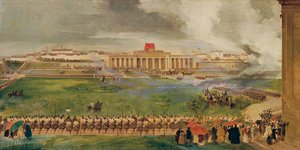
In the quiet, dimly lit interior of Peter Fendi’s 1838 masterpiece, The Sad Message, time seems to suspend itself, capturing a moment of profound human vulnerability. The painting presents a heart-wrenching domestic tableau, where the heavy atmosphere of mid-19th-century Romanticism is palpable. At the center of this intimate composition, a distraught mother cradles her infant child, her face etched with the unmistakable shadows of grief. Before her stands a uniformed soldier, his presence introducing the harsh intrusion of the outside world into the sanctity of the home. As he presents a small, enigmatic object, the viewer is drawn into a narrative of loss and sacrifice, feeling the weight of an unspoken tragedy that connects the domestic sphere to the broader, often violent, currents of military conflict.
The emotional resonance of the work is amplified by Fendi’s masterful command of light and shadow. Utilizing a technique reminiscent of the dramatic chiaroscuro found in classical traditions, the artist allows light to spill from an unseen source, illuminating the textures of the mother's skin and the heavy folds of her garments while casting much of the room into deep, somber obscurity. This interplay of light does more than create depth; it serves as a metaphor for the flickering hope struggling against the encroaching darkness of despair. The muted palette—dominated by earthy ochres, deep browns, and melancholic grays—anchors the scene in a sense of historical realism, while subtle punctuations of red in the soldier’s uniform and the mother's dress draw the eye to the focal points of the unfolding drama.
The Artistry of Biedermeier Realism
Beyond its narrative power, The Sad Message stands as a testament to Peter Fendi’s technical virtuosity and his role as a pioneer of the Viennese Biedermeyer style. The painting exhibits a meticulous attention to detail that invites prolonged contemplation. One can almost feel the rough texture of the wooden walls and the delicate softness of the infant's skin through Fendi’s precise, layered brushwork. This level of realism serves to ground the heightened emotionalism of the subject matter, making the tragedy feel not like a distant myth, but a tangible, lived experience. The composition is tightly framed, stripping away any peripheral distractions to force an intimate confrontation between the viewer and the subjects' sorrow.
For the discerning collector or interior designer, this artwork offers much more than mere decoration; it provides a profound focal point for spaces that value depth, history, and emotional intelligence. A high-quality reproduction of this piece brings with it a sense of storied elegance and a conversation-starting gravity. Whether placed in a study filled with leather-bound books or as a contemplative centerpiece in a contemporary gallery-style living room, The Sad Message commands attention through its ability to evoke empathy and wonder. It is an invitation to reflect on the enduring human condition—the resilience of love in the face of inevitable hardship.
Questions & Answers
How can I view "The Sad Message" by Peter Fendi as a slideshow?
The diaporama of "The Sad Message" can be watched on the artwork's Diaporama page.
Is "The Sad Message" by Peter Fendi in the public domain?
Regarding copyright, "The Sad Message" is in the public domain - its copyright has expired.
What atmosphere does "The Sad Message" have?
The overall mood of "The Sad Message" by Peter Fendi is dramatic. The mood describes the general atmosphere of the work.
Artist Biography
Peter Fendi: A Pioneer of Viennese Biedermeier
Peter Fendi, born in Vienna’s heart on September 4th, 1796, was more than just a painter; he was a pivotal figure in the development of Austrian art during the Biedermeier period. His life, marked by an early physical challenge – a fall from a changing table as an infant that left him with lasting spinal issues – ironically fueled a remarkable talent for drawing and ultimately shaped his artistic vision. His father, a schoolmaster, recognized this innate ability, enrolling young Peter at the prestigious St. Anna’s Academy of Fine Art in 1810. There, under the tutelage of esteemed artists like Johann Martin Fischer, Hubert Maurer, and Johann Baptist von Lampi the Elder, Fendi honed his skills, laying the foundation for a prolific career spanning oil paintings, watercolors, prints, etchings, lithographs, and even wood carving. Fendi’s early professional life began at the Imperial Gallery of Coins and Antiquities in 1818, where he served as a draughtsman and engraver under Joseph Barth, an influential art collector and the personal ophthalmologist to Emperor Joseph II. This position provided invaluable access to artistic circles and exposed him to the meticulous detail demanded by imperial commissions. A significant milestone arrived in 1821 when Fendi received a gold medal for his oil painting *Vilenica*, solidifying his reputation within the Viennese art scene. This recognition led to election as a member of the Academy of Fine Arts Vienna in 1836, further cementing his standing amongst his peers.A Dutch Influence and Venetian Inspiration
Fendi’s artistic style was deeply influenced by two distinct yet complementary sources: the Dutch masters and the Italian Renaissance. The realism and genre scenes prevalent in the works of artists like Adriaen Brouwer, Adriaen van Ostade, and Rembrandt resonated profoundly with Fendi, shaping his depictions of everyday life – bustling marketplaces, tavern scenes, and intimate domestic moments. These paintings are characterized by a keen observation of human behavior, often imbued with a subtle sense of humor or social commentary. Simultaneously, Fendi’s journey to Venice in 1821 proved transformative. Immersed in the opulent art collections of Giovanni Bellini, Tintoretto, Titian, and Paolo Veronese, he absorbed their dramatic compositions, rich colors, and masterful use of light – elements that would later infuse his own work with a sense of grandeur and theatricality.Lithographic Innovation and Portraiture
Beyond traditional painting techniques, Fendi was a true innovator in the field of lithography. His multicolored prints, particularly those produced in the 1830s and 40s, were groundbreaking for their time, demonstrating remarkable technical skill and artistic sensitivity. These prints weren’t merely reproductions; they were independent works of art, often depicting scenes from Viennese life with a vibrant palette and dynamic composition. Furthermore, Fendi was a highly sought-after portraitist, capturing the likenesses of both nobles and commoners alike. His portraits are notable for their psychological depth and ability to convey the personality of his subjects – a testament to his keen eye and understanding of human character. Notably, he engraved a series of five Austrian banknotes issued in 1841, showcasing his versatility as an engraver.Legacy and Artistic Significance
Peter Fendi’s legacy extends far beyond the individual artworks that bear his signature. He played a crucial role in shaping the Biedermeier aesthetic – characterized by its intimate scale, realistic depiction of everyday life, and subtle social commentary. His influence can be seen in the works of subsequent generations of Austrian artists. His meticulous attention to detail, combined with his innovative approach to lithography, cemented his place as one of the most important figures of the Biedermeier period. Today, Fendi’s paintings are preserved in prestigious collections such as the Albertina Museum, the Belvedere Gallery, and the Prince of Liechtenstein's collection in Vaduz, ensuring that his artistic contributions continue to be appreciated and studied for generations to come. His work offers a valuable glimpse into 19th-century Austrian society, capturing both its beauty and its complexities with remarkable skill and sensitivity.
Peter Fendi
1796 - 1842 , Austria
Quick Facts
- Full Name: Peter Fendi
- Nationality: Austrian
- Date Of Birth: 1796
- Date Of Death: 1842
- Place Of Birth: Vienna, Austria
- Notable Artworks:
- Princesses Elise & Fanny Liechtenstein
- The rise
- The Sad Message
- Artistic Movement Or Style: Biedermeier
- Artists Who Influenced This Artist:
- Rembrandt
- Adriaen Brouwer
- Giovanni Bellini
- Artists Or Movements Influenced By This Artist:
- Dutch painters
- Italian Renaissance
Related Articles

Oil on Canvas: A Historical & Technical Exploration of a Timeless Artistic Medium
Explore the rich history & enduring techniques of oil painting on canvas. Discover the science behind its longevity, conservation practices, and contemporary relevance. Expert insights for art enthusiasts.
19th Century Masterpieces: 10 Paintings That Defined an Era | OriginalUniqueArt
Journey through 19th century art with OriginalUniqueArt! Explore 10 iconic paintings – from Monet & Renoir to Courbet – and discover the stories behind Romanticism, Realism & Impressionism. Find museum-quality reproductions for your home decor. Explore the full collection online!

The Enduring Legacy of Oil on Canvas: Technique, History & Aesthetic Impact
Explore the rich history & techniques of oil painting – from Renaissance masters to Impressionism. Discover pigments, layering methods, and why this timeless medium endures. Expert insights for artists & art enthusiasts.

The Enduring Power of Painting: A Historical & Contemporary Exploration of Form and Emotion
Explore the rich history & enduring techniques of oil painting with OriginalUniqueArt. Discover masterpieces, learn about art collecting, and find authentic handmade reproductions crafted by skilled artists.

Romantic Realism's Finest: 10 Masterpieces for Your Home | OriginalUniqueArt
Explore 10 defining masterpieces of Romantic Realism! Discover Courbet, Millet & Daumier's powerful paintings—capturing emotion and social realities. Find museum-quality reproductions for your home at OriginalUniqueArt.com.