 Preview
 Send
Send Share
Share
 Details
 Guide
Guide

 Download
 Similars
 X-Ray
X-Ray Diaporama
 Q&A
Q&A Stats
StatsEntry into Jerusalem

- 112.0 x 127.0 cm


 Read More
Get a print-ready file that goes far beyond the web preview. Every digital image we sell comes from a high-resolution master in our stock database — usually 5,000 to 15,000 pixels wide — so you can print large, crop tightly, or reproduce fine detail with confidence.
No file leaves our studio untouched. A digital expert checks the colors against the original painting and corrects them if needed, then improves clarity and detail with professional retouching tools — always staying faithful to the artist's brushwork and style. The result is an image that looks like the painting, not like a filtered scan.
You approve before you're done: our expert sends the image by e-mail within 72 hours for your review. Not satisfied? Ask for improvements or corrections, or request a refund if the quality falls short.
This is the quality relied on by publishers, design studios, galleries and print shops.
Digital Image
Download a high-resolution file for personal display, printing, and creative projects. ( Switch to Print Buy Hand Made Painting)
Included in Every Digital Image Order
Expert Digital Delivery, Guaranteed
When you choose OriginalUniqueArt.com, you're not just getting an image - you're receiving a professionally enhanced digital artwork, crafted with precision and backed by a satisfaction guarantee. Here's everything that comes with your order, automatically:

Fast Email Delivery
Your high-resolution digital image file will be emailed to you within 72 hours of ordering - ready for immediate use.

AI-Enhanced Digital File
Your artwork is professionally optimized using advanced AI tools and manual editing, ensuring maximum detail, clarity, and color accuracy.

Free Lifetime Re-Delivery
Accidentally deleted or lost your file? No worries - we'll resend it to you anytime, free of charge.

No Import Fees - Ever
Enjoy your artwork instantly with zero customs, duties, or delivery fees - digital downloads are always tax-free.

Color Accuracy Guarantee
We ensure your digital image reflects the original colors as closely as possible using professional tools and color management.

100-Day Satisfaction Guarantee
If you're not satisfied with your digital image, we'll revise it or refund 100% within 100 days - no questions asked.

100% Money-Back Guarantee
Not satisfied? Get a full refund within 100 days of receiving your digital file - no questions asked.

Bulk Order Discounts
Buy 3 images, save 10% - Buy 5, save 15% - Buy 10+, save 20%. Great for creative projects, galleries, and agencies.
The Grand Entrance: Pedro Orrente’s “Entry into Jerusalem”
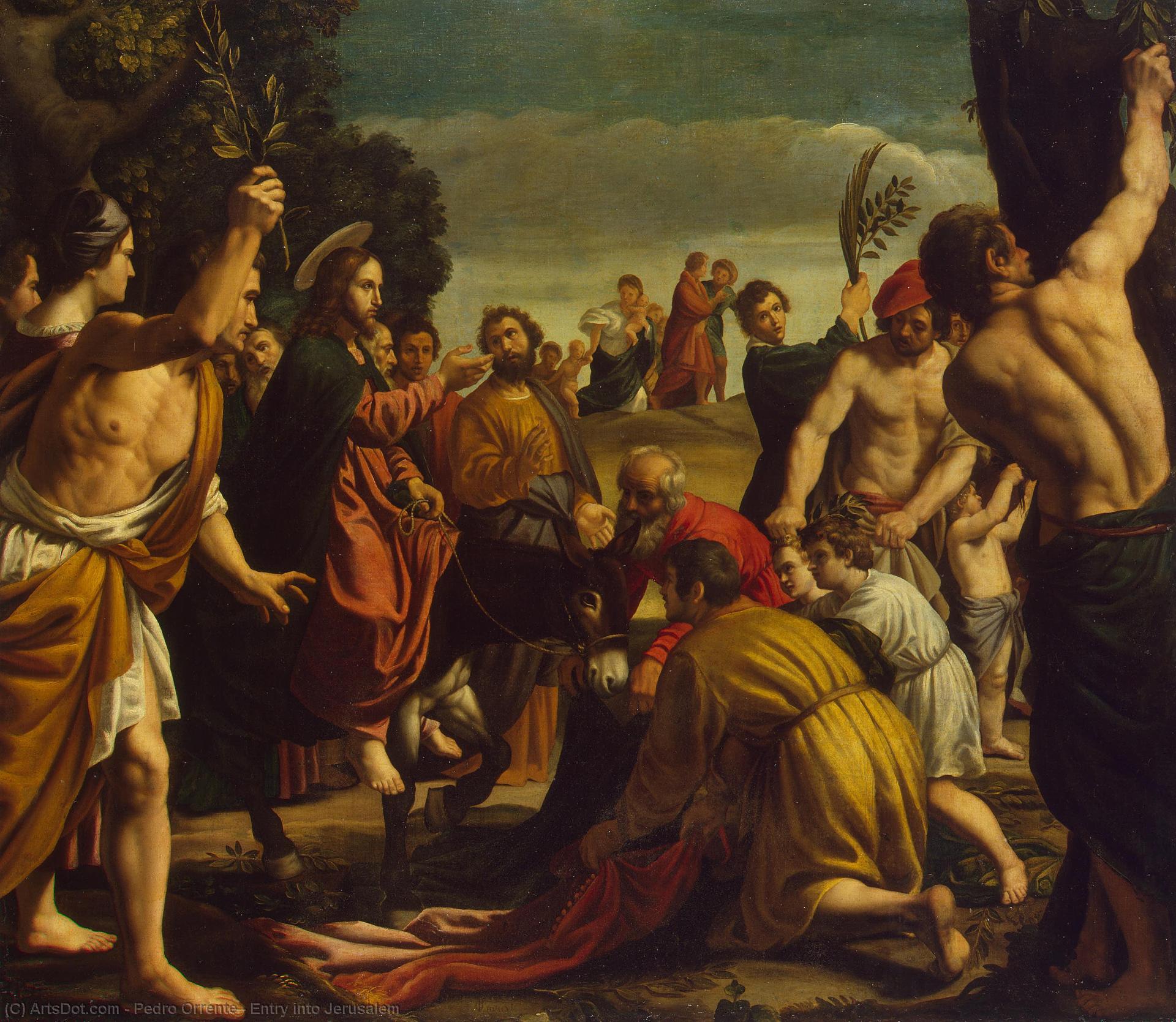
Pedro Orrente's "Entry into Jerusalem," painted around 1620, isn’t merely a depiction of a biblical event; it’s a carefully constructed tableau brimming with religious fervor and the nascent naturalism that would define his artistic legacy. This oil-on-panel work, now meticulously reproduced for OriginalUniqueArt.com, transports us to a pivotal moment – the arrival of Jesus in Jerusalem – rendered not as a distant theological abstraction but as a vibrant, deeply human scene. Measuring 112 x 127 cm, the painting commands attention with its rich palette and dynamic composition, immediately drawing the viewer into the heart of the event.
Orrente, a pivotal figure bridging the Baroque and Naturalism movements in Spanish art, was a master of capturing emotional intensity within a structured framework. Unlike some of his contemporaries who favored flamboyant theatricality, Orrente prioritized realism alongside dramatic elements – a deliberate choice that positioned him as one of Spain’s first artists to truly value accurate representation. The painting's power lies not just in its subject matter but in the artist’s ability to imbue it with palpable emotion and a sense of profound reverence.
A Composition Steeped in Symbolism
The scene unfolds with remarkable clarity, guiding our eye through a carefully orchestrated arrangement. At the center stands Jesus on a humble donkey, flanked by his disciples – a deliberate contrast to the triumphal imagery often associated with such events. The man holding the cross is not merely a prop; he represents sacrifice and suffering, anchoring the narrative in its core theological meaning. Notice the diverse crowd surrounding Jesus: some kneel in adoration, others stand in respectful awe, while still others are further back, suggesting a vastness of faith and devotion.
Beyond the figures themselves, subtle details contribute to the painting’s symbolic weight. The two birds soaring above – a detail often overlooked – represent hope and divine guidance, adding an element of serenity to the otherwise charged atmosphere. The use of light is particularly noteworthy; it illuminates Jesus and the central figures, drawing attention to their importance while casting a softer glow on the surrounding crowd, suggesting that faith extends beyond individual devotion.
Baroque Techniques & Valencian Roots
Orrente’s style reflects the influence of the Spanish Baroque, characterized by dramatic lighting, rich colors, and dynamic compositions. He skillfully employs *sfumato*, a technique borrowed from Italian masters, to create soft transitions between forms and volumes, lending a sense of depth and realism to the figures. The brushwork is visible yet controlled, contributing to the painting’s textured surface and conveying a feeling of immediacy. Born in Murcia and later residing in Valencia, Orrente's work demonstrates a strong connection to the Valencian artistic tradition, known for its vibrant colors and emotional intensity.
The meticulous detail evident in the rendering of clothing, facial expressions, and architectural elements speaks to Orrente’s dedication to his craft. Furthermore, the painting’s composition—a carefully balanced arrangement of figures and space—demonstrates a sophisticated understanding of perspective and spatial relationships. The reproduction offered by OriginalUniqueArt.com faithfully captures these nuances, allowing viewers to appreciate the full beauty and complexity of this remarkable work.
Bringing “Entry into Jerusalem” Home
OriginalUniqueArt.com’s hand-painted reproductions offer a unique opportunity to own a piece of art history. Each reproduction is created by skilled artists using traditional oil painting techniques, replicating the textures, brushstrokes, and luminous quality of Orrente's original masterpiece. Unlike mass-produced prints, our reproductions are true works of art, imbued with the same emotional resonance as the original. Whether you’re a seasoned collector or simply seeking to add a touch of timeless beauty to your home, “Entry into Jerusalem” is a compelling choice – a testament to Orrente's artistic vision and a powerful reminder of faith, hope, and devotion.
Questions & Answers
At what age did Pedro Orrente make "Entry into Jerusalem"?
Pedro Orrente made "Entry into Jerusalem" at the age of 40. The artist was born in 1580 and the work is dated 1620.
Is "Entry into Jerusalem" held in the country of its creator?
No - the artwork is kept abroad. Pedro Orrente was born in Spain, and the original "Entry into Jerusalem" is held in a museum in Russia.
How was "Entry into Jerusalem" made, and how big is it?
The medium of "Entry into Jerusalem" by Pedro Orrente is oil, and its recorded dimensions are 112 x 127 cm.
Artist Biography
The Spanish Bassano: The Life and Legacy of Pedro Orrente
In the vibrant tapestry of the Spanish Golden Age, few threads are as intricately woven yet subtly colored as those left by Pedro Orrente. Born in Murcia in 1580, Orrente emerged during a transformative era when the dramatic tensions of the Baroque were beginning to coalesce with a burgeoning interest in naturalism. While history often shines its brightest spotlight on more flamboyant figures like El Greco, Orrente carved out a profound niche by bridging these two worlds. His life was one of movement and adaptation, traveling from his native Murcia to the artistic hubs of Toledo and eventually settling in Valencia, where he would pass away in 1645. This nomadic existence allowed him to absorb the diverse artistic currents of Spain, creating a body of work that feels both deeply rooted in Spanish tradition and breathlessly connected to the broader European landscape.
The foundations of Orrente’s mastery were laid in his early years, likely under the tutelage of the Murcia painter Juan de Arizmendi. However, it was his time in Toledo around 1600 that truly ignited his professional ascent. It was here that he encountered Jorge Manuel Theotocóp_uli, the son of El Greco, a friendship that undoubtedly exposed him to the lingering echoes of Mannerism. Yet, Orrente’s true artistic soul found its resonance elsewhere. His travels took him to Venice, where the influence of the Bassano family became an indelible part of his visual vocabulary. Often referred to as "the Spanish Bassano," Orrente adopted their unique ability to transform biblical narratives into dynamic genre scenes. He learned to populate his canvases with lively figures set against lush, detailed landscapes, moving away from stiff, idealized compositions toward a more visceral, human experience of the divine.
A Mastery of Naturalism and Dramatic Light
Orrente’s technical prowess is most evident in his ability to manipulate light and shadow to evoke profound emotional responses. He was a pioneer of naturalism within the Spanish Baroque framework, prioritizing an accurate, almost tactile representation of the world around him. In masterpieces such as "The Sacrifice of Isaac" (1616), one can witness this tension between the sacred and the earthly. The composition is charged with an urgent, palpable anxiety, where the intervention of the angel provides a moment of divine grace amidst the raw, human terror of the scene. His use of chiaroscuro—the dramatic interplay of light and dark—serves not merely as a stylistic flourish but as a narrative tool to anchor the viewer’s eye to the most poignant emotional beats of his stories.
This skill is further illuminated in works like "Entry into Jerusalem" (c. 1620), where the biblical event is stripped of distant abstraction and rendered as a vibrant, crowded tableau. Through his brush, Jesus does not arrive merely as a theological icon but as a figure moving through a real, breathing world, surrounded by a diverse crowd of worshippers, skeptics, and onlookers. Orrente had a remarkable gift for detail; whether it was the texture of a donkey's coat, the fluttering of birds in a vast sky, or the subtle expressions of devotion on a disciple's face, his work invites a slow, meditative gaze that rewards the observer with endless layers of meaning.
Historical Significance and Artistic Triumph
The enduring significance of Pedro Orrente lies in his role as a transitional architect of Spanish art. He stood at the crossroads of eras, helping to steer the Spanish aesthetic away from the elongated, spiritualized forms of the late Renaissance toward the grounded, dramatic realism that would define much of the 17th century. His ability to synthesize the Venetian approach to landscape and genre with the intense religious fervor of Spain created a unique visual language that resonated across the regions where he worked.
Reflecting on his contributions, several key elements define his artistic triumph:
- Pioneering Naturalism: He was among the first in his region to prioritize realistic, human-centric representations within religious subjects.
- The Venetian Connection: His successful integration of the Bassano family's style allowed him to introduce a new sense of landscape and movement to Spanish altarpieces.
- Emotional Depth: Through masterful use of light and composition, he transformed static biblical stories into living, breathing dramas.
- Cultural Bridge: His work served as a vital link between the fading influence of El Greco's Mannerism and the rising tide of the Baroque.
Though his name may not always command the immediate recognition of the most famous masters, the impact of Pedro Orrente is felt in every shadow and every sun-drenched landscape of his canvases. He remains a vital figure for any student of art history, representing a moment of profound change where the divine was brought down to earth through the lens of breathtaking realism.

Pedro Orrente
1580 - 1645 , Spain
Quick Facts
- Full Name: Pedro de Orrente
- Nationality: Spanish
- Date Of Birth: 1580
- Date Of Death: 1645
- Place Of Birth: Murcia, Spain
- Notable Artworks:
- The Sacrifice of Isaac
- El bateig de Crist
- Saint Leocadia
- Artistic Movement Or Style: Baroque
- Artists Who Influenced This Artist: ['El Greco']
- Artists Or Movements Influenced By This Artist:
- Esteban March
- Valencian art