Preview
 Send
Send Share
Share
 Details

 Download
 Similars
 X-Ray
X-Ray Diaporama
 Stats
StatsPosition
 Read More
Hand Made Oil Reproduction
Hand-painted oil on canvas in your size and frame, made to order by our artists. ( Switch to Print Switch to Digital Image)




P118B $10

P118H $10

P118W $10

P438Z $10

P508JH $12

P508YH $12

P805H $10

P805Z $10

P919BZ $10

P919G $10

P919XJ $10

P959ZH $10

P968JZ $12

W106C $8

W218G $10

W218JH $8

W218Y $10

W307PJ $10

W316G $10

W316PJ $8

W316Y $10

W398PJ $8

W4111J $10

W500HY $15

W500JH $15

W692G $12

W849H $8

W940BG $15

W953PJ $8




Pick from our preset sizes that match the artwork's original proportions.

You may enter your own dimensions to fit a specific frame or space. If your selected size does not match the original image's proportions, we will either crop the artwork or extend the painting with additional hand-painted elements. A digital mockup will be sent for your approval before production begins.
Please note that the on-screen preview does not reflect the actual cropping or extension. Only the mockup will accurately show the final composition.
While custom sizes are available, we recommend selecting a dimension from the predefined list to preserve the original proportions.
After order, OriginalUniqueArt.com team will email client for instructions and provide a mockup preview
Worldwide Delivery () in 3/4 weeks instead of standard 5 weeks. (12 September). No compromise on quality.

Free Worldwide Express Shipping

High-Quality Linen Canvas

Full Shipping Insurance

Customs Tax Refund Guarantee

True Color Matching Guarantee

100-Day Return Policy (Defects Only)

100% Money-Back Guarantee

Bulk Discount Offer
 Glass option is only available in size under 110 CM

Position
Reproduction Medium
Reproduction Size
-


Total Price
$ 300
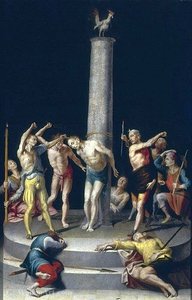
A Scene of Devotion: Pedro de Campaña’s ‘Position’
This powerful painting by Flemish Renaissance artist Pedro de Campaña depicts the crucifixion of Christ, a subject central to Christian iconography, yet rendered with a distinctly emotive and humanistic approach. The composition centers on Jesus upon the cross, his figure commanding attention amidst a gathering of mourners and witnesses. While the size remains unknown, the work’s impact is undeniable – it's a scene brimming with grief, faith, and quiet contemplation. Campaña masterfully utilizes light and shadow to draw the viewer’s eye to Christ’s suffering, while simultaneously detailing the individual responses of those surrounding him.Artistic Style & Technique
Pedro de Campaña, trained initially in Brussels with Bernard van Orley before immersing himself in Italian Renaissance art – particularly that of Raphael – demonstrates a compelling synthesis of Northern and Southern European styles. ‘Position’ showcases his refined technique: meticulous attention to detail in the drapery and facial expressions, combined with a sophisticated understanding of anatomy and perspective. The painting likely employs oil on canvas, allowing for rich color saturation and subtle gradations of tone. The figures are not idealized but possess a realistic quality, conveying genuine emotion. Note the inclusion of two birds – an unusual element that adds a layer of symbolic complexity to the scene; perhaps representing hope or the fleeting nature of life.Historical & Religious Context
Created during the mid-16th century, ‘Position’ reflects the religious fervor and artistic innovation of the Counter-Reformation period. The Catholic Church was actively seeking ways to reaffirm its doctrines and inspire devotion through art. Campaña's work aligns with this goal; it is not merely a depiction of an event but an invitation to empathize with Christ’s sacrifice and contemplate one’s own faith. Having spent much of his career in Spain, Campaña became deeply embedded within the Spanish artistic tradition, known for its dramatic realism and intense religious feeling. His ability to blend Flemish precision with Italian grace made him a sought-after artist.Symbolism & Emotional Resonance
Beyond the central theme of Christ’s crucifixion, ‘Position’ is rich in symbolic details. The varied expressions of those gathered – sorrow, anguish, reverence – represent the diverse human response to suffering and faith. The positioning of figures, their gestures, and even their clothing likely carry specific meanings understood within the context of 16th-century religious art.- The overall composition evokes a sense of solemnity and profound loss.
- The use of light emphasizes Christ’s vulnerability and divine nature.
- The birds, though seemingly minor details, introduce an element of naturalism and potentially symbolize spiritual freedom or the soul's ascent.
Artist Biography
Pedro Campaña (1503–1586): A Renaissance Painter Bridging Flanders and Spain
Pedro Campaña, born in Brussels around 1503, stands as a pivotal figure in the artistic landscape of the Renaissance—a Flemish painter who skillfully traversed the cultural currents between Italy and Spain. Initially trained under Bernard van Orley, Campaña’s early career unfolded amidst the vibrant intellectual milieu of Florence, where he meticulously studied the masterful works of Raphael, establishing himself as his protégé. This formative period profoundly shaped his artistic sensibilities, imbuing him with a dedication to classical ideals and meticulous observation. Recognizing Campaña's talent, Cardinal Domenico Grimani encouraged him to relocate to Seville in 1530, believing it would propel his artistic endeavors. He swiftly established himself as part of Luis de Vargas’s burgeoning studio, fostering a school of painting that soon became the Academy of the Place—a beacon of artistic innovation within Spain. Among Campaña's pupils was Morales, cementing his legacy as an educator and shaping the future of Spanish art. His output during this time included monumental altar-pieces for Seville Cathedral, notably “The Descent from the Cross” (1548), a dramatic depiction reflecting Michelangelo’s influence and capturing the emotional intensity characteristic of Renaissance painting. The artwork was later removed due to the cathedral's ruinous state. Campaña continued his artistic pursuits in Seville until approximately 1563 or 1565, where he undertook the ambitious task of restoring and repainting a chapel commissioned by Hernando de Jaén—a testament to his unwavering commitment to craftsmanship and artistic excellence. Furthermore, Campaña’s influence extended beyond Seville; Murillo specifically requested that his burial take place near Campaña's painting, symbolizing their shared artistic vision. Sadly, the church housing Campaña’s masterpiece succumbed to destruction during the Napoleonic Wars, resulting in the loss of his tomb—a poignant reminder of the ephemeral nature of artistic achievement and historical preservation. His prolific output spanned across various churches throughout Seville, showcasing a remarkable versatility in style and subject matter. Among his most celebrated works are “The Purification of the Virgin” and “The Resurrection,” grand retables embodying Baroque realism and meticulous detail. These paintings exemplify Campaña’s mastery of technique—particularly chiaroscuro—creating luminous effects that heighten emotional impact. His artistic legacy resides not only in these monumental pieces but also in the broader context of Renaissance art history, representing a crucial link between Flemish innovation and Spanish grandeur.- Notable Works: “The Descent from the Cross,” “Crucifixion,” “Pictures of Dona Leonor and Dona Mencia de Cabrera and his daughters”, Chapel Restoration for Hernando de Jaén
- Influences: Raphael, Bernard van Orley
- School: Academy of the Place (Seville)
- Historical Significance: Bridged Flemish and Spanish artistic traditions; Shaped Seville’s Baroque art scene.
Further Exploration
You can delve deeper into Pedro Campaña's artistry by visiting these resources:- Wikipedia Article: https://en.wikipedia.org/wiki/Pedro_Campa%C3%B1a
- Artwork Database: Explore “The Descent from the Cross” Detail
- Museums Database: Hospital de la Caridad – Seville, Municipal Museum of Art of La Plata

pedro de campaña
1503 - 1586 , Belgium
Quick Facts
- Artistic Movement Or Style: Renaissance
- Artists Or Movements Influenced By This Artist:
- Luis de Vargas
- Murillo
- Artists Who Influenced This Artist:
- Bernhard van Orley
- Raphael
- Date Of Birth: Brussels, Belgium (1503)
- Date Of Death: 1586
- Full Name: Pedro de Kempeneer / Pedro Campaña
- Nationality: Flemish
- Notable Artworks:
- Descent from the Cross
- Crucifixion
- Pictures of Dona Leonor and Dona Mencia de Cabrera and his daughters
- Hospital de la Caridad
- Municipal Museum of Art of La Plata
- Place Of Birth: Brussels