Expressionism
Self-portrait (Paula Modersohn-Becker)
Paula Modersohn-Becker (1876–1907) made Self-portrait. It belongs to the Expressionism movement. It is made in oil on canvas.
- Oil On Canvas

 Preview

 Hand Made Oil Painting
 Send
 Share
 Fact sheet


 Download
 Similars
 X-Ray
 Diaporama
 Q&A

 Stats
Self-portrait, in brief
- Title
- Self-portrait
- Artist
- Paula Modersohn-Becker (1876–1907)
- Artist born in
- Dresden, Germany
- Medium
- Oil On Canvas
- Movement
- Expressionism
- Period
- Modern
- Subject
- woman, red hair, green shirt, face, eyes, wall
What does Self-portrait depict?
Identification of the Self-portrait
Self-portrait is a creation by the German Expressionist painter and draftswoman Paula Modersohn-Becker. This specific piece belongs to a vast body of work produced during her active life. The artist was born on 8 February 1876 in Dresden, Germany, and passed away on 30 November 1907 in Worpswede.
In this work, Paula Modersohn-Becker turns her gaze toward the viewer. The image captures a moment of quiet intensity through the artist's own likeness. It remains a direct encounter with her presence.
The Composition and Visual Details
The subject is positioned in front of a plain wall, seated in a manner that brings her face into sharp prominence. She wears a green shirt that contrasts with her red hair. Her hair is styled in an unconventional manner, contributing to the singular presence of the figure. The composition focuses heavily on the facial features, emphasizing a directness of gaze. Her eyes are open wide, looking straight ahead to meet the viewer's eyes with quiet intensity.
The arrangement of the figure against the background creates a sense of immediate, unmediated encounter. There is a notable focus on the psychological weight of the stare. The simplicity of the setting ensures that the viewer's attention remains fixed on the subject's expression and the specific arrangement of her features. This directness removes any sense of artifice from the encounter.
Technique and Artistic Medium
Executed in oil on canvas, this work exemplifies the principles of Expressionism. The medium allows for a directness of form that prioritizes the psychological state over mere physical likeness. Through the application of pigment, the artist achieves a sense of quiet intensity, focusing on the essential features of the face and the gaze to facilitate a moment of introspection.
The application of paint emphasizes a recognizable simplicity of form. This approach moves away from the atmospheric concerns of Impressionism, opting instead for a more structured and subjective visual language. The surface carries the weight of the artist's presence, using color and composition to explore the nuances of identity.
Where to See This Artwork Today
This work is held at the Paula Modersohn-Becker Museum in Bremen, Germany. The institution serves as a primary repository for the artist's output, housing a significant portion of her creative legacy.
Founded in 1927, the museum holds a unique position in art history as the first museum in the world devoted solely to a female artist. Its collection provides a comprehensive view of her development from her early training to her final years in Paris.
Related Works by the Artist
The artist's exploration of the self continued through several distinct phases of her career. In 1906, she produced Self-Portrait Looking Slightly Left, a work that shares a similar searching quality with her other studies of identity. During that same year, she completed Self-Portrait at 6th Wedding Anniversary, a piece that captures a specific moment of transition. This work is also known as Self-portrait on the sixth anniversary of marriage.
Earlier compositions reveal a different focus on objects and the female form. Around 1904, she created Self-Portrait with a bowl and a glass. Her interest in the intersection of the female form and the natural world is further evidenced in Self-Portrait with Two Flowers, where she cradles blossoms with a deliberate, steady intention.
High-resolution images of Self-portrait
Paula Modersohn-Becker, Self-portrait. Public domain.
Questions on Self-portrait, answered
What medium is "Self-portrait" by Paula Modersohn-Becker executed in?
"Self-portrait" is executed in oil on canvas.
What does "Self-portrait" by Paula Modersohn-Becker depict?
The subjects of "Self-portrait" are woman, red hair, green shirt, face, eyes, wall.
Is "Self-portrait" by Paula Modersohn-Becker in the public domain?
The copyright answer for "Self-portrait" by Paula Modersohn-Becker: the work is in the public domain - its copyright has expired. This determines whether reproductions of the image may be freely made.
Who created "Self-portrait"?
The artist behind "Self-portrait" is Paula Modersohn-Becker. The work is catalogued under Paula Modersohn-Becker's name.
What art movement does "Self-portrait" by Paula Modersohn-Becker belong to?
The movement associated with "Self-portrait" by Paula Modersohn-Becker is Expressionism. This classification situates the work among related artists and artworks.
Why is the copyright status of "Self-portrait" what it is?
The copyright status of "Self-portrait" - in the public domain - its copyright has expired - follows from the artist's death in 1907.
What does "Self-portrait" share with the rest of Paula Modersohn-Becker's output?
"Self-portrait" belongs to Paula Modersohn-Becker's Expressionism work, whose recorded themes include cézanne, gauguin, van gogh, identity and femininity, self-exploration and agency, pioneer of expressionism.
How does the subject of "Self-portrait" relate to Paula Modersohn-Becker's usual themes?
Among Paula Modersohn-Becker's recorded themes - cézanne, gauguin, van gogh, identity and femininity, self-exploration and agency, pioneer of expressionism - "Self-portrait" brings its own focus on woman, red hair, green shirt, face, eyes, wall.
About the artist, Paula Modersohn-Becker

1876–1907, Germany
Paula Modersohn-Becker
A Pioneer of Inner Vision: The Life and Art of Paula Modersohn-Becker Paula Modersohn-Becker, a name that resonates with quiet power in the annals of early modern art, was an artist who dared to look inward. Born Minna Hermine Paula Becker on February 8, 1876, in Dresden, Germany, her life was tragically short – she passed away November 30, 1907, in Worpswede – yet within those three decades, she forged a path of remarkable artistic innovation and personal courage. Her story isn’t one of immediate acclaim or widespread recognition during her lifetime; rather, it's a testament to the enduring strength of an individual voice that challenged conventions and explored the depths of human experience with unflinching honesty. From a relatively privileged upbringing in a family marked by a subtle shadow – her uncle had attempted to assassinate the King of Prussia – Paula’s artistic inclinations were nurtured, though not without societal expectations pressing upon them.
About Paula Modersohn-Becker Notable works by Paula Modersohn-Becker
Also by Paula Modersohn-Becker
 Portrait of a young woman with red hat1900
 Half-length portrait of an old farmer1903
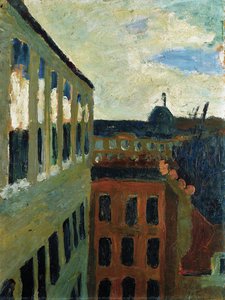 View from the studio window of the artist in Paris1900
 Still life with plant, lemon and orange1906
Essays around Self-portrait
 Polish artworks of the 1900sPolish Symbolism in the 1900s features masterpieces by Jacek Malczewski, Olga Boznańska, and Józef Mehoffer. View the full collection at Or…
 German artworks of the 1900sGerman Expressionism through the works of Franz Marc, Ernst Ludwig Kirchner, and August Macke. Find museum-quality reproductions on Origina…
 Egon Schiele's Top 25 Masterpieces: The Raw Power of ExpressionismExplore 25 iconic Egon Schiele masterpieces of Austrian Expressionism. Discover the raw emotion behind each work on OriginalUniqueArt.com.