Preview
 Send
Send Share
Share
 Details
 Guide
Guide

 Download
 Similars
 X-Ray
X-Ray Diaporama
 Stats
StatsPietà
 Painting
- WallArt
- Baroque Illusionism
 1740
1740- Early Modern
 4.0 x 132.0 cm
 Wien Museum
 Read More
Hand Made Oil Reproduction
Hand-painted oil on canvas in your size and frame, made to order by our artists. ( Switch to Print Switch to Digital Image)




P118B $10

P118H $10

P118W $10

P438Z $10

P508JH $12

P508YH $12

P805H $10

P805Z $10

P919BZ $10

P919G $10

P919XJ $10

P959ZH $10

P968JZ $12

W106C $8

W218G $10

W218JH $8

W218Y $10

W307PJ $10

W316G $10

W316PJ $8

W316Y $10

W398PJ $8

W4111J $10

W500HY $15

W500JH $15

W692G $12

W849H $8

W940BG $15

W953PJ $8




Pick from our preset sizes that match the artwork's original proportions.

You may enter your own dimensions to fit a specific frame or space. If your selected size does not match the original image's proportions, we will either crop the artwork or extend the painting with additional hand-painted elements. A digital mockup will be sent for your approval before production begins.
Please note that the on-screen preview does not reflect the actual cropping or extension. Only the mockup will accurately show the final composition.
While custom sizes are available, we recommend selecting a dimension from the predefined list to preserve the original proportions.
After order, OriginalUniqueArt.com team will email client for instructions and provide a mockup preview
Worldwide Delivery () in 3/4 weeks instead of standard 5 weeks. (26 September). No compromise on quality.

Free Worldwide Express Shipping

High-Quality Linen Canvas

Full Shipping Insurance

Customs Tax Refund Guarantee

True Color Matching Guarantee

100-Day Return Policy (Defects Only)

100% Money-Back Guarantee

Bulk Discount Offer
 Glass option is only available in size under 110 CM

Pietà
Reproduction Medium
Reproduction Size
-


Total Price
$ 300
A Symphony of Sorrow and Serenity
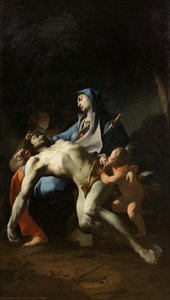
In the quiet depths of Paul Troger’s 1740 masterpiece, Pietà, one finds more than a mere religious tableau; one encounters a profound visual meditation on the human condition. This monochrome marvel captures the heart-wrenching moment of Mary cradling the lifeless body of Jesus following his crucifixion. The composition is an exquisite study in contrast, where the heavy weight of grief meets a transcendent sense of peace. As the eye wanders through the darkened space, it encounters a scene that feels both intimately personal and cosmically significant, inviting the viewer into a sacred dialogue between mourning and divine grace. For the discerning collector or designer, this piece offers a rare opportunity to possess a work that commands attention through its emotional gravity rather than mere spectacle.
The technical brilliance of Troger is nowhere more evident than in his masterful command of chiaroscuro. By orchestrating a dramatic interplay between light and shadow, the artist sculpts the forms of the figures with a breathtaking realism that seems to breathe within the frame. Despite its monochromatic palette, the painting possesses a subtle, shimmering luminosity, achieved through the painstaking layering of thin glazes over a preparatory underpainting. This technique allows light to appear as if it is emanating from within the skin of Christ and the folds of Mary’s garments, creating an illusionistic depth that draws the observer into the very atmosphere of the room. The meticulous detail in the textures—the softness of flesh against the starkness of the background—demonstrates the pinnacle of the Austrian Baroque style.
Historical Resonance and Symbolic Depth
To understand Pietà is to understand the cultural pulse of 18th-century Austria. Created during a period of significant social and spiritual reformation, Troger’s work reflects the humanist ideals of the early Enlightenment, where the focus shifted toward the palpable reality of human suffering and the redemptive power of mercy. The painting serves as a bridge between the intense, dramatic shadows of the late Baroque and the lighter, more ethereal aesthetics of the approaching Rococo. Through his patronage by the influential von Firmament family, Troger was able to infuse this work with an aristocratic refinement that elevates the subject matter from a simple lamentation to a sophisticated piece of theological art.
Symbolically, the work is rich with layers of devotion. The presence of an angel, appearing to offer comfort and reassurance, introduces a flicker of hope amidst the overwhelming darkness of loss. This juxtaposition of the mortal and the divine creates a tension that is both unsettling and deeply comforting. For those looking to integrate such a piece into a curated interior, Pietà acts as a powerful focal point, capable of anchoring a room with its historical weight and spiritual resonance. It is not merely a decoration, but an evocative narrative of compassion, making it an incomparable choice for spaces designed for reflection, contemplation, and the appreciation of fine art history.
Artist Biography
Paul Troger: Architect of Austrian Light
Paul Troger (1698-1762) stands as a pivotal figure in the history of Austrian art, a master whose dramatic frescoes and meticulously crafted drawings profoundly shaped the visual landscape of his era. Born in Welsberg, a small village nestled within the Tyrolean Alps, Troger’s artistic journey began amidst the traditions of Alpine craftsmanship, yet he rapidly embraced and transformed the burgeoning Baroque style, ultimately pioneering a distinctive approach characterized by vibrant color, dynamic movement, and an unprecedented sense of illusionism. His legacy extends far beyond his individual works; he served as a crucial bridge between the weighty darkness of early 18th-century painting and the lighter, more playful aesthetics of the Rococo, profoundly influencing generations of Austrian artists.
Troger’s formative years were spent under the patronage of the influential von Firmian family in Fiume (present-day Rijeka, Croatia). This early exposure to artistic refinement led him to study with Giuseppe Alberti, a renowned humanist scholar and artist. However, it was his subsequent sojourn in Venice that truly ignited his creative spirit. Immersed in the vibrant art scene of the Venetian Republic, Troger encountered the works of Giovanni Battista Piazzetta and Giovanni Battista Pittoni – masters of color and composition who instilled within him a deep appreciation for theatricality and visual drama. Crucially, he also benefited from the rigorous training offered by Sebastiano Ricci, absorbing the techniques of Roman painting and developing his own distinctive style.
Returning to Austria, Troger initially worked in Salzburg, honing his skills before establishing himself permanently in Vienna. It was here that he truly ascended to prominence, becoming the favored fresco painter for numerous monasteries throughout Lower Austria. His commissions were not merely decorative; they represented significant investments in religious and architectural grandeur. The Abbey of Melk, with its magnificent Marble Hall and Library, stands as a testament to Troger’s skill – his frescoes there depicting the Apotheosis of Charles VI as Apollo are particularly celebrated for their scale, dynamism, and masterful use of light. Similarly, his work at Göttweig Abbey, featuring an equally impressive depiction of the Apotheosis, showcases his ability to create immersive environments that transport viewers into realms of divine splendor.
Troger’s artistic philosophy was rooted in a deliberate rejection of the prevailing dark palette favored by earlier Baroque painters. He championed a brighter, more luminous style – a characteristic often referred to as the *leichte Manier* (light manner) – that reflected the emerging Rococo aesthetic and offered a refreshing contrast to the somber tones of the past. This shift was not merely superficial; it represented a fundamental change in how artists approached space, light, and color. Troger’s frescoes are characterized by an astonishing sense of depth and perspective, achieved through subtle gradations of tone and the strategic placement of figures within complex compositions. His ability to create the illusion of three-dimensional space on a flat surface was truly remarkable, earning him widespread acclaim and establishing him as a leading innovator in his field.
The Maestro’s Classroom: Influence and Legacy
Beyond his own prolific output, Paul Troger exerted a profound influence on a generation of Austrian artists. He served as professor at the Imperial Academy of Fine Arts in Vienna, where he mentored numerous students who went on to achieve considerable success. Franz Anton Maulbertsch, arguably his most gifted pupil, inherited Troger’s dramatic style and continued to develop it along independent lines. Other notable students included Franz Karl Palko and Josef Siegmund Keller, each carrying forward elements of Troger's innovative approach.
Troger’s impact extended beyond the immediate circle of his pupils. His work served as a crucial bridge between the weighty traditions of the late Baroque and the lighter, more playful sensibilities of the Rococo. He demonstrated how to effectively utilize color and light to create dynamic compositions that engaged the viewer's imagination. His emphasis on illusionism paved the way for later developments in Austrian painting, influencing artists who sought to capture the fleeting beauty of nature and the emotional intensity of human experience.
Key Works: A Showcase of Artistic Mastery
- Frescoes of the Church of the Englische Fräulein in St. Pölten (1729/1730): This work exemplifies Troger’s ability to create dramatic narratives within a confined space, utilizing vibrant colors and dynamic figures to convey religious themes.
- The Apotheosis of Charles VI as Apollo at Göttweig Abbey (1739): A monumental fresco that showcases Troger's mastery of scale, composition, and illusionistic technique. The depiction of the Habsburg emperor as Apollo is particularly striking in its grandeur and theatricality.
- Frescoes in the Marble Hall and Library of Melk Abbey (1732-1733): These frescoes are renowned for their intricate detail, luminous colors, and masterful use of perspective. They represent a pinnacle of Troger’s artistic achievement.
- Vision of St. Ulrich at the Battle of Lechfeld, St Ulrich, Vienna (1752): A powerful depiction of a pivotal moment in Austrian history, showcasing Troger's ability to combine religious symbolism with historical narrative.
A Lasting Impression: Historical Significance
Paul Troger’s legacy extends far beyond the confines of his individual works. He played a crucial role in shaping the artistic identity of Austria during the late Baroque and early Rococo periods. His innovative approach to fresco painting – characterized by its vibrant colors, dynamic movement, and unprecedented sense of illusionism – profoundly influenced subsequent generations of Austrian artists. Troger’s work continues to be admired for its beauty, drama, and technical brilliance, solidifying his place as one of the most important figures in the history of Austrian art.

Paul Troger
1698 - 1762 , Austria
Quick Facts
- Artistic Movement Or Style: Baroque
- Artists Or Movements Influenced By This Artist: ['Franz Anton Maulbertsch']
- Artists Who Influenced This Artist:
- Giuseppe Alberti
- Giovanni Battista Piazzetta
- Date Of Birth: Oct 30, 1698
- Date Of Death: July 20, 1762
- Full Name: Paul Troger
- Nationality: Austrian
- Notable Artworks:
- Saint Andrew
- Christ on Mount Olives
- Annunciation Prophets
- Place Of Birth: Welsberg, Tyrol
Related Articles

The Visceral Stage: Exploring Dramatic Narratives & Emotional Intensity in Baroque Art
Explore the dramatic world of Baroque art! Discover iconic masters like Caravaggio & Rembrandt, their techniques, and the movement's lasting impact. Expert insights for collectors & enthusiasts at OriginalUniqueArt.

Baroque Drama: Bringing Opulence & Emotion into Contemporary Interiors
Explore the opulent world of Baroque interior design! Discover key elements, modern applications & how to bring dramatic elegance into your home with OriginalUniqueArt.com's authentic reproductions.

The Dramatic Flourish: Exploring the Baroque Movement's Enduring Legacy in Art History
Explore the dramatic world of Baroque art! Discover iconic artists like Caravaggio & Rubens, defining techniques, and its lasting impact on art history. Expert insights for collectors & enthusiasts at OriginalUniqueArt.

Baroque Masterpieces: 10 Paintings That Defined an Era |
Journey through the drama & grandeur of Baroque art! Explore 10 masterpieces by Caravaggio, Rembrandt, Rubens & more. Discover stunning oil paintings, rich colors & timeless stories. Find museum-quality reproductions at .

Baroque Classicism: The Grandeur of Order and Drama in 17th-Century Art History
Explore the profound elegance of Baroque Classicism. Discover how 17th-century masters synthesized dramatic emotion with classical order through the lens of the Counter-Reformation and the works of legends like Carlo Maratta and Andrea Sacchi.