Switch to Print
 Read More







































 For artworks or reproductions larger than 105 cm (approximately 41 inches) on any side, the frame will be shipped as a kit, disassembled. This method ensures safe delivery and prevents damage during transport.


A Visceral Dance of Chaos
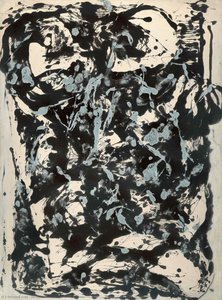
In the realm of Abstract Expressionism, few works capture the raw, unbridled tension of human struggle as poignantly as Paul Jackson Pollock’s “Untitled (Silkscreen I).” This striking black and white lithograph serves as a profound window into a mid-1950s psyche, presenting a scene that feels less like a static image and more like a captured moment of violent upheaval. The composition is densely packed, pulling the viewer into a claustrophobic arena where multiple figures appear locked in a desperate, fragmented encounter. There is no respite for the eye here; instead, one finds themselves navigating a labyrinth of overlapping forms and distorted human shapes that evoke a deep sense of unease and psychological distress.
The power of this piece lies in its ability to translate internal anxiety into external form. Through the use of aggressive, angular lines that dissect the paper, Pollock creates a visual language of disruption. The lack of traditional perspective flattens the space, forcing the struggle to the very surface of the work and amplifying the feeling of being trapped within the conflict. It is an evocative masterpiece for any collector or designer seeking to introduce a sense of dramatic intensity and intellectual depth into a curated space.
The Mastery of Lithographic Texture
While Pollock is world-renowned for his revolutionary drip technique, “Untitled (Silkscreen I)” showcases his ability to translate energy through the meticulous medium of lithography. This process allowed for a remarkable range of tonal variations, where the interplay between deep, obsidian blacks and stark, piercing whites creates a dramatic chiaroscuro effect. The texture of the print is palpable; the varying densities of ink suggest a rhythmic, almost percussive application of material that mirrors the artist's physical engagement with his craft.
The technique employed here bridges the gap between spontaneous action and controlled printmaking. Each etched line and shaded area contributes to a sense of movement, as if the very ink were still settling upon the page. For those looking to adorn a sophisticated interior, this reproduction offers a sophisticated interplay of light and shadow, providing a focal point that is both visually arresting and texturally rich. It stands as a testament to how much emotion can be conveyed through the disciplined manipulation of a single color palette.
Symbolism and Emotional Resonance
Beyond its formal qualities, “Untitled (Silkscreen I)” functions as a profound symbolic exploration of conflict and suffering. The distorted faces and fragmented limbs are not merely abstract shapes; they are emblems of a fractured existence. Influenced by the heavy emotional weight of Expressionist masters like Edvard Munch, Pollock utilizes this work to explore themes of vulnerability and the chaotic nature of human interaction. The piece does not seek to tell a literal story, but rather to evoke a visceral feeling—a resonance that lingers long after the initial viewing.
For the discerning art lover, this artwork offers more than mere decoration; it offers an experience. It invites contemplation on the nature of upheaval and the resilience of the human spirit amidst disorder. Whether placed in a modern gallery setting or as a bold statement piece in a contemporary living space, “Untitled (Silkscreen I)” brings with it an undeniable gravity and a timeless, haunting beauty that continues to fascinate and provoke.
Questions & Answers
Where can I find a guide to "Untitled (Silkscreen I)"?
The Guide page of "Untitled (Silkscreen I)" by Paul Jackson Pollock offers a printable two-sheet factsheet: the artwork with its identity table, a decade band placing it in the artist's lifetime, other works by the artist, the measured color palette, and ready-to-copy citations in four styles.
Is "Untitled (Silkscreen I)" a good gift idea?
"Untitled (Silkscreen I)" is suggested as a gift for corporate gift.
How does the subject of "Untitled (Silkscreen I)" relate to Paul Jackson Pollock's usual themes?
Among Paul Jackson Pollock's recorded themes - exploration of trauma, abstracted human form, emotional intensity, expressionism, lithography, post-war anxiety, distortion, violence - "Untitled (Silkscreen I)" brings its own focus on conflict, violence, struggle, distortion, figures, chaos, tension, abstract form.
More about this painting
 Preview
 Send
Send Share
Share
 Details
 Guide
Guide

 Download
 Similars
 X-Ray
X-Ray Diaporama
 Q&A
Q&A Stats
Stats