 Switch to Print
 Read More







































 For artworks or reproductions larger than 105 cm (approximately 41 inches) on any side, the frame will be shipped as a kit, disassembled. This method ensures safe delivery and prevents damage during transport.


A Monumental Expression of Abstract Emotion
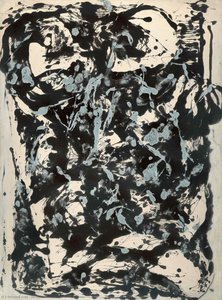
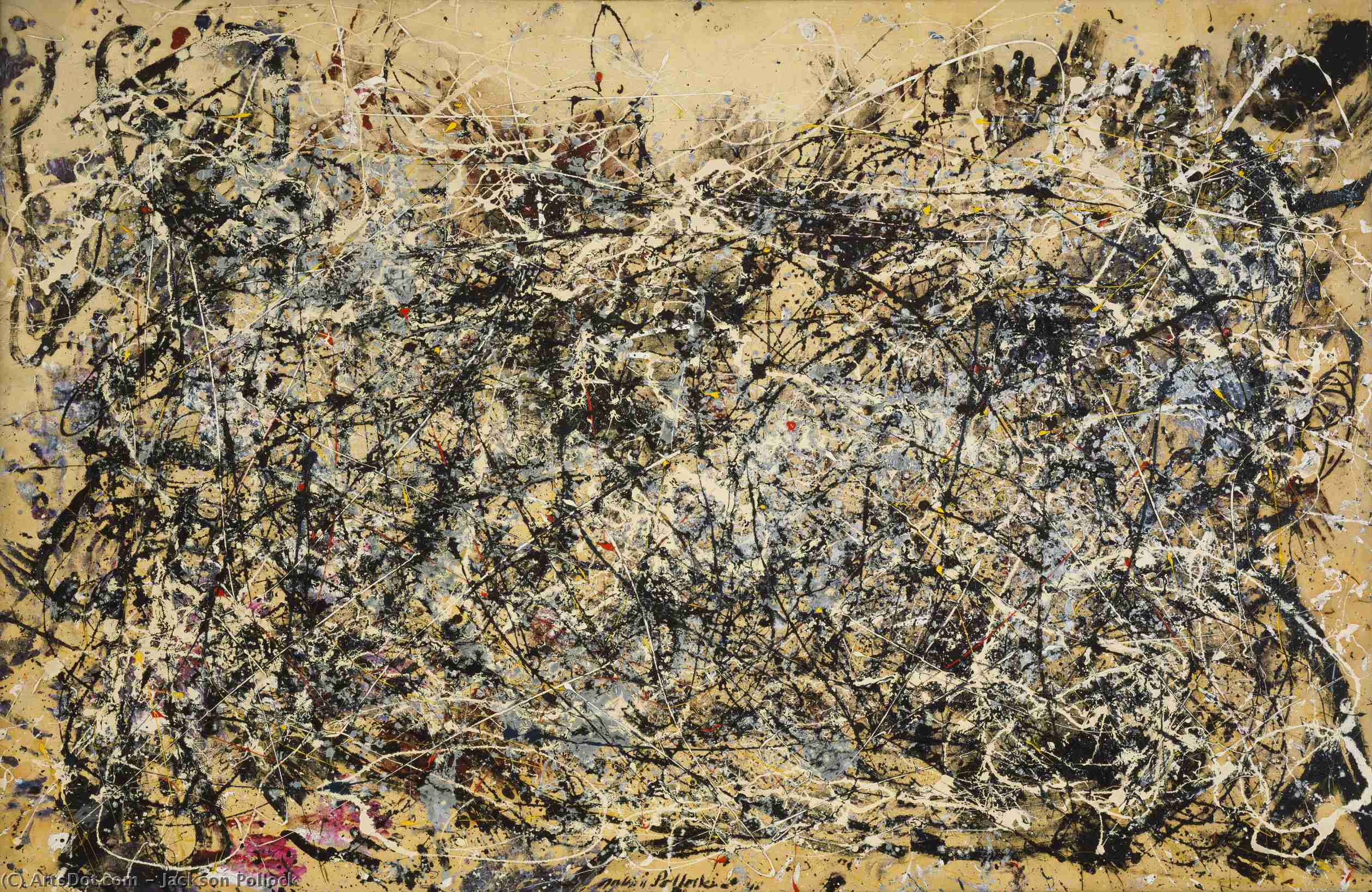
Created in 1950, this captivating work embodies the revolutionary spirit of Abstract Expressionism and stands as a prime example of Jackson Pollock’s iconic “drip” technique. Measuring an impressive 240 x 120 cm, it commands attention not merely through its scale but through the sheer energy radiating from its complex surface.
The Birth of Action Painting
Rejecting traditional easel painting, Pollock laid his canvases directly on the floor, allowing him to approach the work from all sides. This radical shift in perspective is fundamental to understanding the piece – it’s not a window onto another world, but an arena where the act of creation *is* the subject matter. The swirling network of lines and splatters isn't about depicting something; it’s about expressing raw emotion and physical gesture directly onto the canvas. This technique, dubbed “action painting,” prioritized spontaneity and the artist’s subconscious impulses.
Decoding a Non-Representational Landscape
While devoid of recognizable forms, this artwork evokes a sense of vastness and depth. Layers of interwoven lines – varying in thickness, density, and direction – create an all-over composition that draws the eye across the entire surface. Subtle hints of reddish-pink tones offer delicate contrast within the predominantly muted palette of blacks, browns, ochres, and whites. The absence of a focal point encourages prolonged contemplation, inviting viewers to lose themselves in the intricate details and discover their own interpretations.
Historical Context & Artistic Innovation
Emerging in post-World War II America, Abstract Expressionism reflected a cultural shift towards individualism and existential questioning. Pollock’s work, in particular, broke free from European artistic traditions, establishing New York as a new center for avant-garde art. He challenged conventional notions of beauty and skill, prioritizing authentic expression over technical precision. This painting exemplifies the movement's core tenets: freedom, spontaneity, and the power of the subconscious.
Emotional Resonance & Symbolic Depth
The artwork’s emotional impact is profound. It can be interpreted as a visual representation of inner turmoil, boundless energy, or even the chaotic beauty of the universe. The dynamic interplay of lines suggests movement, tension, and release. Though non-representational, it taps into universal human experiences – anxiety, joy, and the search for meaning in an abstract world. It’s a powerful reminder that art can communicate beyond language and logic.
A Statement Piece for Modern Interiors
This reproduction captures the texture and dynamism of Pollock's original with exceptional fidelity. Its large scale and bold composition make it a striking focal point for any modern or contemporary interior. Whether adorning a living room, office, or gallery space, this artwork will undoubtedly spark conversation and inspire contemplation. It’s more than just a painting; it’s an investment in artistic legacy and a testament to the enduring power of abstract expression.
Questions & Answers
What mood does "Number 1, 1949" by Paul Jackson Pollock express within Abstract Expressionism?
The energetic emotion of "Number 1, 1949" accompanies its Abstract Expressionism style.
What technique and size is the original "Number 1, 1949" by Paul Jackson Pollock?
The original "Number 1, 1949" by Paul Jackson Pollock is an oil on canvas work measuring 240 x 120 cm. Technique and size describe the original object.
What is the luminance of "Number 1, 1949" by Paul Jackson Pollock?
The luminance recorded for "Number 1, 1949" by Paul Jackson Pollock is gentle luminance.
More about this painting
 Preview
 Send
Send Share
Share
 Details
 Guide
Guide

 Download
 Similars
 X-Ray
X-Ray Diaporama
 Q&A
Q&A Stats
Stats Top100