Preview
 Send
Send Share
Share
 Details
 Guide
Guide

 Download
 Similars
 X-Ray
X-Ray Diaporama
 Q&A
Q&A Stats
StatsLucifer

- 268.0 x 104.0 cm


 Read More
Giclée / Art Print
Museum-quality giclée or canvas print with fast production and flexible finish options. ( Buy Hand Made Painting Switch to Digital Image)




P118B $10

P118H $10

P118W $10

P438Z $10

P508JH $12

P508YH $12

P805H $10

P805Z $10

P919BZ $10

P919G $10

P919XJ $10

P959ZH $10

P968JZ $12

W106C $8

W218G $10

W218JH $8

W218Y $10

W307PJ $10

W316G $10

W316PJ $8

W316Y $10

W398PJ $8

W4111J $10

W500HY $15

W500JH $15

W692G $12

W849H $8

W940BG $15

W953PJ $8




Pick from our preset sizes that match the artwork's original proportions.

Type the width and the height you need, to fit your frame or your wall. A print can only be cut, never made bigger than the picture, so a size with a different shape loses a part of the image. We send you a digital mockup to approve before we print anything. The picture shown on this page does not show the real cut — only the mockup does.
Worldwide Delivery () in 2 weeks instead of standard 4/5 weeks. (10 November)

Free Worldwide Express Shipping

High-Quality Linen Canvas

Full Shipping Insurance

Customs Tax Refund Guarantee

True Color Matching Guarantee

100-Day Return Policy (Defects Only)

100% Money-Back Guarantee

Bulk Discount Offer
 Glass option is only available in size under 110 CM

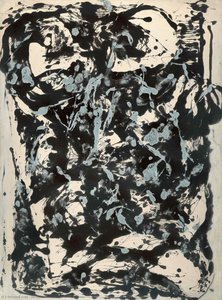
Lucifer
Giclée / Art Print
Reproduction Size
-


Total Price
$ 81
A Descent into Chaos: Exploring Jackson Pollock's "Lucifer"
Jackson Pollock’s “Lucifer,” painted in 1947, isn’t merely a painting; it’s an immersion. Measuring a substantial 268 x 104 cm, this work embodies the raw energy and profound emotionality of Abstract Expressionism at its zenith. The canvas explodes with a carefully orchestrated dance of black and white, a visual storm rendered through Pollock's revolutionary drip technique – a method he perfected to capture not just form, but the very essence of movement and feeling. Close inspection reveals an intricate network of layered textures, each drop and splatter contributing to a composition that feels both chaotic and meticulously controlled.
- Technique: Pollock’s “all-over” technique is central to "Lucifer's" impact. He abandoned traditional brushes, opting instead for sticks, knives, and even syringes to fling paint directly onto the canvas, creating a dense tapestry of overlapping marks.
- Color Palette: The stark contrast between black and white amplifies the painting’s dynamism, forcing the viewer to confront the interplay of light and shadow within its complex structure.
- Scale: The large format of "Lucifer" envelops the observer, drawing them into the heart of Pollock's creative process.
The Genesis of a Vision: Early Influences and Artistic Context
Pollock’s artistic journey began with a restless spirit shaped by his upbringing in Cody, Wyoming – a landscape that instilled within him a deep appreciation for natural forces and the rhythms of the West. His early exposure to Native American art, particularly through his father's surveying work, subtly informed his later explorations of composition and spiritual resonance. This influence is not overt imitation but rather a foundational layer contributing to the painting’s underlying power. Pollock’s formal training at the Art Students League under Thomas Hart Benton, a key figure in the Regionalist movement, further solidified his understanding of dynamic composition – a skill he then radically transformed through his own innovative approach. “Lucifer” stands as a testament to this evolution, building upon established principles while forging entirely new pathways for artistic expression.
Decoding the Symbolism: Layers of Interpretation
"Lucifer" resists easy interpretation, deliberately eschewing representational imagery in favor of abstract forms and textures. The interwoven patterns can be seen as symbolic representations of inner turmoil, spiritual struggle, or perhaps simply a visual manifestation of the artist’s subconscious. Some scholars suggest that the dominant black and white hues symbolize duality – light versus darkness, order versus chaos – reflecting the core themes explored by Abstract Expressionism. The seemingly random arrangement of shapes and forms actually possesses a carefully constructed dynamism, inviting viewers to engage in their own personal interpretations.
A Legacy of Innovation: "Lucifer" within the Art Historical Landscape
“Lucifer” is inextricably linked to the broader context of Abstract Expressionism, a movement that sought to liberate art from traditional constraints and explore the depths of human emotion. Works by Clyfford Still, with their similarly monumental scale and abstract forms, share conceptual affinities. Furthermore, the influence of Wassily Kandinsky’s exploration of geometric shapes and vibrant colors can be detected in Pollock's approach. Currently held within the Peggy Guggenheim Collection in Venice, "Lucifer" remains a pivotal work in Pollock’s oeuvre and a cornerstone of modern art history – a testament to his revolutionary vision and enduring impact.
Questions & Answers
Is "Lucifer" by Paul Jackson Pollock a bright or a dark artwork?
Overall, "Lucifer" is recorded as balanced. Perceived brightness describes how light or dark the work appears.
What is the recommended use of a print of "Lucifer"?
A reproduction of "Lucifer" by Paul Jackson Pollock is recommended for statement. This suggestion follows from the work's subject, mood and colors.
Where can I find statistics about "Lucifer" by Paul Jackson Pollock?
The Stats page of "Lucifer" by Paul Jackson Pollock presents public visit statistics: monthly visits of this artwork, a comparison with the artist's most viewed works, and where its visitors come from.
Artist Biography
Early Life, Family and Training
The story of Paul Jackson Pollock begins in the rugged landscape of Cody, Wyoming, where he was born on January 28, 1912. He was the youngest of five brothers, born to Stella May McClure and LeRoy Pollock. His father worked as a land surveyor, a profession that required constant movement across the vast American West. This nomadic existence meant that the young boy's early years were defined by frequent relocations, a restlessness that seemed to mirror the shifting horizons of his father's work. These early travels through the West provided him with a direct, unmediated encounter with the natural world and the spiritual resonance of Native American art, impressions that would quietly settle into his subconscious long before he ever held a brush.
As he grew, the search for a sense of place led him toward the urban energy of the coast. He enrolled at Manual Arts High School in Los Angeles, seeking a formal structure for his burgeoning impulses. However, the true shaping of his hand occurred much later, when he moved to New York City. It was there, at the Art Students League, that he began a long and transformative period of study. From 1929 to 1942, he labored under the guidance of Thomas Hart Benton. While Benton emphasized rhythmic compositions and the narrative weight of American life, the young student was already beginning to drift toward his own, more abstract, internal truths.
The Development of a Unique Technique
By 1947, a profound shift had taken hold in the way he approached the canvas. He moved away from the traditional easel, choosing instead to lay his canvases directly upon the floor. This change allowed him to stand over his work, becoming part of the creative act itself. He did not merely apply paint; he dripped, splashed, and flung it from above, letting the liquid fall in unpredictable patterns. This method turned the act of painting into a physical performance, where gravity and gesture dictated the final form.
His tools were as unconventional as his methods. He reached for sticks, knives, and even syringes to manipulate the fluid medium. Sometimes he used trowels or dripping fluid paint to achieve specific textures. He would often scratch into the surface or use strange objects to build up a thick crust of paint, adding a tactile, sculptural quality to the work. This process was less about controlled brushwork and more about a rhythmic, almost primal release of energy onto the surface.
Key Works and Artistic Expressions
As he moved away from the constraints of the easel, his canvases began to reflect a more visceral engagement with the medium. In 1943, he produced Mural, a massive work measuring 8-by-20-foot (2.4 by 6.1 m), which demonstrated his ability to command a vast surface. During this period, his explorations into the subconscious and the act of painting itself led to works like Eyes in the Heat, created about 1946. These pieces were not merely images but records of a physical presence, where the movement of his whole body dictated the placement of every splatter and pool of color.
The years that followed saw him perfecting the rhythmic, all-over compositions that would define his reputation. He sought to create a sense of boundless space, where no single point held dominance over the rest. This approach is evident in Number 1, 1949, a work that captures a raw outpouring of energy, and in Lavender Mist, Number 1, 1950, which remains a significant piece of his output. In these works, the interplay between control and chance creates a delicate balance, as if the paint were released rather than applied.
His later experiments continued to push the boundaries of how paint could be manipulated on a horizontal surface. He often used sticks, knives, or even the cans themselves to fling pigment, resulting in complex networks of lines. This method is clearly seen in Blue Poles, Number 11, 1952 and in the energetic Convergence. Through these works, he achieved a state where the painting seemed to possess a life of its own, emerging from a deep immersion in his own imagination.
Patrons, Workshop and Commissions
The path of his career was shaped by both public necessity and the generosity of a few vital supporters. Between 1938 and 1942, he found steady work as a painter for the WPA Federal Art Project, a period that provided a necessary rhythm to his developing practice. This stability gave way to a more personal and transformative alliance when Peggy Guggenheim offered him a gallery contract in July 1943. Her support proved to be more than professional; in 1945, she provided a $2,000 down payment to help him secure a home, a gesture that deeply intertwined his personal life with his artistic survival.
His creative life eventually found its center in East Hampton, New York. There, within the Pollock-Krasner House and Studio, he lived and worked alongside his wife, Lee Krasner. The studio was a place of intense physical movement, where the boundaries between the artist and the canvas dissolved. He often moved away from the traditional easel, preferring to lay his canvases upon the floor to engage with the paint from all sides. This workspace was not merely a room for production but a site of profound, restless energy where his most radical experiments took place.
Later Years and Death
The personal life of the artist was deeply intertwined with his creative struggles. In 1945, he married the artist Lee Krasner, a union that provided a significant presence in his life during his most transformative years. Yet, beneath the surface of his professional ascent, a persistent shadow remained. He struggled with an alcohol addiction throughout his entire life, a battle that often complicated his existence and his ability to navigate the pressures of his growing fame.
This internal and external turbulence reached a tragic end in East Hampton, New York, USA. On August 11, 1956, at the age of 44, his life was cut short in a sudden, violent accident. While driving, he was involved in a single-car collision caused by alcohol. The crash proved fatal, leaving behind a legacy that was as tumultuous as the paint he flung across his canvases.
Legacy and Influence on Modern Art
The ripples of his radical methods reached far beyond the studio walls of East Hampton. By breaking the traditional bond between the brush and the easel, he became a central figure in the Abstract Expressionist movement, a shift that fundamentally altered the trajectory of American creativity. His presence helped solidify New York City's position as a global center for modern art, moving the heart of the avant-garde away from European dominance. He was among the first American painters to be recognized as a peer of the great 20th-century European masters, proving that a new, visceral language could emerge from the soil of the United States.
His influence acted as a catalyst for many subsequent art movements that followed in his wake. The way he engaged with the canvas—treating it as an arena for physical action rather than a mere surface for representation—opened doors for many who sought to express the subconscious through gesture. This emphasis on the process of creation itself left a permanent mark on the history of modern art, ensuring that the spontaneous and the unplanned would forever hold a place in the artist's toolkit.
- Number 1, 1949
- Blue Poles: Number 11, 1952
- Convergence
- Autumn Rhythm. Number 30, 1950
Where to See the Works Today
To witness the physical traces of his movement, one must travel to the great institutions that preserved his radical energy. In New York City, the Museum of Modern Art holds several of his canvases, allowing viewers to stand before the sprawling, uncentered compositions that defined his era. The National Gallery of Art in Washington D.C. also maintains his works, offering a space to observe the intricate networks of color he achieved through his unique methods. Across the Atlantic, the Tate Gallery in London keeps his presence alive within its collections, ensuring his influence reaches far beyond American shores.
For those seeking a more intimate connection to his process, the Pollock-Krasner House and Studio in East Hampton offers a profound sense of place. This site, a National Historic Landmark, was the space where he and his wife, Lee Krasner, lived and worked. The property remains a vital link to his life, preserving the environment that nurtured his transition from traditional forms to the spontaneous, floor-based methods that changed the course of modern painting. Walking through these spaces provides a sense of the scale and the physical reality of his creative struggle.
- Number 1, 1949
- Blue Poles: Number 11, 1952
- Mural (1943)
- Convergence

Paul Jackson Pollock
1912 - 1956 , United States of America
Quick Facts
- Artistic Movement Or Style: Abstract Expressionism
- Artists Or Movements Influenced By This Artist:
- Color Field painting
- Abstract expressionism
- Artists Who Influenced This Artist:
- Thomas Hart Benton
- José Clemente Orozco
- David Alfaro Siqueiros
- Full Name: Paul Jackson Pollock
- Nationality: American
- Notable Artworks:
- Number 1, 1950 (Lavender Mist)
- One: Number 31, 1950
- Blue Poles: Number 11, 1952
- Convergence
- Place Of Birth: Cody, United States of America
- Date Of Birth: 1912
- Date Of Death: 1956
Related Articles
Paul Jackson Pollock: A Radical Departure – Exploring Abstract Expressionism's Pioneering Figure and His Enduring Legacy
Explore the revolutionary art of Jackson Pollock & Abstract Expressionism. Discover his iconic drip paintings, lasting impact, and considerations for collecting this pivotal American artist. Expert insights at OriginalUniqueArt.

Beyond Representation: Exploring the Emotional Landscape of Abstract Expressionism
Explore the profound emotional world of Abstract Expressionism with OriginalUniqueArt. Discover key artists like Pollock & Rothko, learn about collecting, and find museum-quality reproductions to inspire your space.

Beyond the Lines: Mastering the High-Impact World of Contemporary Abstraction
Master the high-impact world of contemporary abstraction. Discover how bold colors, textures, and modern movements like Abstract Expressionism can transform your space with premium, high-energy art curated for the design-conscious professional.

Mastering Abstraction: The 25 Most Iconic Works by Wassily Kandinsky
Explore 25 iconic Kandinsky masterpieces and the birth of abstraction. Discover the full collection online at OriginalUniqueArt.com.

Abstract Expressionism's 10 Defining Masterpieces |
Explore 10 defining Abstract Expressionism masterpieces by Pollock, Rothko & de Kooning. Discover the stories behind these iconic paintings and find museum-quality art reproductions to elevate your home decor on .