Preview
 Send
Send Share
Share
 Details
 Guide
Guide

 Download
 Similars
 X-Ray
X-Ray Diaporama
 Stats
StatsChrysis
 Acrylic On Canvas
- WallArt
- Surrealism
 1967
1967- Modern
 160.0 x 140.0 cm
 Read More
The artwork displayed on this page is protected by copyright law, which means we cannot legally create or sell an identical reproduction. This protection is enforced under international agreements such as the Berne Convention and by national laws, including those outlined by the U.S. Copyright Law - Title 17.
As a respectful and legal alternative, we offer custom, hand-painted artworks inspired by the original. Our skilled and professional artists carefully study the original's style, mood, and artistic essence to create a new, unique piece that evokes the same feeling - while remaining an original creation in its own right.
This method fully complies with copyright regulations because it does not involve copying or duplicating the protected artwork. Instead, it is a creative reinterpretation - a new painting that is influenced by the original but not identical to it.
Hand Made Oil Reproduction
Hand-painted oil on canvas in your size and frame, made to order by our artists. ( Switch to Print Switch to Digital Image)




P118B $10

P118H $10

P118W $10

P438Z $10

P508JH $12

P508YH $12

P805H $10

P805Z $10

P919BZ $10

P919G $10

P919XJ $10

P959ZH $10

P968JZ $12

W106C $8

W218G $10

W218JH $8

W218Y $10

W307PJ $10

W316G $10

W316PJ $8

W316Y $10

W398PJ $8

W4111J $10

W500HY $15

W500JH $15

W692G $12

W849H $8

W940BG $15

W953PJ $8




Pick from our preset sizes that match the artwork's original proportions.

You may enter your own dimensions to fit a specific frame or space. If your selected size does not match the original image's proportions, we will either crop the artwork or extend the painting with additional hand-painted elements. A digital mockup will be sent for your approval before production begins.
Please note that the on-screen preview does not reflect the actual cropping or extension. Only the mockup will accurately show the final composition.
While custom sizes are available, we recommend selecting a dimension from the predefined list to preserve the original proportions.
After order, OriginalUniqueArt.com team will email client for instructions and provide a mockup preview
Worldwide Delivery () in 3/4 weeks instead of standard 5 weeks. (11 October). No compromise on quality.

Free Worldwide Express Shipping

High-Quality Linen Canvas

Full Shipping Insurance

Customs Tax Refund Guarantee

True Color Matching Guarantee

100-Day Return Policy (Defects Only)

100% Money-Back Guarantee

Bulk Discount Offer
 Glass option is only available in size under 110 CM

Chrysis
Reproduction Medium
Reproduction Size
-


Total Price
$ 300
A Descent into Dreamscapes: Paul Delvaux’s *Chrysis*
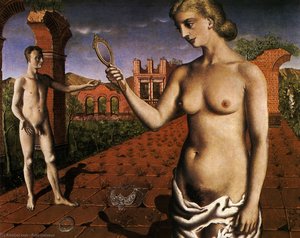
Paul Delvaux's 1967 painting, *Chrysis*, is not merely a depiction of a woman on stairs; it’s an immersion into the unsettling and profoundly beautiful realm of Surrealism. This meticulously rendered work, measuring 160 x 140 cm, captures a moment suspended between reality and dream, a hallmark of Delvaux's distinctive style that cemented his place as one of the movement’s most compelling figures. The painting immediately confronts the viewer with an arresting image: a nude woman, her skin rendered in a startlingly vibrant blue, stands poised on a grand staircase, holding a cup and cigarette – objects imbued with ambiguous significance within this nocturnal tableau.
- The Uncanny Realism: Delvaux’s technical mastery is immediately apparent. He employs a hyper-realistic style, meticulously detailing every surface, from the smooth texture of the woman's skin to the worn steps of the staircase. This realism, however, is deliberately deployed to heighten the unsettling effect, creating an "uncanny" quality that draws the viewer into a state of disquiet and fascination.
- Surrealist Symbolism: The blue figure itself is central to the painting’s enigmatic power. Blue has long been associated with melancholy, mystery, and the subconscious in art history. Combined with the woman's nudity – a recurring motif in Delvaux’s work – it evokes themes of vulnerability, desire, and perhaps even death.
Contextualizing the Dream: Delvaux and Surrealism
Delvaux emerged during a pivotal moment in the history of Surrealism, a movement born from the ashes of World War I and fueled by a desire to explore the irrational depths of the human psyche. Unlike some of his contemporaries who embraced overtly fantastical imagery, Delvaux’s surrealism was rooted in a meticulous observation of the everyday, transforming mundane scenes into dreamlike narratives. His work reflects a fascination with classical mythology, particularly themes of metamorphosis and transformation – evident in the woman's almost insect-like stillness and the implied sense of transition.
The presence of two clocks adds another layer of complexity to the scene. Clocks are frequently used as symbols of time, mortality, and the disruption of natural order—themes prevalent in Surrealist art. Their placement within the composition suggests a deliberate manipulation of temporal perception, further contributing to the painting’s dreamlike atmosphere.
Technique and Materials
Delvaux primarily worked with oil paints, utilizing a glazing technique that allowed him to build up layers of color and create subtle gradations of tone. This meticulous approach is crucial to achieving the painting's remarkable realism and luminous quality. The use of light and shadow is particularly effective in sculpting the woman’s form and creating a sense of depth within the confined space. The smooth, almost polished finish of the blue pigment contributes significantly to the unsettling effect, mimicking the sheen of skin or perhaps even insect wings.
Emotional Resonance and Legacy
*Chrysis* is more than just a beautiful image; it’s an invitation to contemplate the hidden anxieties and desires that lie beneath the surface of consciousness. Delvaux's work continues to resonate with viewers today, prompting questions about identity, sexuality, and the nature of reality itself. This reproduction offers a unique opportunity to own a piece of Surrealist history, bringing the unsettling beauty of Delvaux’s dreamscapes into your home or office.
Questions & Answers
Where in the home does a reproduction of "Chrysis" fit well?
"Chrysis" by Paul Delvaux is recommended for a living room. This suggestion is based on the work's subject, colors and mood.
What is the creation date of "Chrysis" by Paul Delvaux?
"Chrysis" dates from 1967. The date places the work within Paul Delvaux's career and its era.
Are the colors of "Chrysis" by Paul Delvaux saturated or muted?
The palette of "Chrysis" is muted in saturation.
How old was Paul Delvaux when creating "Chrysis" in 1967?
Paul Delvaux was 70 years old when creating "Chrysis" in 1967. The age is computed from the artist's birth year, 1897.
From which country does the Surrealism work "Chrysis" come?
"Chrysis" connects the Surrealism movement with Belgium through its creator's birthplace.
Which period of Paul Delvaux's career does "Chrysis" belong to?
"Chrysis" belongs to the Modern of Paul Delvaux's career. This classification relates the work to the artist's development.
Who created "Chrysis"?
"Chrysis" was created by Paul Delvaux. The information on this page describes Paul Delvaux's original work.
Artist Biography
A Dream Weaver: The Life and Art of Paul Delvaux
Born in 1897 in the small Belgian village of Wanze, Paul Delvaux embarked on a journey that would lead him to become one of the most distinctive voices within Surrealism, though he often resisted strict categorization. His early life was steeped in contrasting influences – the rigorous discipline of classical education in Greek and Latin alongside the fantastical worlds conjured by Jules Verne and Homer’s *Odyssey*. This duality, between order and imagination, would come to define his artistic vision. Initially steered towards a practical career in architecture by his parents, Delvaux found himself drawn inexorably toward painting, eventually enrolling at the Académie Royale des Beaux-Arts in Brussels. Though he struggled with the mathematical demands of architecture, the training instilled within him a mastery of perspective and form that would later serve as a foundation for the unsettling realism of his dreamscapes. His early works reflected this academic grounding, primarily landscapes painted in a post-impressionist style, but even then, hints of the peculiar atmosphere that would characterize his mature work were beginning to emerge.The Birth of a Surreal Vision
The pivotal moment in Delvaux’s artistic development arrived with his encounter with the work of Giorgio de Chirico. De Chirico's metaphysical paintings – stark, enigmatic scenes populated by shadows and classical architecture – resonated deeply with Delvaux, unlocking a new realm of possibilities. He began to populate his canvases with nude figures, often juxtaposed against imposing architectural structures or within vast, desolate landscapes. These were not merely depictions of the human form; they were explorations of desire, alienation, and the subconscious mind. The influence of Flemish Expressionists like Constant Permeke and Gustave De Smet is also visible in this period, lending a certain somber intensity to his palette and brushwork. However, Delvaux quickly transcended these influences, forging a style uniquely his own – a blend of classical precision and dreamlike irrationality. His paintings began to evoke a sense of unease, a feeling that something hidden lurked beneath the surface of reality. Recurring motifs emerged: trains, skeletal figures, and women with veiled faces, all contributing to the unsettling atmosphere that defines his work.Recurring Motifs and Symbolic Language
Delvaux’s artistic language is rich in symbolism, though he consistently resisted attempts at straightforward psychoanalytic interpretation. The female nude, a central figure in many of his paintings, often appears passive or melancholic, embodying both desire and vulnerability. Trains and railway stations frequently appear as symbols of transition, displacement, and the anxieties of modernity. Skeletons, far from being morbid emblems of death, represent a haunting presence, a reminder of mortality that permeates even the most idyllic scenes. Classical architecture provides a backdrop of order and permanence, yet it is often rendered strangely distorted or incomplete, suggesting a fragility beneath the surface. These elements are not merely decorative; they are integral to the emotional and psychological impact of his work. Night Train, for example, encapsulates many of these themes – the anonymous figures, the looming architecture, and the sense of impending doom create a powerful and unforgettable image. The artist himself explained that his imagery stemmed from deeply personal memories and impressions, particularly those from his youth, rather than conscious attempts to decode the subconscious.Legacy and Lasting Influence
Throughout his long career, Paul Delvaux remained a singular figure in the art world. While briefly associated with the Surrealist movement, he maintained a degree of independence, refusing to adhere strictly to its tenets. His paintings continue to captivate audiences with their haunting beauty and enigmatic atmosphere. Major works like The Summer, Grise City, and multiple versions of Sleeping Venus are held in prominent museums around the world, including the Tate Gallery in London and the Musee de Toyama in Japan. Delvaux’s influence can be seen in the work of numerous contemporary artists who explore themes of memory, desire, and the subconscious. He demonstrated that Surrealism could exist beyond the confines of automatic writing and dream analysis, embracing instead a meticulous technique and a deeply personal vision. His legacy endures not only through his paintings but also through the enduring power of his unique artistic language – a language that continues to speak to our deepest fears and desires. The Paul Delvaux Museum in Saint-Idesbald, Belgium, stands as a testament to his lasting impact, housing the world’s largest collection of his work and offering visitors a glimpse into the captivating realm of his imagination.
Paul Delvaux
1897 - 1994 , Belgium
Quick Facts
- Full Name: Paul Delvaux
- Nationality: Belgian
- Date Of Birth: 1897
- Date Of Death: 1994
- Place Of Birth: Wanze, Belgium
- Notable Artworks:
- Night Train
- Sleeping Venus
- The Summer
- Grise City
- The Sabbath
- Artistic Movement Or Style: Surrealism
- Artists Who Influenced This Artist:
- Giorgio de Chirico
- René Magritte
- Artists Or Movements Influenced By This Artist: Future generations
Related Articles

The Enigmatic Realm of Paul Delvaux: Surrealism, Memory & the Poetics of Disquiet
Explore the haunting dreamscapes of Paul Delvaux, a master of Surrealism. Discover his iconic motifs, classical influences & enduring legacy with OriginalUniqueArt.com.

The Enduring Allure of the Nude: A Historical & Artistic Exploration of the Human Form
Explore the captivating history of nude art! Discover iconic paintings & artists from classical to modern eras. Uncover symbolism, techniques & find museum-quality reproductions at OriginalUniqueArt.
Surrealism's Visionaries: 10 Masterpieces for Your Home | OriginalUniqueArt
Journey into the dreamlike world of Surrealism! Explore 10 masterpieces by Dali, Magritte & Miró that redefined art. Discover their stories & find museum-quality reproductions to elevate your home decor on OriginalUniqueArt.com.

Cézanne's Masterpieces: 25 Iconic Artworks to Transform Your Space
Journey through 25 iconic artworks by Paul Cézanne – a master of Impressionism and Post-Impressionism. Explore his landscapes, still lifes, and the stories behind these timeless masterpieces. Discover museum-quality reproductions & curated decor at OriginalUniqueArt.com.
Paul Klee's Masterpieces: Explore 25 Iconic Paintings & Prints | OriginalUniqueArt
Journey through Paul Klee's 25 most iconic paintings & prints. Explore his abstract style, Bauhaus influence, and vibrant color palettes. Find museum-quality art reproductions & decor ideas at OriginalUniqueArt.com. Discover all masterpieces online.