 Preview
 Send
Send Share
Share
 Details
 Guide
Guide

 Download
 Similars
 X-Ray
X-Ray Diaporama
 Stats
StatsVertical: January 1956


 Read More
The artwork displayed on this page is protected by copyright law, which means we cannot legally create or sell an identical reproduction. This protection is enforced under international agreements such as the Berne Convention and by national laws, including those outlined by the U.S. Copyright Law - Title 17.
As a respectful and legal alternative, we offer custom, hand-painted artworks inspired by the original. Our skilled and professional artists carefully study the original's style, mood, and artistic essence to create a new, unique piece that evokes the same feeling - while remaining an original creation in its own right.
This method fully complies with copyright regulations because it does not involve copying or duplicating the protected artwork. Instead, it is a creative reinterpretation - a new painting that is influenced by the original but not identical to it.
Hand Made Oil Reproduction
Hand-painted oil on canvas in your size and frame, made to order by our artists. ( Switch to Print Switch to Digital Image)




P118B $10

P118H $10

P118W $10

P438Z $10

P508JH $12

P508YH $12

P805H $10

P805Z $10

P919BZ $10

P919G $10

P919XJ $10

P959ZH $10

P968JZ $12

W106C $8

W218G $10

W218JH $8

W218Y $10

W307PJ $10

W316G $10

W316PJ $8

W316Y $10

W398PJ $8

W4111J $10

W500HY $15

W500JH $15

W692G $12

W849H $8

W940BG $15

W953PJ $8




Pick from our preset sizes that match the artwork's original proportions.

Type the width and the height you need, to fit your frame or your wall. This is hand-painted, so for a size with a different shape the artist can paint a bit more around the picture, or cut a bit — you choose. We send you a digital mockup to approve before the painting starts. The picture shown on this page does not show the real result — only the mockup does.
After order, OriginalUniqueArt.com team will email client for instructions and provide a mockup preview
Worldwide Delivery () in 3/4 weeks instead of standard 5 weeks. (24 October). No compromise on quality.

Free Worldwide Express Shipping

High-Quality Linen Canvas

Full Shipping Insurance

Customs Tax Refund Guarantee

True Color Matching Guarantee

100-Day Return Policy (Defects Only)

100% Money-Back Guarantee

Bulk Discount Offer
 Glass option is only available in size under 110 CM

Vertical: January 1956
Reproduction Medium
Reproduction Size
-


Total Price
$ 300
Vertical: January 1956 – A Dialogue Between Colour and Form
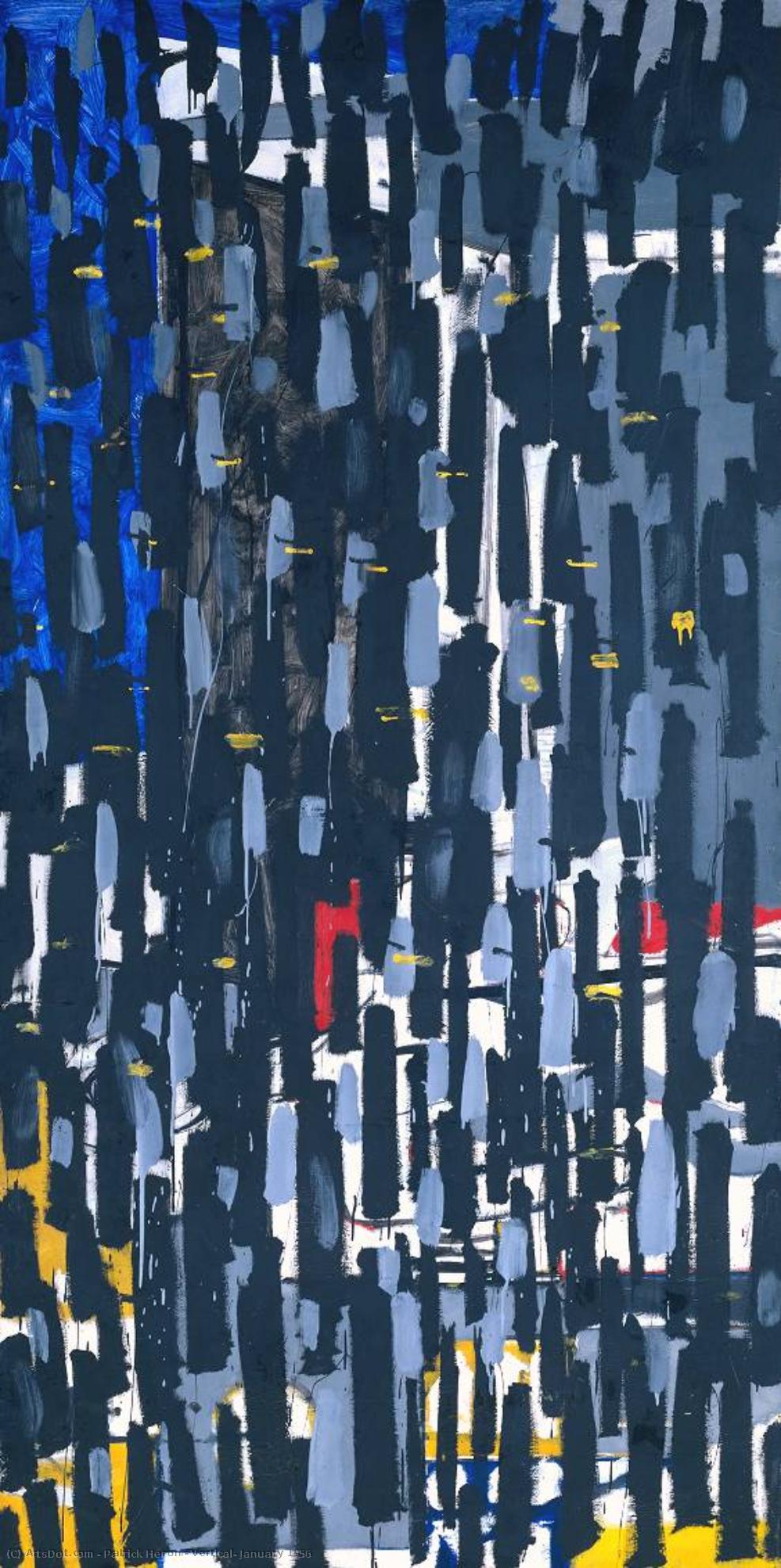
Patrick Heron’s “Vertical: January 1956” isn't merely a painting; it’s an invitation to contemplate the elemental forces shaping our perception of the world. Created in 1956 during the height of Color Field Painting, this artwork embodies the spirit of Abstract Expressionism—a movement driven by artists seeking to liberate art from representational constraints and explore the expressive potential inherent within pure color and geometric abstraction. Heron’s studio overlooking Zennor Head provided an enduring source of inspiration, subtly informing his artistic vision for decades.- Artist: Patrick Heron (1920-1999)
- Born Year: 1920
- Death Year: 1999
- Birth City: Headingley
- Birth Country: United Kingdom
Heron’s artistic journey began far from the academic institutions of his youth, nurtured by a father who instilled in him a profound appreciation for craftsmanship and pacifism. This formative period culminated in a relocation to Cornwall in 1925—a landscape that would become synonymous with Heron's oeuvre. The dramatic Cornish light, coupled with its rugged coastline, served as a constant stimulus for his creative explorations.
“Vertical: January 1956” exemplifies Heron’s signature technique – the deliberate layering of oil paint onto hardboard—resulting in a textured surface that pulsates with visual energy. The artist eschewed blending colors, opting instead to maintain their distinct identities, creating a palpable dialogue between hues and shapes. This approach aligns perfectly with Color Field Painting's core principle: prioritizing color as the dominant expressive element.
The painting’s palette is dominated by blues—ranging from deep indigo to paler shades—suggesting both tranquility and underlying tension. Accents of white, yellow, red, and grey punctuate these hues, adding complexity and visual interest. These colors aren't merely decorative; they are carefully considered symbols reflecting Heron’s preoccupation with the natural world and his desire to capture its essence.
The composition is characterized by vertical strokes—the painting’s title—that intersect irregularly shaped rectangular forms. These shapes appear fragmented, resisting any sense of rigid structure, mirroring Heron's belief that art should embrace spontaneity and unpredictability. The resulting visual field invites contemplation, prompting viewers to consider the relationship between form and color as they perceive it.
“Vertical: January 1956” transcends mere aesthetic beauty; it communicates a profound emotional resonance—a feeling of upward movement, growth, and perhaps even an acknowledgement of inherent chaos contained within order. Heron’s work continues to captivate audiences today, demonstrating the enduring power of abstract art to provoke thought and inspire emotion.
Additional Research:
- Vertical: January 1956
- Patrick Heron
- ‘Vertical : January 1956’, Patrick Heron, 1956 | Tate
- Vertical: January 1956, 1956 - Patrick Heron - WikiArt.org
- Patrick Heron
Size: Unknown
Date: 1956
Questions & Answers
What is the perceived brightness of "Vertical: January 1956" by Patrick Heron?
Overall, "Vertical: January 1956" is recorded as shadow. Perceived brightness describes how light or dark the work appears.
Where can I find a guide to "Vertical: January 1956"?
The guide to "Vertical: January 1956" is the artwork's Guide page - a printable factsheet showing the artwork with its caption, credit line and identity table (artist, dates, medium, original size, collection).
Can I order an oil reproduction of "Vertical: January 1956"?
Hand-painted copies of "Vertical: January 1956" by Patrick Heron are sold on this website: a hand-painted oil reproduction on linen canvas, ordered from its Hand-Painted Reproduction page.
Artist Biography
A Life Immersed in Colour and Light
Patrick Heron, a pivotal figure in 20th-century British art, wasn’t merely a painter; he was a visual poet, translating the vibrancy of the world onto canvas with an intensely personal language. Born in Headingley, Leeds, in 1920, his artistic journey began not within the hallowed halls of academia, but amidst the practicalities of family business and the burgeoning beauty of the Cornish landscape. His father, a clothes manufacturer and committed pacifist, fostered an environment where creativity flourished, allowing young Patrick to design fabric patterns even as a teenager – an early indication of his innate sensitivity to colour and form. This formative period, culminating in a move to Cornwall in 1925, proved crucial; the dramatic light and rugged scenery would become enduring motifs throughout his career, subtly informing his abstract explorations for decades to come. A pivotal moment arrived during a school trip to London’s National Gallery in 1933, where an encounter with the works of Paul Cézanne ignited a lifelong passion and profoundly shaped his artistic trajectory.From Figurative Beginnings to Abstract Realms
Heron's initial forays into painting were deeply rooted in the traditions he admired – Matisse, Bonnard, Braque, and Cézanne all cast long shadows over his early work. *The Piano* (1943) is often cited as his first mature piece, demonstrating a nascent ability to capture atmosphere and emotion through colour and composition. Commissions followed, notably portraits of T.S. Eliot in 1947, solidifying his reputation as a skilled figurative artist. However, the post-war era witnessed a seismic shift in Heron’s approach. Influenced by the burgeoning American Abstract Expressionist movement and a renewed engagement with European modernism, he began to dismantle representational forms, venturing into the realm of pure abstraction. This transition wasn't abrupt; it was a gradual unfolding, spurred by his move to Eagles Nest in Cornwall in 1956 – a location that would become synonymous with his artistic identity. Here, surrounded by the raw beauty of the Cornish coast, he fully committed himself to exploring non-figurative forms and the expressive potential of colour relationships.The Language of Stripes and Beyond
The late 1950s and 1960s saw the emergence of Heron’s signature ‘stripe’ paintings – bold, dynamic compositions characterized by elongated vertical lines and a dazzling array of vibrant hues. These weren't merely decorative exercises; they were rigorous investigations into the interplay of colour and space, pushing abstraction to its very limits. As Alan Bowness observed, these works were “suffused with light and color and full of a positive life-enhancing quality.” He wasn’t simply applying paint to canvas; he was constructing visual experiences, inviting viewers to immerse themselves in the pure sensation of colour. This period marked a high point in Heron's career, establishing him as a leading voice in British abstract art. Later, during the 1960s and 70s, his style evolved again, embracing what became known as ‘wobbly hard-edge’ painting. Works like *Cadmium with Violet, Scarlet, Emerald, Lemon and Venetian: 1969* exemplify this phase – bold colours and defined shapes coexisting in a dynamic tension, showcasing Heron's continued experimentation and refusal to be confined by stylistic conventions.A Critic as Well as Creator
Patrick Heron was not solely an artist; he was also a formidable art critic and writer. He contributed regularly to publications such as the *New Statesman* and *Arts New York*, offering insightful, often provocative commentary on modern art. His writings weren’t merely supplementary to his painting; they were integral to his artistic practice, reflecting a deep intellectual engagement with the history and theory of art. Through his critical lens, Heron championed modernist ideals, challenging conventional notions of beauty and representation. He sought to illuminate the underlying principles that governed abstract expression, providing valuable context for understanding not only his own work but also the broader currents shaping the art world. This dual role – artist and critic – positioned him as a key intellectual figure in post-war Britain, fostering dialogue and debate within the artistic community.A Lasting Legacy
Patrick Heron’s contribution to British art is undeniable. He stands as a leading figure in the development of abstraction, bridging the gap between European modernism and American Abstract Expressionism while forging his own unique path. His unwavering commitment to exploring colour, light, and form, coupled with his insightful critical writing, cemented his place in art history. He didn’t simply follow trends; he *created* them, influencing generations of artists who came after him. Heron's ability to “invent an imagery that was unmistakably his own, and yet which connects immediately with the natural world” remains a testament to his enduring artistic vision – a vision that continues to resonate with audiences today. His work serves as a powerful reminder of the transformative power of abstraction and the enduring beauty of colour itself.
Patrick Heron
1920 - 1999 , United Kingdom
Quick Facts
- Full Name: Patrick Heron
- Nationality: British
- Date Of Birth: 1920
- Date Of Death: 1999
- Place Of Birth: Headingley, United Kingdom
- Notable Artworks:
- The Piano
- St Ives Churchyard
- A. S. Byatt
- Artistic Movement Or Style: Abstract Expressionism
- Artists Who Influenced This Artist:
- Cézanne
- Matisse
- Braque
- Bonnard
- Artists Or Movements Influenced By This Artist: British abstract art
Related Articles
Color Field Painting: The Emotional Power of Pure Abstraction and Chromatic Depth
Explore the profound emotional depth of Color Field painting. Discover the history of mid-century abstraction, from Rothko to Newman, and learn how pure color transforms the viewer's experience through our expert art history guide.

Slate Blue Masterpieces: 10 Iconic Paintings & Timeless Home Decor Ideas
Immerse yourself in the captivating world of slate blue! Explore 10 iconic paintings by Monet, Van Gogh & Renoir. Discover their stories, techniques & find museum-quality art reproductions for your home at .

Kandinsky's Masterpieces: 25 Paintings That Define Abstract Art | OriginalUniqueArt
Journey through Wassily Kandinsky's 25 most iconic abstract paintings. Explore his revolutionary use of color, form & spiritual expressionism. Find museum-quality Kandinsky reproductions and elevate your home decor with OriginalUniqueArt.com. Discover all masterpieces on OriginalUniqueArt.com!

Abstract Expressionism's 10 Defining Masterpieces |
Explore 10 defining Abstract Expressionism masterpieces by Pollock, Rothko & de Kooning. Discover the stories behind these iconic paintings and find museum-quality art reproductions to elevate your home decor on .

Geometric Abstraction's 10 Defining Masterpieces | Art for Your Home - OriginalUniqueArt
Explore 10 defining masterpieces of Geometric Abstraction! Discover Kandinsky, Mondrian & Malevich’s iconic works. Find museum-quality art reproductions and curated decor ideas to elevate your home at OriginalUniqueArt.com.