 Switch to Print
 Read More







































 For artworks or reproductions larger than 105 cm (approximately 41 inches) on any side, the frame will be shipped as a kit, disassembled. This method ensures safe delivery and prevents damage during transport.


The Intimacy of the Fragmented Moment
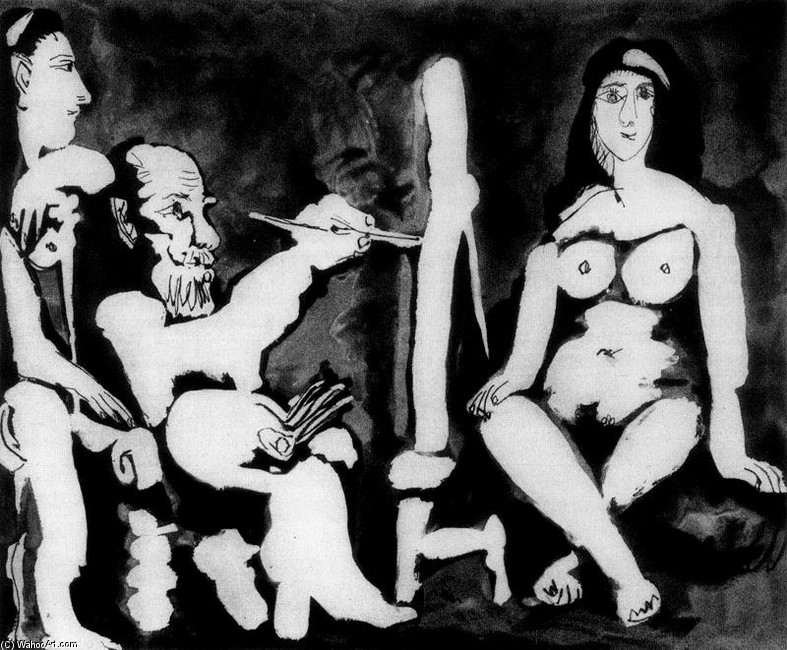
In the quiet, shadowed corners of a 1929 studio, a profound dialogue unfolds between creator and muse. Pablo Picasso’s The Painter and His Model is not merely a depiction of an artistic session; it is a window into the very soul of the creative process. During this pivotal era, following the dissolution of his marriage to Olga Khochlova, Picasso navigated a landscape of intense emotional shifts, and nowhere is this more evident than in this masterful composition. The painting captures a moment of quiet contemplation, where the boundaries between the artist’s perception and the subject's reality begin to blur. Through the revolutionary lens of Cubism, we do not encounter a literal representation, but rather a psychological landscape where figures are dismantled into geometric planes, inviting the viewer to reconstruct the intimacy of the scene through their own eyes.
A Symphony in Monochrome and Line
The visual power of this work lies in its striking restraint. Eschewing the vibrant colors often associated with later periods, Picasso employs a monochromatic palette dominated by shades of grey, deep blacks, and stark whites. This choice strips away the superficiality of color, forcing the eye to focus on the structural integrity of the forms and the raw energy of the line. The composition is anchored by the central easel, a symbol of the artist's active role in shaping visual truth. Bold, thick lines define the contours of the figures, creating a sense of weight and permanence even as the perspective fractures. There is an implied texture here—a roughness born from visible brushstrokes that suggests the spontaneity of a moment captured in flux. The use of overlapping planes and distorted perspectives creates a flattened space that paradoxically feels deeply layered, offering a complexity that rewards prolonged study.
Timeless Resonance for the Modern Space
For the discerning collector or the interior designer seeking to infuse a room with intellectual depth, this piece offers an unparalleled presence. Its stark, monochromatic elegance allows it to integrate seamlessly into contemporary minimalist environments, while its historical weight provides a sophisticated anchor for more eclectic or classical settings. The artwork does not merely decorate a wall; it commands the atmosphere, evoking a sense of quietude and creative energy. To display a high-quality reproduction of such a seminal work is to bring a piece of the Cubist revolution into the home—a constant reminder of the beauty found in fragmentation and the enduring power of human connection. It serves as a captivating focal point that sparks conversation, inviting anyone who enters the room to contemplate the delicate, eternal dance between observation and creation.
Questions & Answers
What technique and style characterize "The painter and his model 9" by Pablo Picasso?
"The painter and his model 9" by Pablo Picasso combines the lithograph technique with the Cubism style. Technique and movement describe the making and the style of the work.
What subject and atmosphere does "The painter and his model 9" by Pablo Picasso combine?
"The painter and his model 9" shows man, woman, easel, chairs, black and white, grey tones, figures, and its recorded mood is elegant.
Where can I find a guide to "The painter and his model 9"?
A Guide page is available for "The painter and his model 9" by Pablo Picasso: a printable factsheet about the artwork, designed for students and classroom use.
More about this painting
 Preview
 Send
Send Share
Share
 Details
 Guide
Guide

 Download
 Similars
 X-Ray
X-Ray Diaporama
 Q&A
Q&A Stats
Stats