
 Preview
 Send
Send Share
Share
 Details
 Guide
Guide

 Download
 Similars
 X-Ray
X-Ray Diaporama
 Q&A
Q&A Stats
StatsThree Nudes
 Acrylic On Canvas
- WallArt
- Expressionism
 1910
1910- 19th Century
 395.0 x 315.0 cm
 Kunstpalast
 Read More
Giclée / Art Print
Museum-quality giclée or canvas print with fast production and flexible finish options. ( Buy Hand Made Painting Switch to Digital Image)




P118B $10

P118H $10

P118W $10

P438Z $10

P508JH $12

P508YH $12

P805H $10

P805Z $10

P919BZ $10

P919G $10

P919XJ $10

P959ZH $10

P968JZ $12

W106C $8

W218G $10

W218JH $8

W218Y $10

W307PJ $10

W316G $10

W316PJ $8

W316Y $10

W398PJ $8

W4111J $10

W500HY $15

W500JH $15

W692G $12

W849H $8

W940BG $15

W953PJ $8




Pick from our preset sizes that match the artwork's original proportions.

Type the width and the height you need, to fit your frame or your wall. A print can only be cut, never made bigger than the picture, so a size with a different shape loses a part of the image. We send you a digital mockup to approve before we print anything. The picture shown on this page does not show the real cut — only the mockup does.
Worldwide Delivery () in 2 weeks instead of standard 4/5 weeks. (30 October)

Free Worldwide Express Shipping

High-Quality Linen Canvas

Full Shipping Insurance

Customs Tax Refund Guarantee

True Color Matching Guarantee

100-Day Return Policy (Defects Only)

100% Money-Back Guarantee

Bulk Discount Offer
 Glass option is only available in size under 110 CM

Three Nudes
Giclée / Art Print
Reproduction Size
-


Total Price
$ 81
Otto Mueller’s ‘Three Nudes’: A Study in Rural Melancholy
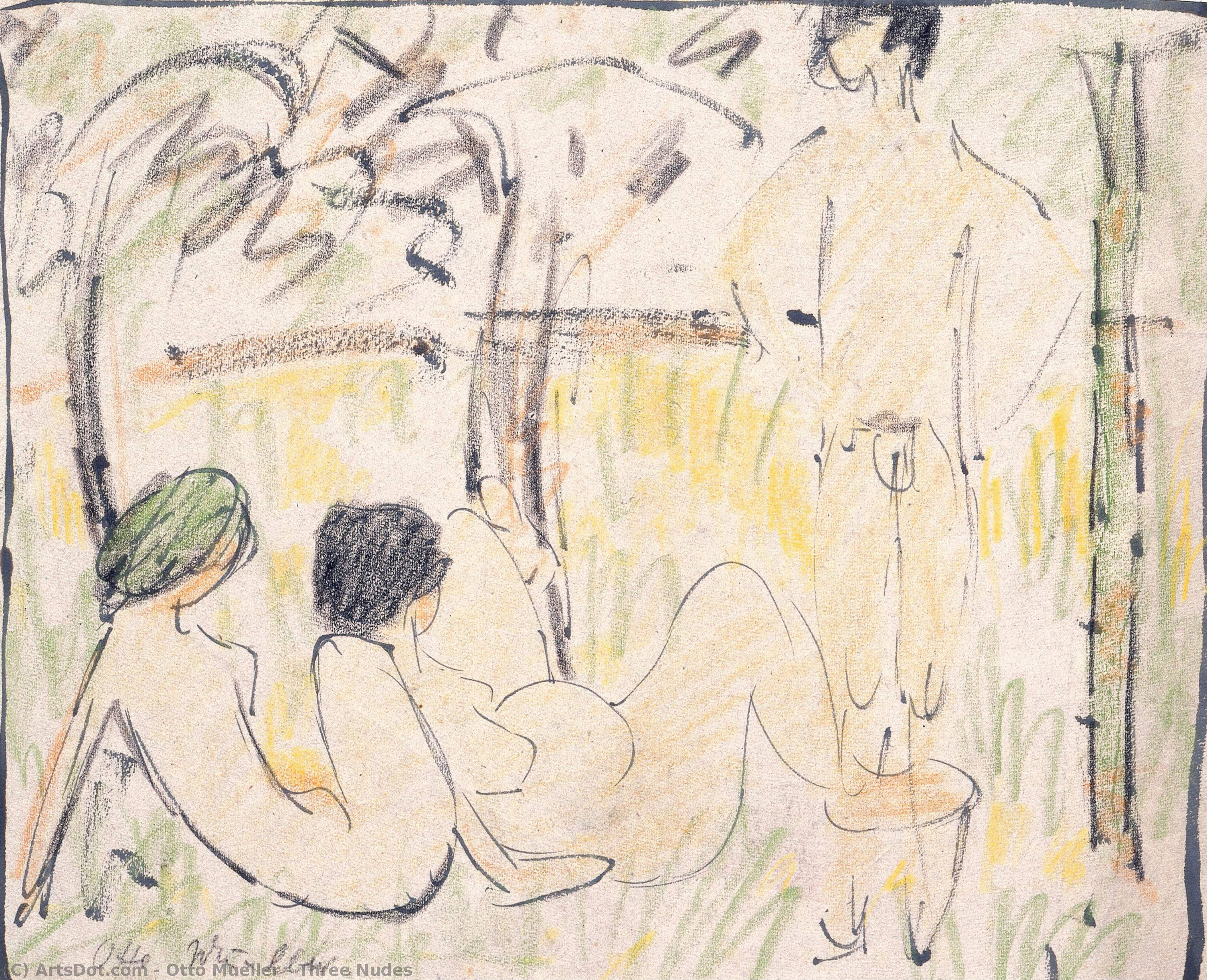
“Three Nudes,” painted in 1910 by Otto Mueller, is more than just a depiction of three figures seated in a grassy field; it's a poignant meditation on isolation, observation, and the quiet dignity of everyday life. This work, rendered with Mueller’s signature meticulous attention to detail and his deeply rooted connection to the natural world, exemplifies the burgeoning Expressionist movement while retaining a distinctly Romantic sensibility. Measuring 395 x 315 cm, the scale of the canvas amplifies the sense of intimacy within the scene, drawing the viewer into the figures' contemplative space.
Expressionism and the Rural Landscape
Born in Liebau, Poland (then part of Prussia), Otto Mueller’s artistic trajectory was shaped by his itinerant lifestyle. He spent years wandering through Germany’s rural landscapes, meticulously documenting the lives of farmers, laborers, and other individuals living on the fringes of society. “Three Nudes” reflects this profound engagement with the realities of rural existence. The painting's style aligns squarely within Expressionism, a movement characterized by its emphasis on subjective emotion and distorted forms to convey inner experience. However, Mueller’s approach is tempered by a classical restraint; his brushwork is precise, almost photographic in its detail, yet imbued with a palpable sense of melancholy.
Composition and Symbolism
The composition itself is subtly powerful. The three figures, rendered in muted earth tones – browns, ochres, and grays – are arranged in a triangular formation, their gazes averted from the viewer, lost in thought or observation. The presence of the two chairs adds an element of domesticity, suggesting a moment of respite or perhaps a shared contemplation. The setting—a natural, unadorned landscape—further emphasizes the figures’ vulnerability and isolation. While explicitly depicting nude subjects, Mueller avoids overt sensuality; instead, he focuses on their psychological state, inviting viewers to contemplate themes of loneliness, introspection, and the human condition.
Technique and Historical Context
Mueller's technique is characterized by a rigorous approach to line and texture. Executed with oil paints, the canvas reveals a remarkable level of detail – from the individual blades of grass to the subtle folds in the figures’ clothing. This meticulousness was influenced by his early training in lithography, a medium that demanded precision and control. Created during a period of significant artistic experimentation, “Three Nudes” anticipates many of the key themes explored by later Expressionist artists, such as Kirchner and Nolde. It stands as a crucial work in Mueller’s oeuvre, demonstrating his mastery of depicting both the beauty and the sadness inherent in the natural world.
Perfect Reproduction
OriginalUniqueArt offers a meticulously crafted hand-painted reproduction of Otto Mueller's “Three Nudes,” capturing the essence of this evocative artwork. Each reproduction is created by skilled artisans, ensuring an unparalleled level of detail and color accuracy. This piece would be a stunning addition to any art collection or a sophisticated focal point within interior design settings.
Questions & Answers
Is "Three Nudes" more bright or more dark overall?
"Three Nudes" is brilliant overall, and its luminance is luminous.
How do the colors of "Three Nudes" relate to each other?
The colors of "Three Nudes" by Otto Mueller show a strong color unity harmony. Harmony describes how the colors relate to each other.
Is there a factsheet about "Three Nudes" by Otto Mueller for students?
The Guide page of "Three Nudes" by Otto Mueller offers a printable two-sheet factsheet: the artwork with its identity table, a decade band placing it in the artist's lifetime, other works by the artist, the measured color palette, and ready-to-copy citations in four styles.
Artist Biography
A Wanderer’s Soul: The Life and Art of Otto Mueller
Otto Mueller, a name often whispered alongside the pioneers of German Expressionism, was an artist deeply attuned to the rhythms of nature and the lives lived on its fringes. Born in 1874 in Liebau, Silesia – now Lubawka, Poland – his journey began amidst a landscape that would forever imprint itself upon his artistic vision. Early training in lithography at Görlitz and Breslau provided him with a foundational skill set, a mastery of line and texture that would characterize much of his later work. He continued his studies at the prestigious academies of Dresden and Munich, though a dismissive assessment from Franz von Stuck at the latter led to a period of self-directed exploration. These formative years saw Mueller absorbing influences from Impressionism, Jugendstil, and Symbolism, yet he remained restless, searching for a voice uniquely his own.Finding Harmony in Distortion: The Expressionist Path
The turning point arrived with Mueller’s relocation to Berlin in 1908. Here, amidst the burgeoning artistic ferment of the city, his style began its dramatic transformation. Interactions with figures like Wilhelm Lehmbruck and Rainer Maria Rilke fueled a growing interest in exploring the emotional depths of human experience. In 1910, he formally joined ‘Die Brücke’ (The Bridge), a group of artists dedicated to rejecting academic conventions and forging a new visual language rooted in raw emotion and subjective perception. While his colleagues often embraced jarring color palettes and aggressive brushwork, Mueller charted a slightly different course. He sought harmony within distortion, simplifying forms and contours to reveal an underlying sense of unity between humanity and the natural world. His landscapes, imbued with a quiet intensity, echo the spirit of Vincent van Gogh, while his figures – particularly those of Romani women – possess a haunting grace. This period cemented his nickname, “Gypsy Müller,” though it was a moniker born more from fascination with his subject matter than any confirmed lineage.A Unique Technique and Recurring Motifs
Mueller’s artistic process was as distinctive as his vision. He favored distemper – a water-based paint – applied to coarse canvas, creating a matte surface that lent his works an earthy, almost primal quality. This technique contributed significantly to the overall mood of his paintings, evoking a sense of intimacy and vulnerability. His subject matter consistently revolved around several key themes: serene landscapes often reminiscent of starry nights, expressive nudes embodying both sensuality and melancholy, and, most notably, depictions of Romani people. These figures were not merely portraits; they represented a longing for freedom, a connection to nature, and an alternative way of life outside the constraints of bourgeois society. He was a prolific printmaker as well, with lithography being his preferred medium, alongside some woodcuts and etchings. The simplicity of line in these prints further emphasized the emotional core of his subjects.Shadows of War and Legacy
Like many of his generation, Mueller’s life was profoundly impacted by World War I. He served as a soldier on both the French and Russian fronts, an experience that undoubtedly left its mark, though it did not dramatically alter his artistic style. After the war, he accepted a professorship at the Academy of Fine Arts in Breslau, dedicating himself to teaching until his death in 1930. Tragically, his work fell victim to the ideological purges of the Nazi regime in 1937, with over three hundred pieces confiscated from German museums and labeled as “degenerate art.” Despite this suppression, Mueller’s artistic legacy endured. Today, he is recognized as a pivotal figure in Expressionism, an artist whose sensitive depictions of humanity and nature continue to resonate with audiences worldwide. His work serves as a poignant reminder of the power of art to transcend political boundaries and speak to the universal human condition.
Otto Mueller
1874 - 1930 , Poland
Quick Facts
- Full Name: Otto Mueller
- Nationality: German
- Date Of Birth: 1874
- Date Of Death: 1930
- Place Of Birth: Liebau, Poland
- Notable Artworks:
- Starry Night landscapes
- Expressive nudes
- Romani women portraits
- Artistic Movement Or Style: Expressionism
- Artists Who Influenced This Artist:
- Impressionism
- Jugendstil
- Symbolism
- Artists Or Movements Influenced By This Artist: ['Die Brücke']
Related Articles

Echoes of Time: Exploring the Enduring Appeal & Historical Context of Vintage Art Prints
Explore the captivating world of vintage art prints! Discover their history, collecting tips & enduring appeal. Expert insights on chromolithography and building a legacy collection with OriginalUniqueArt.

The Enduring Legacy of Fine Art Prints: Technique, History & Aesthetic Impact
Explore the rich history & techniques of fine art prints. Discover investment potential, assess authenticity, and learn how to preserve your collection with expert guidance. Trusted insights for discerning collectors.

The Enduring Allure of the Nude: A Historical & Artistic Exploration of the Human Form
Explore the captivating history of nude art! Discover iconic paintings & artists from classical to modern eras. Uncover symbolism, techniques & find museum-quality reproductions at OriginalUniqueArt.

Giclée Prints: Archival Quality & Aesthetic Nuances for the Discerning Collector
Explore the world of giclée prints with OriginalUniqueArt. Learn about archival quality, aesthetic nuances & investment potential. Expert guidance for discerning art collectors seeking museum-quality reproductions and lasting value.
The Enduring Legacy of Printmaking: Techniques, Themes & Artistic Innovation Across Centuries
Explore the rich history of printmaking with OriginalUniqueArt. Discover techniques from intaglio to lithography, learn about collecting valuable prints & find museum-quality reproductions. Expert insights for art enthusiasts and collectors.


