Preview
 Send
Send Share
Share
 Details
 Guide
Guide

 Download
 Similars
 X-Ray
X-Ray Diaporama
 Stats
StatsA nun


 Read More
Giclée / Art Print
Museum-quality giclée or canvas print with fast production and flexible finish options. ( Buy Hand Made Painting Switch to Digital Image)




































Pick from our preset sizes that match the artwork's original proportions.

Type the width and the height you need, to fit your frame or your wall. A print can only be cut, never made bigger than the picture, so a size with a different shape loses a part of the image. We send you a digital mockup to approve before we print anything. The picture shown on this page does not show the real cut — only the mockup does.
Worldwide Delivery () in 2 weeks instead of standard 4/5 weeks. (26 October)

Free Worldwide Express Shipping

High-Quality Linen Canvas

Full Shipping Insurance

Customs Tax Refund Guarantee

True Color Matching Guarantee

100-Day Return Policy (Defects Only)

100% Money-Back Guarantee

Bulk Discount Offer
 Glass option is only available in size under 110 CM

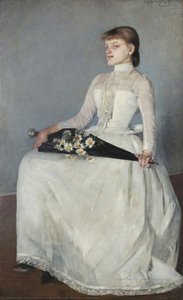
A nun
Giclée / Art Print
Reproduction Size
-


Total Price
$ 81
Artist Biography
The Soul Captured in Shadow: The Life of Olga Boznańska
In the quiet, atmospheric corners of late nineteenth-century European art, few names resonate with as much psychological depth and tonal subtlety as Olga Boznańska. Born in 1865 in Kraków to a Polish father and a French mother, her very existence was a bridge between two worlds. This dual heritage—the rich, historical weight of Poland and the avant-garde spirit of France—would become the cornerstone of her artistic identity. Her early years were steeped in a cultural duality that allowed her to navigate the prestigious art circles of Munich and Paris with an ease that few of her contemporaries could claim. As she matured, Boznańska did not merely paint subjects; she sought to capture the invisible essence of her sitters, creating works that feel less like static images and more like whispered secrets shared between the artist and the viewer.
Her journey through the heart of the European art scene was shaped by profound encounters with the masters of her era. Immersed in the burgeoning Impressionist movement in Paris, she absorbed the revolutionary lessons of light and color offered by figures such as Claude Monet. Yet, Boznańska possessed a temperament that resisted the purely optical experiments of pure Impressionism. Instead, she found a kindred spirit in the emotional intensity of Edvard Munch, whose ability to translate internal psychological states onto canvas deeply moved her. This synthesis of French light and Northern European introspection allowed her to develop a style that was uniquely hers—a technique defined by soft, blurred edges, a muted palette of silvery greys, deep blues, and delicate ochres, and a mastery of sfumato that lent her portraits an ethereal, almost ghostly quality.
A Mastery of Introspection and Technique
The true brilliance of Boznańska’s oeuvre lies in her ability to find profound meaning within the seemingly mundane. While many of her contemporaries sought the spectacle of grand historical narratives or the bright sunlight of plein air landscapes, Bozna and her subjects often retreated into the intimate sanctuary of the studio. Her portraits are legendary for their psychological complexity; she had an uncanny ability to strip away the social pretenses of her subjects, leaving behind a raw, contemplative vulnerability. Whether depicting a young girl lost in thought or a seasoned aristocrat, her brushwork remains incredibly nuanced, using subtle tonal gradations to build form and emotion without the need for harsh outlines.
Her technical repertoire was as diverse as her emotional range, encompassing several key elements of her artistic language:
- The Use of Tonalism: Rather than relying on high-contrast colors, she utilized a sophisticated range of mid-tones to create atmosphere and depth.
- Psychological Portraiture: Her subjects often possess an introspective gaze, inviting the viewer into their private emotional landscapes.
- Still Life as Emotion: In her still lifes, objects like flowers or simple vessels are treated with the same reverence and soulfulness as her human subjects.
- The Influence of Pastel and Oil: Her ability to manipulate different mediums allowed her to achieve both the soft, powdery textures of light and the rich, heavy shadows of deep emotion.
Legacy and Historical Significance
As a prominent figure within the Young Poland movement, Boznańska played a vital role in elevating Polish art to the international stage during a period of significant national transition. Her studio in Paris and later her return to Kraków served as more than just workspaces; they were intellectual crucibles where the boundaries of modern portraiture were pushed and redefined. She stood as a pioneer for female artists, proving that a woman could command the profound, often somber themes of psychological realism with unparalleled authority.
Today, her legacy is preserved not just in museums, but in the way we perceive the intersection of light and human emotion. Her masterpiece, Girl with Chrysanthemums, remains a haunting testament to her ability to render innocence through a lens of melancholy beauty. Boznańska’s work continues to captivate modern audiences because it speaks to a universal truth: that beneath the surface of every face lies a complex, beautiful, and often tragic story waiting to be told through the delicate dance of shadow and light.

Olga Boznańska
1865 - 1940 , Poland
Quick Facts
- Full Name: Olga Boznańska
- Nationality: Polish
- Date Of Birth: 1865
- Date Of Death: 1940
- Place Of Birth: Krakow, Poland
- Notable Artworks:
- Girl with Chrysanthemums
- Portrait of Gabriela Reval
- Cathedral of Pisa
- Portrait of Faliks Manggha Jasieński
- Artistic Movement Or Style: Impressionism
- Artists Who Influenced This Artist: ['Gustav Klimt']
- Artists Or Movements Influenced By This Artist: ['Polish Impressionism']