Oil Edition
 Everything about Auricular Cell







































 For artworks or reproductions larger than 105 cm (approximately 41 inches) on any side, the frame will be shipped as a kit, disassembled. This method ensures safe delivery and prevents damage during transport.


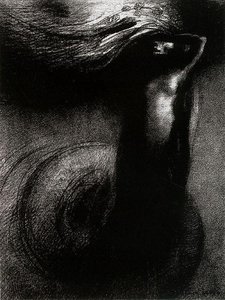
The Weight of Silence
A woman’s face emerges from a pale oval, held within a larger, ghostly circle. Her eyes are closed, drifting in a state of quietude or perhaps a dream. The most striking feature is the ears, exaggerated and large, pulling the viewer toward the concept of listening. This is a lithograph from 1894, a moment when the artist was deeply immersed in his noirs, those monochromatic explorations of shadow and light. The image does not seek to replicate a person, but to capture a sensation of profound, internal stillness.
The composition relies on a delicate tension between containment and expansion. The circular boundaries create a sense of isolation, a private chamber for the mind to wander. Through the use of fine, closely spaced lines, the artist builds a texture that feels almost tactile, like grain in a memory. The lighting does not fall from an external source; it seems to glow from within the skin itself, casting soft shadows that define the contours of the face and the heavy, sensitive curves of the ears.
The Language of Line
The technical execution of this lithograph reveals a mastery of tonal gradation. By varying the density of the lines, the artist achieves a sense of depth without the need for traditional perspective. The shadows are thick and dark, while the highlights remain delicate and airy. This method creates a specific visual rhythm:
- Dense, dark hatching that defines the deep recesses of the ears.
- Fine, sparse lines that allow the light to breathe across the forehead.
- A grainy, stippled texture that suggests the ephemeral nature of a dream.
- A flattened perspective that denies the viewer a way into a physical room.
The Symbolism of Perception
In this work, the anatomy becomes a metaphor for the soul's sensitivity. The oversized ears suggest a heightened state of intuition, a capacity to hear the unspoken or the unseen. It is a study of the internal rather than the external. The monochromatic palette of black, white, and grey strips away the distractions of the physical world, leaving only the essential shapes of thought and feeling. The subject is not a woman being looked at, but a consciousness being felt. The silence is heavy.
Questions & Answers
Is this Auricular Cell painted by hand or printed?
Painted by hand: a trained painter copies Auricular Cell in oil on linen canvas.
What size should I choose for Auricular Cell?
The original measures 26 x 25 cm. Sizes run from 32.9 x 30.4 cm ($200) to 249.1 x 230.5 cm ($2071); the table on this page lists the main steps and their prices.
How long does delivery take?
Delivery takes 4 to 5 weeks, with free worldwide express shipping; an urgent production option is offered on this page. You can return it within 100 days for a full refund, with no condition.
What medium did Odilon Redon use for Auricular Cell?
Lithograph.
More about this painting
 Preview

 Send
 Share
 Details
 Fact sheet


 Download
 Similars
 X-Ray
 Diaporama
 Q&A

 Stats