

 Send
Send Share
Share
 Details
 Guide
Guide

 Download
 Similars
 Diaporama
 Stats
StatsConnection I
 Sculpture
- Sculpture
- Contemporary Realism
 1996
1996- Modern
 50.0 x 55.0 cm
 Paintings in Hospitals
 Read More
The artwork displayed on this page is protected by copyright law, which means we cannot legally create or sell an identical reproduction. This protection is enforced under international agreements such as the Berne Convention and by national laws, including those outlined by the U.S. Copyright Law - Title 17.
This method fully complies with copyright regulations because it does not involve copying or duplicating the protected artwork. Instead, it is a creative reinterpretation - a new painting that is influenced by the original but not identical to it.
Giclée / Art Print
Museum-quality giclée or canvas print with fast production and flexible finish options. ( Buy Hand Made Painting Switch to Digital Image)




































Pick from our preset sizes that match the artwork's original proportions.

Type the width and the height you need, to fit your frame or your wall. A print can only be cut, never made bigger than the picture, so a size with a different shape loses a part of the image. We send you a digital mockup to approve before we print anything. The picture shown on this page does not show the real cut — only the mockup does.
Worldwide Delivery () in 2 weeks instead of standard 4/5 weeks. (25 October)

Free Worldwide Express Shipping

High-Quality Linen Canvas

Full Shipping Insurance

Customs Tax Refund Guarantee

True Color Matching Guarantee

100-Day Return Policy (Defects Only)

100% Money-Back Guarantee

Bulk Discount Offer
 Glass option is only available in size under 110 CM

Connection I
Giclée / Art Print
Reproduction Size
-


Total Price
$ 81
Norie Hatakeyama’s “Connection I”: A Coral Echo of Ancient Resonance
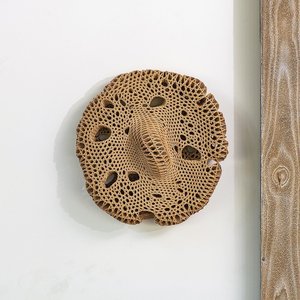
Norie Hatakeyama's "Connection I," created in 1996, is more than just a sculpture; it’s an invitation to contemplate the enduring power of nature and the echoes of ancient symbolism. This intimate piece, measuring 50 x 55 cm, immediately draws the viewer into its intricate world – a meticulously crafted assemblage of shells and coral that seems to breathe with oceanic energy. The photograph captures a moment of profound detail, highlighting the sculpture’s deliberate imperfections, the very holes that lend it such captivating texture and an almost unsettling beauty.
The Artist's Vision: Hatakeyama and the Spirit of Japan
Norie Hatakeyama, born in Tokyo in 1952, is a significant figure within contemporary Japanese art. Her work frequently explores themes of nature, spirituality, and memory, often drawing upon traditional Japanese aesthetics and philosophies. Hatakeyama’s artistic practice reflects a deep connection to the natural world, particularly the sea – a recurring motif in her sculptures. This reverence for the organic informs every aspect of “Connection I,” from its raw materials to its evocative form. Her work is frequently described as embodying a quiet contemplation, inviting viewers to find their own resonance within its delicate structure.
Technique and Materiality: A Dialogue with the Ocean
The sculpture’s remarkable quality stems directly from Hatakeyama's masterful technique. The use of shells and coral – materials inherently imbued with the history of the ocean – elevates the piece beyond a simple assemblage. Each hole, carefully created or naturally occurring, isn’t merely an absence; it’s a deliberate element that contributes to the overall composition. This meticulous attention to detail suggests a profound respect for the raw beauty of the materials and a desire to reveal their inherent qualities. The process likely involved careful selection of each component, considering not just its visual impact but also its tactile properties – the smooth curve of a shell, the rough texture of coral.
Symbolism and Emotional Impact: A Fragmented Narrative
"Connection I" resonates with themes of interconnectedness and impermanence. The fragmented nature of the sculpture—the individual shells and corals combined to form a larger whole—can be interpreted as a metaphor for life itself, constantly shifting and evolving. The holes within the structure might represent voids, absences, or perhaps opportunities – portals to new connections. Considering Hatakeyama’s broader artistic concerns, this piece likely speaks to a deeper yearning for harmony between humanity and nature, echoing sentiments prevalent in Japanese art traditions that emphasize the cyclical nature of existence. The sculpture's quiet power evokes a sense of serenity and invites introspection, making it a compelling addition to any collection or interior space.
Questions & Answers
What is "Connection I" made with?
Norie Hatakeyama used the sculpture technique for "Connection I". The technique defines the material nature of the original work.
Which period of Norie Hatakeyama's career does "Connection I" belong to?
"Connection I" represents the Mature Period of Norie Hatakeyama.
What atmosphere would a reproduction of "Connection I" by Norie Hatakeyama bring to a room?
"Connection I" by Norie Hatakeyama has an earthy atmosphere and is recommended for a living room. The mood is what the work brings to the space around it.
Artist Biography
The Intricate Geometry of Nature and Material
Norie Hatakeyama is a Japanese artist whose work exists at the profound intersection of nature, urbanization, and mathematical precision. Her practice is defined by a mesmerizing exploration of structure, where the boundaries between organic growth and geometric form become beautifully blurred. Through her unique approach to sculpture, she invites viewers into a world that feels simultaneously ancient and contemporary, capturing the energy of living organisms within meticulously crafted three-dimensional shapes. Her artistic vision is driven by an impulse to redefine both material and method, seeking to uncover the subtle beauty found in rhythm, texture, and thoughtful repetition.
The essence of Hatakeyama’s work lies in her ability to listen to her materials, allowing shape and gesture to unfold through a process of slow making and material intuition. Her sculptures often possess an ethereal quality, appearing as though they have no apparent starting or endpoints, much like the continuous cycles of regeneration found in the natural world. By embracing the tension between science—such as mathematics and geometry—and art, she creates pieces that reflect the complex structures of the universe itself. In her view, the natural world is a field composed of matter and energy, and her work serves as a meditative reflection on this radiating, unremitting energy.
Materiality and the Art of the Plait
One of the most striking aspects of Hatakeyama’s technique is her innovative use of unconventional, factory-made materials to achieve complex, organic results. She is globally recognized for her contemporary, intricate plaited works that utilize Japanese rice paper and paper-packing tape. This choice of medium allows her to bridge the gap between the industrial and the natural, using a mundane, mass-produced substance like tape to realize sophisticated geometric concerns. Her process involves an intense level of craftsmanship, where the act of plaiting becomes a way to explore the transition from simple matter into complex, sculptural forms.
Her development as an artist was significantly shaped by her early studies in basketmaking. In 1980, she began studying this traditional craft under Hisako Sekijima in Japan. This mentorship was transformative; Sekijima’s nontraditional and open-minded approach to the medium of basketry provided Hatakeyama with the freedom to push beyond expected boundaries. This foundation in traditional techniques, combined with her desire to explore modern materials, has allowed her to create a body of work that is both deeply rooted in Japanese craft heritage and strikingly modern in its execution.
Legacy and Global Recognition
The significance of Norie Hatakeyama’s contribution to contemporary sculpture is reflected in the prestigious collections and exhibition venues that house her work. Her pieces have been featured in diverse international settings, ranging from museum collections in the United States to specialized craft museums in Europe and Japan. Her ability to resonate with audiences across different cultures highlights the universal appeal of her themes regarding structure, nature, and the interconnectedness of all things.
Notable recognitions of her work include:
- Selected Collections: The Museum of Art at the University of Michigan, Ann Arbor; Paintings in Hospitals, Derby City Council, UK.
- Exhibition Venues: Nigata Prefectural Museum of History, Japan; National Vlechtmuseum, Noorwolde, the Netherlands; Crafts Council, London, UK; Senbikiya Gallery, Tokyo, Japan; Space S. Tokyo, Japan; Silk Gallery, Japan Embassy, Seoul, Korea; Racine Art Museum, Wisconsin; and the Flinn Gallery, Connecticut.
Norie Hatakeyama
1952 - , Japan
Quick Facts
- Artistic Movement Or Style: Contemporary sculpture and basketry
- Artists Who Influenced This Artist: ['Hisako Sekijima']
- Full Name: Norie Hatakeyama
- Nationality: Japanese
- Notable Artworks:
- Connection I
- Endless Line Series
- Place Of Birth: Tokyo, Japan
- Date Of Birth: 1952
Related Articles

The Enduring Form: Sculpture Across History, Technique & Emotional Resonance
Explore the rich history of sculpture with OriginalUniqueArt. Discover key techniques, influential artists & investment potential for discerning collectors. Expert insights into valuing and collecting timeless masterpieces.

Bronze Sculptures That Defined Art History | OriginalUniqueArt
Journey through art history with our Top 10 bronze sculptures! Explore masterpieces by Rodin, Michelangelo & more. Discover stories behind iconic statues and find museum-quality reproductions for your home decor at OriginalUniqueArt.com.
The Enduring Legacy of Bronze Sculpture: History, Techniques & Contemporary Interpretations
Explore the rich history & enduring appeal of bronze sculpture. Learn about casting techniques, iconic artists, collecting tips, & contemporary interpretations. Expert insights for discerning art collectors.

The Enduring Form: Exploring Themes & Techniques in Sculpture Across Historical Periods
Explore the rich history of sculpture from ancient masterpieces to contemporary innovations. Discover key techniques, influential artists & investment potential for discerning art collectors.

Bronze Age to Modern Masters: 10 Sculptures That Redefined Art | OriginalUniqueArt
Journey through art history with 10 legendary bronze sculptures – from Michelangelo's David to Rodin’s Thinker. Explore the stories, techniques & timeless beauty of these masterpieces. Find museum-quality reproductions & elevate your home decor on OriginalUniqueArt.com.
