Preview
 Send
Send Share
Share
 Details

 Download
 Similars
 X-Ray
X-Ray Diaporama
 Stats
StatsCanadian Geese
 Contemporary Realism
 1979
1979 55.0 x 68.0 cm
 Read More
Giclée / Art Print
Museum-quality giclée or canvas print with fast production and flexible finish options. ( Buy Hand Made Painting Switch to Digital Image)




P118B $10

P118H $10

P118W $10

P438Z $10

P508JH $12

P508YH $12

P805H $10

P805Z $10

P919BZ $10

P919G $10

P919XJ $10

P959ZH $10

P968JZ $12

W106C $8

W218G $10

W218JH $8

W218Y $10

W307PJ $10

W316G $10

W316PJ $8

W316Y $10

W398PJ $8

W4111J $10

W500HY $15

W500JH $15

W692G $12

W849H $8

W940BG $15

W953PJ $8




Pick from our preset sizes that match the artwork's original proportions.

You may enter your own dimensions to fit a specific frame or space. If your selected size does not match the original image's proportions, we will either crop the artwork or extend the image with a mirrored or solid-fill edge. A digital mockup will be sent for your approval before production begins.
Please note that the on-screen preview does not reflect the actual cropping or extension. Only the mockup will accurately show the final composition.
While custom sizes are available, we recommend selecting a dimension from the predefined list to preserve the original proportions.
Worldwide Delivery () in 2 weeks instead of standard 4/5 weeks. (10 September)

Free Worldwide Express Shipping

High-Quality Linen Canvas

Full Shipping Insurance

Customs Tax Refund Guarantee

True Color Matching Guarantee

100-Day Return Policy (Defects Only)

100% Money-Back Guarantee

Bulk Discount Offer
 Glass option is only available in size under 110 CM

Canadian Geese
Giclée / Art Print
Reproduction Size
-


Total Price
$ 81
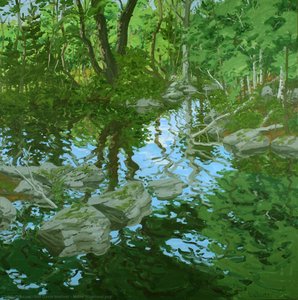
A Serene Study in Form: Neil Welliver's "Canadian Geese"
This striking print by Neil Gavin Welliver, created in 1979, offers a captivating glimpse into the natural world. It depicts three Canada geese gracefully swimming on calm waters, rendered not with photographic realism but through a stylized and deliberate artistic approach. The composition is elegantly simple; the geese are centrally positioned against a rich, textured background, drawing the viewer's eye to their quiet presence. This isn’t merely an observation of wildlife; it’s a carefully constructed visual poem about tranquility and connection with nature.Style & Technique: Echoes of Japanese Woodblock Printing
Welliver’s "Canadian Geese" demonstrates a clear influence from Japanese aesthetic principles, particularly those found in woodblock printing (Ukiyo-e). The artwork's flattened perspective, geometric simplification of forms – the ovals for bodies, triangles for heads – and layered blocks of color are all hallmarks of this technique. While the exact process remains undocumented, it’s highly probable that multiple woodblocks were carved and meticulously layered to achieve the final image. This method allows for a controlled build-up of color and texture, creating a visual depth despite the overall two-dimensional feel. The implied brushstrokes within the printmaking process further enhance the artwork's tactile quality, suggesting movement and life even in this stylized representation.Symbolism & Context
Geese have long held symbolic significance across various cultures. They often represent journeys, migration, loyalty, and family bonds – themes that resonate within the serene depiction of these birds navigating their watery domain. Created in 1979, this print reflects a broader cultural interest in environmental awareness and appreciation for natural landscapes during that era. While Welliver is primarily known for his large-scale oil paintings depicting Maine's forests and figures, this work demonstrates his versatility and ability to capture the essence of nature through different mediums.Emotional Impact & Artistic Legacy
"Canadian Geese" evokes a profound sense of calm and contemplation. The diffused lighting, soft shadows, and subtle reflections on the water’s surface contribute to an atmosphere of quiet observation. It's a fleeting moment captured in time – a testament to Welliver’s skill in distilling complex natural scenes into their most essential forms. As a Maine landscape painter known for his evocative style, Neil Welliver (1929-2005) left behind a legacy of capturing the beauty and power of the American wilderness. Owning a reproduction of "Canadian Geese" allows you to bring a touch of that enduring artistic vision into your own space – a constant reminder of nature's serenity and the artistry of observation.Artist Biography
Early Life and Artistic Foundations
Neil Gavin Welliver, born in the small lumber town of Millville, Pennsylvania, on July 22, 1929, embarked on a journey that would establish him as a pivotal figure in American landscape painting. His upbringing amidst the rugged beauty of rural Pennsylvania instilled within him a deep connection to nature—a reverence that would become the defining characteristic of his artistic vision. After graduating from high school with a small class of twenty-one students, Welliver pursued formal training at the Philadelphia College of Art (now part of the University of the Arts), laying the groundwork for his future explorations in visual expression. He continued his studies at Yale University, earning an MFA and encountering influential abstract artists like Burgoyne Diller and Josef Albers. These early encounters with abstraction proved formative, shaping Welliver’s understanding of color theory and composition—principles that would subtly inform his later representational work.
From Abstraction to the Maine Wilderness
Welliver's artistic trajectory wasn’t a straight line but rather an evolving process of discovery. Initially drawn to abstract color field painting, he began teaching at Cooper Union in 1953 and then at Yale from 1956 to 1966. However, a pivotal shift occurred during his time in Maine—a state that would become synonymous with his artistic identity. In the early 1960s, Welliver ventured into the remote woodlands of Maine, abandoning the confines of abstraction for the direct observation of nature. He began painting figures outdoors, often depicting his sons canoeing or female nudes bathing in the pristine waters and rugged landscapes. These works were characterized by a sense of intimacy and immediacy, capturing fleeting moments of human connection with the natural world.
The Large-Scale Landscapes: A Unique Approach
By the mid-1970s, Welliver’s focus narrowed exclusively to landscape. He wasn't interested in idyllic depictions; instead, he sought to capture the raw, untamed essence of the Maine wilderness. His mature paintings—often monumental in scale, reaching dimensions of 8 by 10 feet—are remarkable for their dual nature: they are simultaneously richly painted abstractions and clear representational images. He carried his equipment on his back, a hefty 70-pound pack containing eight essential oil colors: white, ivory black, cadmium red scarlet, manganese blue, ultramarine blue, lemon yellow, cadmium yellow, and talens green light. These plein-air studies were arduous undertakings, requiring approximately nine hours of focused work in three-hour increments to account for the shifting light conditions. Welliver wasn’t striving for exact replication; he sought “a color that makes it look like it is, again, surrounded by air.” He embraced the challenges of painting outdoors even in winter, relishing the crystal clarity and luminosity created by snow but acknowledging the physical discomfort involved.
Narrative Style and Lasting Legacy
Welliver’s paintings are not merely depictions of landscapes; they are imbued with a sense of narrative—a quiet storytelling that invites viewers to immerse themselves in the scene. He meticulously translated his plein-air sketches into large studio canvases, dedicating 4 to 7 hours each day to the process, starting in the upper left corner and methodically working towards the lower right. The resulting works possess an “emotional intensity that goes beyond the ordinary limits of realism,” yet they also carry a somber quality—a reflection perhaps of the solitude and challenges inherent in his artistic pursuit. His work often features rocky hills, beaver houses, tree stumps, and rushing water, occasionally opening out to expansive blue skies. Welliver’s influence extends beyond painting; he was a dedicated educator, serving as chairman of the University of Pennsylvania Graduate School of Fine Art from 1966 until his retirement in 1989.
Recognition and Historical Significance
Neil Gavin Welliver passed away on April 5, 2005, near his home in Lincolnville, Maine, leaving behind a rich artistic legacy. His paintings are held in esteemed collections worldwide, including the Metropolitan Museum of Art, the Whitney Museum of American Art, the Boston Museum of Fine Arts, and the Hirshhorn Museum and Sculpture Garden. He is remembered as a master of American realism—an artist who redefined landscape painting through his unique approach to color, composition, and narrative. His son, Titus Welliver, also achieved prominence, though as an actor, demonstrating a continuation of artistic talent within the family. Welliver’s work continues to resonate with audiences today, offering a powerful testament to the enduring beauty and emotional depth of the natural world.

neil gavin welliver
1929 - 2005 , United States of America
Quick Facts
- Artistic Movement Or Style: Modern Realism
- Artists Who Influenced This Artist:
- Burgoyne Diller
- Josef Albers
- Date Of Birth: July 22, 1929
- Date Of Death: April 5, 2005
- Full Name: Neil Gavin Welliver
- Nationality: American
- Notable Artworks:
- untitled (5364)
- untitled (2241)
- untitled (37)
- Place Of Birth: Millville, USA
Related Articles

The Art of the Woodblock Print: Mastering Texture, Tradition, and the Legacy of Ukiyo-e
Explore the profound beauty of woodblock printing. From Ukiyo-e masters to intricate textures, discover the history, craftsmanship, and enduring legacy of this timeless art form through our expert art-history lens.
The Enduring Legacy of Woodblock Printmaking: Technique, History & Artistic Expression
Explore the rich history of woodblock printmaking – from ancient techniques to Ukiyo-e masterpieces. Discover expert insights on collecting, preserving & appreciating this enduring art form.

Giclée Prints: Archival Quality & Aesthetic Nuances for the Discerning Collector
Explore the world of giclée prints with OriginalUniqueArt. Learn about archival quality, aesthetic nuances & investment potential. Expert guidance for discerning art collectors seeking museum-quality reproductions and lasting value.
The Soul of the Carved Line: Discovering the Timeless Magic of Japanese Woodblock Prints
Embark on a cultural journey through the delicate beauty of Japanese woodblock prints. Explore the mastery of Ukiyo-e, from Hokusai's dramatic lines to Obata's serene designs, and discover the enduring soul of this timeless art form for the discerning collector.
Mastering the Woodblock Print: A Definitive Guide to the Timeless Art of Ukiyo-e and Beyond
Explore the profound artistry of woodblock printing. From Ukiyo-e masters like Kuniyoshi to modern techniques, discover the intricate history, carving processes, and enduring legacy of this timeless printmaking tradition.