Preview
 Send
Send Share
Share
 Details
 Guide
Guide

 Download
 Similars
 X-Ray
X-Ray Diaporama
 Stats
StatsNumber 28


 Read More
The artwork displayed on this page is protected by copyright law, which means we cannot legally create or sell an identical reproduction. This protection is enforced under international agreements such as the Berne Convention and by national laws, including those outlined by the U.S. Copyright Law - Title 17.
This method fully complies with copyright regulations because it does not involve copying or duplicating the protected artwork. Instead, it is a creative reinterpretation - a new painting that is influenced by the original but not identical to it.
Giclée / Art Print
Museum-quality giclée or canvas print with fast production and flexible finish options. ( Buy Hand Made Painting Switch to Digital Image)




P118B $10

P118H $10

P118W $10

P438Z $10

P508JH $12

P508YH $12

P805H $10

P805Z $10

P919BZ $10

P919G $10

P919XJ $10

P959ZH $10

P968JZ $12

W106C $8

W218G $10

W218JH $8

W218Y $10

W307PJ $10

W316G $10

W316PJ $8

W316Y $10

W398PJ $8

W4111J $10

W500HY $15

W500JH $15

W692G $12

W849H $8

W940BG $15

W953PJ $8




Pick from our preset sizes that match the artwork's original proportions.

Type the width and the height you need, to fit your frame or your wall. A print can only be cut, never made bigger than the picture, so a size with a different shape loses a part of the image. We send you a digital mockup to approve before we print anything. The picture shown on this page does not show the real cut — only the mockup does.
Worldwide Delivery () in 2 weeks instead of standard 4/5 weeks. (19 October)

Free Worldwide Express Shipping

High-Quality Linen Canvas

Full Shipping Insurance

Customs Tax Refund Guarantee

True Color Matching Guarantee

100-Day Return Policy (Defects Only)

100% Money-Back Guarantee

Bulk Discount Offer
 Glass option is only available in size under 110 CM

Number 28
Giclée / Art Print
Reproduction Size
-


Total Price
$ 81
A Symphony of Color and Fluidity
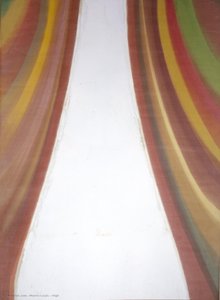
In the realm of mid-century abstraction, few works capture the ethereal essence of movement as profoundly as Morris Louis’s Number 28. Created in 1961, this masterpiece stands as a definitive pillar of the Color Field painting movement, inviting the viewer into a meditative space where boundaries between form and pigment dissolve. At first glance, the composition presents a striking minimalist architecture: two vertical bands of vibrant, saturated color that descend like celestial ribbons against a stark, luminous white void. There is no traditional subject matter here—no figures to anchor the eye or landscapes to ground the soul—only the pure, unadulterated interplay of light and hue.
The brilliance of Number 28 lies in its breathtaking use of color. Within the vertical columns, a kaleidoscopic spectrum unfolds, ranging from deep, oceanic blues and verdant greens to fiery oranges and warm yellows. These colors do not sit static upon the canvas; rather, they appear to breathe and pulse. Through a masterful layering of tones, Louis achieves a sense of translucent depth, as if one is peering through layers of stained glass or watching sunlight filter through tropical waters. This fluidity creates an organic, living quality that transforms the flat surface into a window of infinite, swirling energy.
The Alchemy of Staining and Technique
To understand the emotional resonance of this work, one must appreciate the revolutionary technique employed by Louis. Moving away from the heavy, impasto textures of the Abstract Expressionists who preceded him, Louis embraced the method of "staining." Utilizing thinned acrylic paints—specifically the pioneering Magna paint—he allowed the pigment to soak directly into the unprimed canvas fibers. This process ensures that the color becomes one with the fabric itself, eliminating the distinction between the medium and the support. The result is a surface that possesses a remarkable luminosity, where the edges of the color fields are not defined by harsh lines, but by soft, bleeding transitions that suggest an eternal state of flux.
This technique imbues the painting with a sense of effortless grace. There is no evidence of the artist's brushstroke or physical struggle; instead, there is only the record of gravity and flow. This lack of tactile resistance contributes to the artwork’s profound sense of serenity. For the collector or interior designer, this piece offers a unique aesthetic advantage: it provides a focal point that is both commanding in its presence and soothing in its execution. It does not demand attention through aggression, but rather captivates through a quiet, hypnotic magnetism.
A Legacy of Serenity for Modern Spaces
Beyond its technical mastery, Number 28 serves as an emotional sanctuary. The verticality of the composition evokes a sense of aspiration and monumentality, much like the soaring columns of classical architecture, yet it remains intimately personal and soft. It is a work that celebrates the beauty of simplicity and the power of pure perception. In a modern interior, a high-quality reproduction of this piece acts as a sophisticated anchor, bringing a sense of calm, intellectual depth, and timeless elegance to any room.
Whether placed in a minimalist gallery setting or a richly textured living space, the painting’s ability to harmonize diverse color palettes makes it an invaluable asset for those seeking to curate an atmosphere of refined tranquility. It remains a testament to Morris Louis's vision: a world where color is not merely applied to a surface, but becomes the very soul of the art itself.
Questions & Answers
Does "Number 28" by Morris Louis use strong contrasts or soft harmonies?
The color composition of "Number 28" by Morris Louis combines a statement contrast with a discordant palette harmony.
What does "Number 28" share with the rest of Morris Louis's output?
"Number 28" belongs to Morris Louis's Color Field Painting work, whose recorded themes include color field, abstract expressionism, post-war american art, experimentation, innovation, process, minimalist, serene composition.
How harmonious are the colors of "Number 28" by Morris Louis?
The colors of "Number 28" by Morris Louis show a discordant palette harmony. Harmony describes how the colors relate to each other.
Artist Biography
Early Life and Education
- Born: Morris Louis Bernstein, November 28, 1912, Baltimore, Maryland
- Parents: Louis Bernstein (furniture salesman) and Cecelia Luckman Bernstein.
- Education: Attended public schools in Baltimore; Maryland Institute of Fine and Applied Arts (now MICA), 1929-1932. Did not complete a degree.
- Early influences included Eugene Speicher and Paul Cézanne.
- Showed an early interest in art, encouraged by his family despite limited opportunities in Baltimore.
Development as an Artist & Key Influences
- 1930s: Worked various odd jobs to support himself while painting (vegetable peeling, laundry work, Gallup Poll research).
- 1934-1936: Participated in the Public Works of Art Project mural project under Sam Swerdloff.
- 1936-1937: Moved to New York City; experimented with techniques at the Siqueiros Workshop.
- Magna Paint Discovery (1948): A pivotal moment – Louis pioneered the use of Magna paint, a newly developed oil-based acrylic paint created for him by Leonard Bocour and Sam Golden. This allowed for greater fluidity and transparency in his work.
- Influence of Helen Frankenthaler: In 1953, Louis and Kenneth Noland visited Frankenthaler's studio and were deeply impressed by her stain paintings (particularly "Mountains and Sea"). This inspired their experimentation with pouring and staining techniques.
The Veil Paintings & Color Field Innovations
- Mature Veil Paintings (1954): Characterized by overlapping, superimposed layers of transparent color poured onto and stained into sized or unsized canvas.
- Technique: Extremely diluted paint was applied to an unprimed, unstretched canvas, allowing it to flow over the inclined surface, creating translucent color veils. This eliminated brushstrokes and emphasized flatness.
- Color Field Painting: Louis became a central figure in Color Field painting, simplifying pictorial space and emphasizing flat planes of intense color. He was part of the Washington Color School movement.
- Series & Styles: Beyond the Veil paintings, he explored series like florals, columns (1960), unfurleds (1960-61) – featuring rivulets of opaque color – and stripe paintings (1961-62).
Major Achievements & Historical Significance
- Pioneering Color Field Painting: Louis is recognized as a key innovator in Color Field painting, alongside artists like Kenneth Noland and Helen Frankenthaler.
- Influence on Abstract Expressionism: His work expanded the boundaries of Abstract Expressionism by focusing on color and flatness rather than gesture or composition.
- Washington Color School: A significant contributor to this influential movement, which emphasized a reductive approach to painting.
- Destruction of Works: Notably, Louis destroyed many of his paintings between 1955 and 1957, reflecting a critical self-assessment of his work.
- Legacy: His emphasis on color, flatness, and the materiality of paint continues to influence contemporary artists.
Later Years & Death
- Louis continued painting prolifically until his death.
- Death: Died September 7, 1962, in Washington, D.C., at the age of 49.
- Memorial Exhibition (1963): A significant exhibition was held at the Solomon R. Guggenheim Museum shortly after his death.
- Retrospective Exhibitions: Major retrospectives followed at the Museum of Fine Arts, Boston (1967), and the National Gallery of Art, Washington, D.C. (1976).

Morris Louis
1912 - 1962 , United States of America
Quick Facts
- Full Name: Morris Louis
- Nationality: American
- Date Of Birth: 1912
- Date Of Death: 1962
- Place Of Birth: Baltimore, United States of America
- Notable Artworks:
- High
- Number 1-36
- Where
- Number 1-68
- Gamma Tau
- Third Element
- Delta Theta
- Artistic Movement Or Style: Color Field painting
- Artists Who Influenced This Artist:
- Helen Frankenthaler
- Jackson Pollock
- Cézanne
- Artists Or Movements Influenced By This Artist:
- Kenneth Noland
- Washington Color School
Related Articles
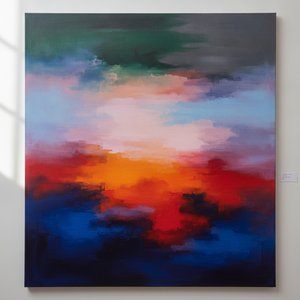
Color Field Painting: The Emotional Power of Pure Abstraction and Chromatic Depth
Explore the profound emotional depth of Color Field painting. Discover the history of mid-century abstraction, from Rothko to Newman, and learn how pure color transforms the viewer's experience through our expert art history guide.

Slate Blue Masterpieces: 10 Iconic Paintings & Timeless Home Decor Ideas
Immerse yourself in the captivating world of slate blue! Explore 10 iconic paintings by Monet, Van Gogh & Renoir. Discover their stories, techniques & find museum-quality art reproductions for your home at .
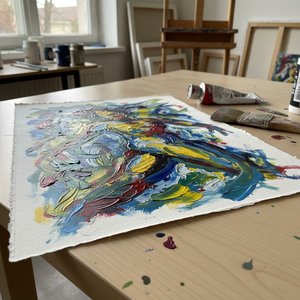
Acrylic on Paper: A Modern Canvas for Contemporary Expression
Explore the versatility of acrylic painting on paper! Discover expert techniques, artist insights & archival practices for creating stunning contemporary art. Learn more at OriginalUniqueArt.

Serene Blue Backgrounds: Discover Soulful Art to Transform Your Space with Timeless Elegance
Transform your home with soulful blue art. From serene Monet impressions to modern textured sculptures, discover curated masterpieces designed to inspire calm. Explore expert art consultations and bespoke hand-painted reproductions to create your personal sanctuary.

Morris Louis: Pioneering Color Field Painting & Abstract Expressionism's Legacy
Explore the groundbreaking abstract expressionism of Morris Louis, a pioneer of Color Field painting. Discover his innovative techniques, influential series & lasting legacy in post-war American art. Learn more at OriginalUniqueArt.