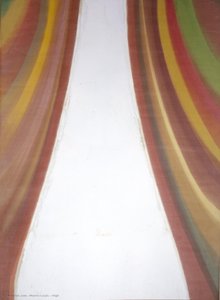
Ambi I
Acrylic On Canvas
WallArt
Color Field Painting
1960
Contemporary
241.0 x 349.0 cm
San Francisco Museum of Modern Art
Hand Made Oil Reproduction
Hand-painted oil on canvas in your size and frame, made to order by our artists.
P118B $10
P118H $10
P118W $10
P438Z $10
P508JH $12
P508YH $12
P805H $10
P805Z $10
P919BZ $10
P919G $10
P919XJ $10
P959ZH $10
P968JZ $12
W106C $8
W218G $10
W218JH $8
W218Y $10
W307PJ $10
W316G $10
W316PJ $8
W316Y $10
W398PJ $8
W4111J $10
W500HY $15
W500JH $15
W692G $12
W849H $8
W940BG $15
W953PJ $8
Pick from our preset sizes that match the artwork's original proportions.
You may enter your own dimensions to fit a specific frame or space. If your selected size does not match the original image's proportions, we will either crop the artwork or extend the painting with additional hand-painted elements. A digital mockup will be sent for your approval before production begins.

Please note that the on-screen preview does not reflect the actual cropping or extension. Only the mockup will accurately show the final composition.
While custom sizes are available, we recommend selecting a dimension from the predefined list to preserve the original proportions.
After order, OriginalUniqueArt.com team will email client for instructions and provide a mockup preview
Worldwide Delivery () in 3/4 weeks instead of standard 5 weeks. (23 July). No compromise on quality.
Free Worldwide Express Shipping
High-Quality Linen Canvas
Full Shipping Insurance
Customs Tax Refund Guarantee
True Color Matching Guarantee
60-Day Return Policy (Defects Only)
100% Money-Back Guarantee
Bulk Discount Offer
Ambi I
Reproduction Medium
Reproduction Size
-
Total Price
-
Artwork Description
The Veil of Color: Exploring Morris Louis's Ambi I
To stand before Ambi I is to step into a realm where pigment itself becomes the primary subject. This monumental canvas by Morris Louis is not merely a depiction of color, but an immersion within it—a breathtaking study in atmospheric depth and fluid movement. The work eschews any recognizable narrative or focal point, instead inviting the viewer into a vast, breathable space built entirely from washes of diluted acrylics. It feels less like an object hung on a wall and more like a captured moment of natural phenomenon: perhaps the slow drift of colored smoke, or the ethereal curtain drawn across a distant vista.
A Masterclass in Color Field Technique
Louis’s signature technique is evident in every soft gradation across this piece. He pioneered methods that allowed color to stain the very weave of the canvas, creating an effect that transcends simple painting. The resulting texture is one of luminous transparency; you can sense the underlying structure of the material while simultaneously being enveloped by the rich interplay of hues—deep greens yielding into watery blues, punctuated by streaks of warm yellow and soft pink. These colors do not sit atop the surface; they penetrate it, creating a visual resonance that seems to emanate from within the fabric itself. This mastery over staining and pouring defines its place within the Color Field movement.
Historical Echoes and Artistic Innovation
Created in 1960, Ambi I stands as a testament to Louis’s relentless experimentation following his pivotal discovery of Magna paint. As an artist whose career was marked by constant technical evolution, this work embodies the mid-century push toward abstraction. It speaks to a moment when art began to prioritize pure sensory experience over traditional representation. For collectors and designers alike, understanding this context is key; owning such a piece means acquiring a tangible link to post-war American abstract expressionism at its most refined and meditative.
Emotional Resonance for Modern Spaces
The emotional impact of Ambi I is profoundly calming yet dynamically engaging. Because the composition lacks rigid structure, it possesses an inherent sense of controlled randomness—a visual breath that allows the viewer’s mood to dictate their focus. For interior design applications, this piece functions as a monumental anchor. It does not compete with surrounding furnishings; rather, it elevates them by providing a backdrop of pure, sophisticated ambiance. Whether placed in a grand foyer or a contemplative gallery space, its flowing, curtain-like quality introduces movement and depth without ever feeling chaotic.
A Reproduction for Lasting Inspiration
To bring the sublime experience of Ambi I into your own home, we offer hand-painted reproductions that honor Louis’s delicate washes. Our artisans meticulously recreate the luminosity and the subtle layering achieved by his original staining process. Owning a reproduction allows you to incorporate this monumental sense of atmospheric depth—this veil of color—into your décor, ensuring that the quiet power and sophisticated artistry of Morris Louis remain accessible for years to come.
Artist Biography
Early Life and Education
- Born: Morris Louis Bernstein, November 28, 1912, Baltimore, Maryland
- Parents: Louis Bernstein (furniture salesman) and Cecelia Luckman Bernstein.
- Education: Attended public schools in Baltimore; Maryland Institute of Fine and Applied Arts (now MICA), 1929-1932. Did not complete a degree.
- Early influences included Eugene Speicher and Paul Cézanne.
- Showed an early interest in art, encouraged by his family despite limited opportunities in Baltimore.
Development as an Artist & Key Influences
- 1930s: Worked various odd jobs to support himself while painting (vegetable peeling, laundry work, Gallup Poll research).
- 1934-1936: Participated in the Public Works of Art Project mural project under Sam Swerdloff.
- 1936-1937: Moved to New York City; experimented with techniques at the Siqueiros Workshop.
- Magna Paint Discovery (1948): A pivotal moment – Louis pioneered the use of Magna paint, a newly developed oil-based acrylic paint created for him by Leonard Bocour and Sam Golden. This allowed for greater fluidity and transparency in his work.
- Influence of Helen Frankenthaler: In 1953, Louis and Kenneth Noland visited Frankenthaler's studio and were deeply impressed by her stain paintings (particularly "Mountains and Sea"). This inspired their experimentation with pouring and staining techniques.
The Veil Paintings & Color Field Innovations
- Mature Veil Paintings (1954): Characterized by overlapping, superimposed layers of transparent color poured onto and stained into sized or unsized canvas.
- Technique: Extremely diluted paint was applied to an unprimed, unstretched canvas, allowing it to flow over the inclined surface, creating translucent color veils. This eliminated brushstrokes and emphasized flatness.
- Color Field Painting: Louis became a central figure in Color Field painting, simplifying pictorial space and emphasizing flat planes of intense color. He was part of the Washington Color School movement.
- Series & Styles: Beyond the Veil paintings, he explored series like florals, columns (1960), unfurleds (1960-61) – featuring rivulets of opaque color – and stripe paintings (1961-62).
Major Achievements & Historical Significance
- Pioneering Color Field Painting: Louis is recognized as a key innovator in Color Field painting, alongside artists like Kenneth Noland and Helen Frankenthaler.
- Influence on Abstract Expressionism: His work expanded the boundaries of Abstract Expressionism by focusing on color and flatness rather than gesture or composition.
- Washington Color School: A significant contributor to this influential movement, which emphasized a reductive approach to painting.
- Destruction of Works: Notably, Louis destroyed many of his paintings between 1955 and 1957, reflecting a critical self-assessment of his work.
- Legacy: His emphasis on color, flatness, and the materiality of paint continues to influence contemporary artists.
Later Years & Death
- Louis continued painting prolifically until his death.
- Death: Died September 7, 1962, in Washington, D.C., at the age of 49.
- Memorial Exhibition (1963): A significant exhibition was held at the Solomon R. Guggenheim Museum shortly after his death.
- Retrospective Exhibitions: Major retrospectives followed at the Museum of Fine Arts, Boston (1967), and the National Gallery of Art, Washington, D.C. (1976).
Morris Louis
1912 - 1962 , United States of America
Quick Facts
- Artistic Movement Or Style: Color Field painting
- Artists Or Movements Influenced By This Artist:
- Kenneth Noland
- Washington Color School
- Artists Who Influenced This Artist:
- Helen Frankenthaler
- Jackson Pollock
- Cézanne
- Date Of Birth: November 28, 1912
- Date Of Death: September 7, 1962
- Full Name: Morris Louis
- Nationality: American
- Notable Artworks:
- High
- Number 1-36
- Where
- Number 1-68
- Gamma Tau
- Third Element
- Delta Theta
- Place Of Birth: Baltimore, United States

Glass option is only available in size under 110 CM