

 Preview
 Send
Send Share
Share
 Details

 Download
 Similars
 X-Ray
X-Ray Diaporama
Synthetic Arrangement


 Read More
Hand Made Oil Reproduction
Hand-painted oil on canvas in your size and frame, made to order by our artists. ( Buy Print Buy Image)




































Pick from our preset sizes that match the artwork's original proportions.

You may enter your own dimensions to fit a specific frame or space. If your selected size does not match the original image's proportions, we will either crop the artwork or extend the painting with additional hand-painted elements. A digital mockup will be sent for your approval before production begins.
Please note that the on-screen preview does not reflect the actual cropping or extension. Only the mockup will accurately show the final composition.
While custom sizes are available, we recommend selecting a dimension from the predefined list to preserve the original proportions.
After order, OriginalUniqueArt.com team will email client for instructions and provide a mockup preview
Worldwide Delivery () in 3/4 weeks instead of standard 5 weeks. (6 September). No compromise on quality.

Free Worldwide Express Shipping

High-Quality Linen Canvas

Full Shipping Insurance

Customs Tax Refund Guarantee

True Color Matching Guarantee

100-Day Return Policy (Defects Only)

100% Money-Back Guarantee

Bulk Discount Offer
 Glass option is only available in size under 110 CM

Synthetic Arrangement
Reproduction Medium
Reproduction Size
-


Total Price
$ 300
Synthetic Arrangement: A Dynamic Exploration of Form and Color
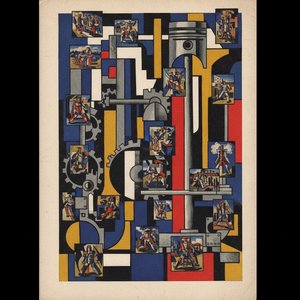
Morris Kantor's "Synthetic Arrangement," painted in 1922, is a striking example of early Cubist experimentation within the American art scene. Measuring an impressive 197 x 141 cm, this large-scale oil on canvas presents a complex interplay of geometric shapes and a warm color palette, creating a visually dynamic and intellectually stimulating composition.
Subject and Style: Deconstructing Reality
"Synthetic Arrangement" exemplifies the core tenets of Cubism. Rather than depicting objects from a single viewpoint, Kantor fragments forms and reassembles them across multiple perspectives on a single plane. The artwork centers around an abstracted human figure, seemingly emerging from or interwoven with a network of angular shapes – triangles, rectangles, and more rounded, overlapping forms. This fragmentation isn't chaotic; it’s deliberate, suggesting a process of deconstruction and reconstruction. The style is heavily influenced by European Cubist pioneers like Pablo Picasso and Georges Braque, but Kantor brings his own distinct sensibility to the movement.
Technique and Composition: Layered Depth and Impasto
Kantor’s technique involves thickly applied oil paint, creating a noticeable impasto effect that adds texture and visual interest. The brushstrokes are evident, contributing to the sense of dynamism and layered depth within the composition. The lighting is dramatic, with strong highlights emphasizing the edges of the shapes and casting deep shadows that define the forms. This creates a flattened perspective; traditional three-dimensionality is eschewed in favor of overlapping planes and contrasting values. The vertical orientation of the canvas emphasizes an upward thrust, potentially symbolizing aspiration or transformation.
Historical Context and Symbolism: A Post-War Aesthetic
Created in 1922, "Synthetic Arrangement" reflects a period of significant artistic innovation following World War I. Cubism emerged as a reaction against traditional representational art, seeking to capture the essence of objects rather than their literal appearance. The fragmented nature of the composition can be interpreted as symbolic of disruption or transformation – perhaps reflecting the societal upheaval and anxieties of the post-war era. While Kantor doesn't offer explicit narrative elements, the overall effect is one of energy, tension, and a deliberate rejection of representational accuracy in favor of formal exploration.
Emotional Impact: Energy and Contemplation
Despite its abstract nature, "Synthetic Arrangement" evokes a powerful emotional response. The warm color palette—dominated by reds, oranges, and yellows—creates a sense of vibrancy and warmth, while the sharp lines and fragmented forms generate a feeling of tension and dynamism. The abstracted figure invites contemplation – is it in motion, caught in a moment of action, or engaged in quiet introspection? Ultimately, Kantor’s work challenges viewers to engage with art on a purely formal level, appreciating the interplay of shapes, colors, and textures while simultaneously prompting deeper reflections on themes of transformation and perception.
Artist Biography
Morris Kantor (1896–1974): Bridging Cubism and American Realism
Morris Kantor (1896–1974) was a Russian-born American painter whose artistic journey spanned diverse styles, ultimately establishing him as a significant figure in 20th-century art. Born in Minsk, Russia—now Belarus—Kantor emigrated to the United States in 1906, settling primarily in New York City where he cultivated his career and honed his distinctive vision. His formative years were marked by exposure to European avant-garde movements, particularly Cubism and Futurism, experiences that profoundly shaped his artistic sensibilities.- Early Influences: Kantor’s initial training encompassed traditional Russian academic painting, providing him with a foundational understanding of composition and technique. However, he quickly gravitated toward the revolutionary ideas championed by artists like Picasso and Braque, immersing himself in the geometric explorations characteristic of Cubism.
- Futurist Experimentation: Embracing the dynamism and energy of Futurism—a movement advocating for speed, technology, and rejection of traditional artistic conventions—Kantor produced canvases infused with bold colors and fragmented forms. This period demonstrated his willingness to challenge established norms and push boundaries within the art world.
- Notable Works: Kantor’s oeuvre includes iconic pieces such as “Baseball at Night,” a mesmerizing depiction of a baseball game illuminated by moonlight—a masterful blend of Cubist fragmentation and atmospheric realism. This artwork exemplifies his ability to convey complex narratives through visual language.
- Smithsonian Legacy: Kantor's paintings are housed in the Smithsonian American Art Museum’s collection, ensuring that his artistic contributions endure for generations to come. His work continues to inspire artists and scholars alike, serving as a testament to his enduring influence on American art history.

morris kantor
1896 - 1974
Quick Facts
- Artistic Movement Or Style: Cubism & Futurism
- Date Of Birth: 1896
- Date Of Death: 1974
- Full Name: Morris Kantor
- Nationality: Russian
- Notable Artworks: ['Baseball at Night']
- Place Of Birth: Minsk, Russia
Related Articles

Geometric Abstraction's 10 Defining Masterpieces | Art for Your Home - OriginalUniqueArt
Explore 10 defining masterpieces of Geometric Abstraction! Discover Kandinsky, Mondrian & Malevich’s iconic works. Find museum-quality art reproductions and curated decor ideas to elevate your home at OriginalUniqueArt.com.

Neo-Abstract Art: The High-Impact Evolution of Modern Visual Energy and Geometric Sophistication
Discover the power of Neo-Abstract art. Explore how bold geometric forms and high-impact visual energy are redefining modern design. Learn to curate sophisticated, high-energy spaces with the latest trends in contemporary abstraction and structural color.

Beyond Form & Color: Geometric Abstraction's Evolution in 20th/21st Century Art
Explore the evolution of geometric abstraction from Cubism to contemporary art. Discover key artists like Malevich & Mondrian, investment insights, and expert collecting advice at OriginalUniqueArt.

Beyond Form & Color: Geometric Abstraction's Enduring Legacy in Art History
Explore the captivating world of geometric abstraction! Discover its origins, key artists like Malevich & Mondrian, and why this movement remains highly valued by art collectors today. Expert insights at OriginalUniqueArt.
Fernand Léger's Masterpieces: 25 Iconic Paintings & The Machine Age Aesthetic | OriginalUniqueArt
Explore 25 iconic Fernand Léger paintings that defined the Machine Age & Cubism. Discover the stories behind his bold colors, geometric forms & avant-garde style. Find museum-quality art reproductions on OriginalUniqueArt.com.


