Text size

() ·

A painting made for you, by hand

Farewell at Dawn

Hand Made Oil Reproduction

Hand-painted oil on canvas in your size and frame, made to order by our artists. ( Switch to Print Switch to Digital Image)

Collectible Description

Admire 'Farewell at Dawn' by Moritz von Schwind – a captivating 1859 Austrian Romantic painting. Explore its lyrical beauty & historical significance. Hand-painted reproduction available.

Artist Biography

Discover Moritz von Schwind: Austrian painter of chivalry & folklore! Explore his lyrical works, illustrations, & fresco designs – a key figure in German Romanticism.

from ·

Chapter 1

How large should it be?

Slide to change the size; the picture on the left shows the frame at its real width. The proportions of the original are kept.

Standard
custom
CM
INCH

Pick from our preset sizes that match the artwork's original proportions.

width
height

Type the width and the height you need, to fit your frame or your wall. This is hand-painted, so for a size with a different shape the artist can paint a bit more around the picture, or cut a bit — you choose. We send you a digital mockup to approve before the painting starts. The picture shown on this page does not show the real result — only the mockup does.

Chapter 2

How should it arrive?

Choose the edges of the stretched canvas

Choose your frame

Corner sample of the WhiteWrap canvas edge finish, stretched on solid wood bars
White $1
Corner sample of the BlurSideWrap canvas edge finish, stretched on solid wood bars
Blurside $1
Corner sample of the ExtendedWrap canvas edge finish, stretched on solid wood bars
Extended $1
Corner sample of the P118B picture frame: moulded polystyrene, 5 cm wide and 3 cm thick
P118B $10
Corner sample of the P118H picture frame: moulded polystyrene, 5 cm wide and 3 cm thick
P118H $10
Corner sample of the P118W picture frame: moulded polystyrene, 5 cm wide and 3 cm thick
P118W $10
Corner sample of the P438Z picture frame: moulded polystyrene, 5.5 cm wide and 3.5 cm thick
P438Z $10
Corner sample of the P508JH picture frame: moulded polystyrene, 7 cm wide and 3.5 cm thick
P508JH $12
Corner sample of the P508YH picture frame: moulded polystyrene, 7 cm wide and 3.5 cm thick
P508YH $12
Corner sample of the P805H picture frame: moulded polystyrene, 5 cm wide and 3.5 cm thick
P805H $10
Corner sample of the P805Z picture frame: moulded polystyrene, 5 cm wide and 3.5 cm thick
P805Z $10
Corner sample of the P919BZ picture frame: moulded polystyrene, 7 cm wide and 3.5 cm thick
P919BZ $10
Corner sample of the P919G picture frame: moulded polystyrene, 7 cm wide and 3.5 cm thick
P919G $10
Corner sample of the P919XJ picture frame: moulded polystyrene, 7 cm wide and 3.5 cm thick
P919XJ $10
Corner sample of the P959ZH picture frame: moulded polystyrene, 5 cm wide and 3 cm thick
P959ZH $10
Corner sample of the P968JZ picture frame: moulded polystyrene, 6 cm wide and 4 cm thick
P968JZ $12
Corner sample of the W106C picture frame: solid wood, 5 cm wide and 3 cm thick
W106C $8
Corner sample of the W218G picture frame: solid wood, 5 cm wide and 3 cm thick
W218G $10
Corner sample of the W218JH picture frame: solid wood, 5 cm wide and 3 cm thick
W218JH $8
Corner sample of the W218Y picture frame: solid wood, 5 cm wide and 3 cm thick
W218Y $10
Corner sample of the W307PJ picture frame: solid wood, 6 cm wide and 3 cm thick
W307PJ $10
Corner sample of the W316G picture frame: solid wood, 6 cm wide and 3 cm thick
W316G $10
Corner sample of the W316PJ picture frame: solid wood, 6 cm wide and 3 cm thick
W316PJ $8
Corner sample of the W316Y picture frame: solid wood, 6 cm wide and 3 cm thick
W316Y $10
Corner sample of the W398PJ picture frame: solid wood, 5 cm wide and 3 cm thick
W398PJ $8
Corner sample of the W4111J picture frame: solid wood, 6.5 cm wide and 3.5 cm thick
W4111J $10
Corner sample of the W500HY picture frame: solid wood, 7 cm wide and 5 cm thick
W500HY $15
Corner sample of the W500JH picture frame: solid wood, 7 cm wide and 5 cm thick
W500JH $15
Corner sample of the W692G picture frame: solid wood, 8 cm wide and 4 cm thick
W692G $12
Corner sample of the W849H picture frame: solid wood, 5 cm wide and 3 cm thick
W849H $8
Corner sample of the W940BG picture frame: solid wood, 7.5 cm wide and 4.5 cm thick
W940BG $15
Corner sample of the W953PJ picture frame: solid wood, 6 cm wide and 3.5 cm thick
W953PJ $8
Corner sample of the H24-GOLD picture frame: carved wood with gesso, 10 cm wide and 6 cm thick
H24-GOLD $30
Corner sample of the H24-SILVER picture frame: carved wood with gesso, 10 cm wide and 6 cm thick
H24-SILVER $30
Corner sample of the H36-GOLD picture frame: carved wood with gesso, 15 cm wide and 6.5 cm thick
H36-GOLD $45
Corner sample of the H36-SILVER picture frame: carved wood with gesso, 15 cm wide and 6.5 cm thick
H36-SILVER $45
Frame preview
Framed

Moulding: . Overall size with the frame: .

Chapter 3

Who paints it, and should anything change?

Examples of what can be changed: Replace face with customer photo; Add pet (e.g., replace cat with dog); Include hidden message in background; Change background landscape or elements.
After order, OriginalUniqueArt.com team will email client for instructions and provide a mockup preview

Worldwide Delivery () in 3/4 weeks instead of standard 5 weeks. (31 October). No compromise on quality.

Chapter 4

The finishing touches

A nameplate, as in a museum?

Engraved Bronze Plaque Details

This elegant plaque features the artist's name and the title of the artwork, finely engraved for a timeless presentation.

It is made from bronze with a refined, elegant finish. The text is precisely laser-engraved for a sharp and permanent result. Measuring 9x2 cm, the plaque is compact yet easy to read. It's built to be durable and scratch-resistant, offering a professional, museum-quality look. Mounting is simple thanks to the included adhesive backing.

Transparent Acrylic Plaque Details

The plaque includes essential engraved details such as the artist's name, the title of the artwork, the date it was created, the type of media used-like oil on canvas or watercolor-a brief description of the piece, and a QR code that links to the complete artwork information.

It is crafted from clear acrylic, offering a sleek, modern appearance. The text is UV-engraved in black to ensure strong visual contrast. With a size of 10x15 cm, it ensures optimal readability. It comes equipped with two metal hooks for secure wall mounting. The plaque is designed to be weather-resistant, making it suitable for various environments, and it includes interactive features that work seamlessly with smartphone scanning.

Black Acrylic Plaque Details

This elegant plaque includes engraved information such as the artist's name, the title of the artwork, the date it was created, the type of media used (like oil on canvas or watercolor), a short description of the artwork, and a QR code for quick access to more information.

The plaque itself is made from refined black acrylic with a premium finish. The text is laser-engraved in white for high contrast and readability. Its size is 10x15 cm, designed to be easy to read. It comes with two metal hooks for professional mounting. The design is sleek and fits any interior style. It is also weather-resistant and durable, with built-in digital integration for mobile compatibility.

A protective varnish?

When do you need it?

Chapter 5

Your painting, as you ordered it

Farewell at Dawn

Reproduction Medium

Reproduction Size

-

Elite Senior Artist

More detail, finesse, and extra production time

-

Reproduction Frame

-

-

For artworks or reproductions larger than 105 cm (approximately 41 inches) on any side, the frame will be shipped as a kit, disassembled. This method ensures safe delivery and prevents damage during transport.

Professional assembly required - this is not a DIY product.
The kit must be assembled and the canvas stretched by an experienced professional framer, using wood glue (not supplied), a canvas stretching plier and clamps to hold the bars square while the glue dries. Incorrect assembly or uneven canvas tension can permanently damage the artwork and is not covered by our warranty.

  • All solid wood bars are included, precisely cut to size.

  • Assembled with the screws provided, plus wood glue for the corner joints, which is not supplied and must be sourced by your framer.

  • Professional tools are required and not included: a canvas stretching plier (tensioner) and clamps to hold the bars square while the glue dries.

Important:
The corner joints require wood glue, the bars must be held with clamps until the glue is fully dry, and tightening the canvas on the assembled frame requires a canvas stretching plier. None of these are included in the kit. Please arrange an experienced professional framer before ordering this size.

Nameplate

-

-

Protective Varnish

Glossy Varnish (enhances colors, protects against light/moisture)

-

Customize My Artwork

Examples of what can be changed: Replace face with customer photo; Add pet (e.g., replace cat with dog); Include hidden message in background; Change background landscape or elements.

-

Urgent

Worldwide Delivery () in 3/4 weeks instead of standard 5 weeks. (31 October). No compromise on quality.

-

Express Shipping

Worldwide Delivery () in 5 weeks. (7 November).

Included

Total Price

$ 300

Total Price $ 300

Glass option is only available in size under 110 CM

Included with every order

  • Free Worldwide Express Shipping
  • High-Quality Linen Canvas
  • Full Shipping Insurance
  • Customs Tax Refund Guarantee
  • True Color Matching Guarantee
  • 100-Day Return Policy (Defects Only)
  • 100% Money-Back Guarantee
  • Bulk Discount Offer

A Moment of Melancholy: Moritz von Schwind's "Farewell at Dawn"

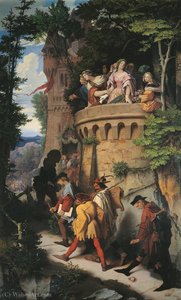
Moritz von Schwind’s “Farewell at Dawn,” painted in 1859, is more than a simple depiction of a woman contemplating a distant view; it’s a poignant distillation of Romantic ideals – a yearning for the unattainable, a reverence for nature's beauty, and an exploration of profound emotional states. Executed with meticulous detail and imbued with a palpable sense of atmosphere, this 36 x 24 cm artwork transports the viewer to a quiet street corner bathed in the ethereal light of dawn. The woman’s posture, turned away from us yet intensely focused on something beyond the frame, immediately establishes a feeling of wistful contemplation, inviting us to share her unspoken thoughts and emotions.

Romanticism's Poetic Vision

Schwind, often described as a “Poet of the Romantic Imagination,” was deeply influenced by Germanic folklore, medieval legends, and the burgeoning spirit of Romanticism. His work frequently sought to evoke powerful emotional responses in the viewer, employing dramatic landscapes, symbolic imagery, and carefully constructed compositions. "Farewell at Dawn" exemplifies this approach perfectly. The scene’s muted palette – dominated by soft blues, greys, and browns – contributes significantly to its melancholic mood, while the subtle play of light and shadow adds depth and complexity. The inclusion of the bird, a recurring motif in Schwind's work often symbolizing hope or transition, further elevates the painting's symbolic resonance.

Technique and Detail

Schwind’s mastery of technique is immediately apparent in the meticulous rendering of every detail within this piece. The brushwork is precise yet fluid, creating a remarkable sense of texture – from the worn surface of the benches to the delicate feathers of the bird. The artist's use of sfumato, a technique popularized by Leonardo da Vinci, softens edges and creates an atmospheric haze, enhancing the painting’s dreamlike quality. The careful positioning of the two chairs—one close to the woman, one further away—adds to the sense of depth and spatial awareness within the composition, guiding the viewer's eye towards the vanishing point and reinforcing the feeling of distance and longing.

Historical Context and Symbolism

"Farewell at Dawn" was created during a period of significant social and artistic change in Europe. The Romantic movement challenged the rationalism of the Enlightenment, emphasizing emotion, imagination, and individualism. Schwind’s work reflects this shift, exploring themes of loss, nostalgia, and the beauty of the natural world. The title itself – “Farewell at Dawn” – suggests a finality, a parting, perhaps a farewell to youth or innocence. The woman's back turned to the viewer can be interpreted as a representation of introspection, a moment of solitary reflection on life’s transient nature. This painting offers a window into the artistic sensibilities of 19th-century Germany and remains a testament to Schwind’s enduring legacy.

Questions & Answers

What luminance does "Farewell at Dawn" by Moritz von Schwind have?

"Farewell at Dawn" by Moritz von Schwind has a dark luminance. Luminance describes how much light the colors appear to reflect.

How intense are the colors in "Farewell at Dawn" by Moritz von Schwind?

The color intensity of "Farewell at Dawn" is balanced. Intensity describes how strong the colors appear.

What type of artwork is "Farewell at Dawn" by Moritz von Schwind?

In the catalog, "Farewell at Dawn" by Moritz von Schwind is filed as wall art. The category helps find similar works.

More about this painting

Preview AR preview Switch to Print Switch to Digital Image Send
Details Guide Add to favorites Download Similars X-Ray Diaporama Q&A Stats

In numbers

  • 1859the year it was painted
  • 29frames to choose from
  • standard sizes, in its own proportions
  • 5weeks to paint and deliver it
Moritz von Schwind

Moritz von Schwind

1804 - 1871, Austria

Quick facts about Moritz von Schwind

  • Artistic Movement Or Style: German Romanticism
  • Artists Who Influenced This Artist: ['Cornelius']
  • Full Name: Moritz von Schwind
  • Nationality: Austrian
  • Notable Artworks:
    • The Cat Symphony
    • Farewell at Dawn
    • A Symphony
    • Honeymoon
  • Place Of Birth: Vienna, Austria
  • Date Of Birth: 1804
  • Date Of Death: 1871

Artist Biography

Moritz von Schwind: A Poet of the Romantic Imagination

Moritz von Schwind, born in Vienna’s vibrant artistic circles in 1804 and tragically passing away in Pöcking, Bavaria, in 1871, remains a captivating figure within German Romanticism. More than simply a painter, he was a poet rendered in oils, a weaver of dreams and folklore, and a master of evocative landscapes imbued with profound symbolism. His genius lay not just in technical skill but in his ability to translate the emotional currents of his time – chivalry’s lingering allure, the whispers of Germanic legends, and the burgeoning spirit of Romanticism – into visually arresting works that continue to resonate today. Schwind's life was a tapestry woven with friendships with musical giants like Schubert, commissions from royalty, and a relentless pursuit of capturing the essence of poetic fancy.

Early Life and Artistic Foundations

Schwind’s early years were marked by privilege and a fortunate exposure to artistic influences. Born into an aristocratic family, he received a rudimentary but solid education, fostering a love for literature and music alongside his burgeoning artistic talent. A key moment in his development occurred when he befriended Franz Schubert, whose songs provided a significant source of inspiration throughout Schwind’s career. He illustrated several of Schubert's compositions, capturing the composer’s melancholic beauty with remarkable sensitivity. Moving to Munich in 1828, following Schubert’s death, marked a pivotal shift. There, he found mentorship under Cornelius, then director of the Academy, and forged connections with fellow artists like Schnorr, creating a fertile environment for his artistic growth. This period laid the groundwork for his distinctive style – one characterized by lyrical grace, meticulous detail, and an almost dreamlike quality.

Royal Commissions and Artistic Flourishing

Schwind’s career truly ascended in the 1830s and 40s, fueled by a series of prestigious commissions. In 1834, he was entrusted with decorating King Ludwig's new palace in Munich, undertaking monumental wall paintings illustrating scenes from Tieck’s poetry – a project that showcased his burgeoning mastery of narrative composition and historical detail. Further cementing his reputation, he designed “Kinderfries” (children’s frieze) for the same palace, playful depictions of youthful merriment that demonstrated his ability to capture fleeting moments of joy. He also accepted commissions in Saxony and Baden, solidifying his position as a leading artist of the era. A particularly significant undertaking was his work at the Karlsruhe Academy in 1839, where he created a vast fresco embodying Goethe’s ideas – an ambitious project that reflected the intellectual fervor of the time.

The Height of Romantic Vision: Landscapes and Legends

Schwind's most celebrated works emerged during his residency in Frankfurt (1844-1847) and later in Munich. This period witnessed the creation of some of his finest easel paintings, including “Singers’ Contest in the Wartburg” (1846), a masterpiece that perfectly encapsulates Romantic ideals – a gathering of musicians lost in passionate song amidst a dramatic medieval setting. His designs for the Goethe celebration further showcased his ability to blend historical accuracy with poetic imagination. However, it was his interpretations of Germanic legends and folklore that truly defined his artistic legacy. The “Niebelungenlied” cycle, particularly his stunning frescoes for Hohenschwangau Castle depicting the epic tale of Siegfried and Brunhilde, stands as a testament to his skill in translating complex narratives into visually compelling scenes. His work on the story of Cupid and Psyche for Leipzig is equally remarkable, demonstrating his ability to evoke both beauty and melancholy.

Later Years and Legacy

Schwind’s later years were marked by declining health but continued artistic productivity. He returned to Vienna in 1847, where he created a cycle of paintings based on the legend of Melusine, showcasing his enduring talent. His final works, including designs for commemorative musicians at the Vienna State Opera, reflected a deep appreciation for music and its power to inspire. Moritz von Schwind died in Niederpöcking in 1871, leaving behind a rich artistic legacy that continues to captivate audiences today. His paintings are celebrated not only for their technical brilliance but also for their ability to transport viewers to worlds of myth, legend, and profound emotional resonance – solidifying his place as a key figure in the history of German Romantic art.

Notable Works

  • Rübezahl (1834): A dramatic landscape featuring the mythical guardian of the Bavarian Alps, embodying themes of nature, power, and mystery.
  • The Dream of Erwin von Steinbach (1822): An intricate drawing capturing a Gothic scene filled with symbolism and psychological depth.
  • Landscape with Wanderer (1835): A haunting black-and-white drawing depicting a solitary figure contemplating a fantastical landscape, reflecting themes of isolation and introspection.
  • Singers’ Contest in the Wartburg (1846): A vibrant and dynamic painting capturing a scene of musical passion amidst a medieval setting – Schwind's most famous work.
  • Seven Ravens (1857): A series of illustrations based on Grimm’s fairy tales, showcasing his ability to blend fantasy with narrative storytelling.

Further Exploration

Quick Facts

  • Movement: Romanticism
  • Influences:
    • German folklore
    • Schubert
  • Artist: Moritz von Schwind
  • Subject or theme: Farewell, melancholy
  • Title: Farewell at Dawn