Send
Send Share
Share
 Details
 Guide
Guide

 Download
 Similars
 Diaporama
 Stats
StatsIgnudo (13)


 Read More
Giclée / Art Print
Museum-quality giclée or canvas print with fast production and flexible finish options. ( Buy Hand Made Painting Switch to Digital Image)




































Pick from our preset sizes that match the artwork's original proportions.

Type the width and the height you need, to fit your frame or your wall. A print can only be cut, never made bigger than the picture, so a size with a different shape loses a part of the image. We send you a digital mockup to approve before we print anything. The picture shown on this page does not show the real cut — only the mockup does.
Worldwide Delivery () in 2 weeks instead of standard 4/5 weeks. (24 October)

Free Worldwide Express Shipping

High-Quality Linen Canvas

Full Shipping Insurance

Customs Tax Refund Guarantee

True Color Matching Guarantee

100-Day Return Policy (Defects Only)

100% Money-Back Guarantee

Bulk Discount Offer
 Glass option is only available in size under 110 CM

Ignudo (13)
Giclée / Art Print
Reproduction Size
-


Total Price
$ 81
Ignudo (13): A Study in Human Form within Michelangelo's Sistine Chapel
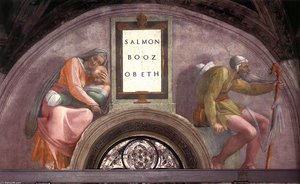
Ignudo (13), meaning "Nude (13)," is one of a series of nude male figures painted by Michelangelo Buonarroti on the ceiling of the Sistine Chapel in Vatican City. Created between 1508 and 1512 as part of his monumental fresco cycle depicting scenes from Genesis, this particular figure stands out for its anatomical precision and expressive posture. It is not a narrative element within a specific biblical story but rather an idealized representation of human beauty and strength, contributing to the overall aesthetic harmony of the chapel's ceiling.
Style and Technique: High Renaissance Idealism
Ignudo (13) exemplifies the artistic ideals of the High Renaissance. Michelangelo’s style is characterized by a profound understanding of human anatomy, achieved through meticulous observation and study of classical sculptures. The figure displays a remarkable level of detail in its musculature, veins, and skin texture. The fresco technique itself—applying pigments to wet plaster—demands speed and precision. Michelangelo's mastery allowed him to create vibrant colors and lasting images despite the challenges of this medium. The composition is carefully balanced, with the nude figure positioned against a backdrop that creates depth and perspective within the vast ceiling.
Historical Context: A Papal Commission and Artistic Innovation
The Sistine Chapel ceiling project was commissioned by Pope Julius II, a powerful and ambitious patron of the arts. Julius sought to transform the chapel into a magnificent testament to papal authority and religious devotion. Michelangelo initially resisted the commission, preferring sculpture to painting, but ultimately accepted the challenge. The sheer scale of the undertaking—covering over 5,000 square feet—was unprecedented. Ignudo (13), along with the other frescoes, represents a pivotal moment in art history, marking a shift towards greater naturalism and dynamism in religious imagery. It was created during a period of intense artistic competition and innovation in Rome.
Symbolism and Emotional Impact: Beauty, Strength, and Human Potential
While Ignudo (13) doesn't directly illustrate a biblical narrative, it carries symbolic weight within the context of the Sistine Chapel. The idealized nude figure represents human potential and physical perfection—a reflection of Renaissance humanist ideals that celebrated human achievement and beauty. The figure’s relaxed yet powerful posture conveys a sense of confidence and serenity. Michelangelo’s skill in rendering the human form evokes a profound emotional response, inspiring awe and admiration for the capabilities of both the artist and humankind. The placement of these figures amongst scenes from Genesis suggests a connection between divine creation and human existence.
Legacy and Influence: A Cornerstone of Western Art
Ignudo (13) has had an enduring impact on Western art, influencing generations of artists with its anatomical accuracy, dynamic composition, and expressive power. The figure’s iconic status is evident in countless reproductions and parodies. It remains a testament to Michelangelo's genius and the transformative power of High Renaissance art. The Sistine Chapel ceiling as a whole continues to draw millions of visitors each year, solidifying Ignudo (13)’s place as one of the most recognizable and celebrated works of art in history.
Questions & Answers
When was "Ignudo (13)" created, and to which movement does it belong?
"Ignudo (13)" was made in 1511, within the High Renaissance movement.
Is a download available for "Ignudo (13)"?
A download is available for "Ignudo (13)": the artwork's Download page offers a high-resolution digital image download.
Is "Ignudo (13)" a famous High Renaissance artwork?
Within the High Renaissance movement, "Ignudo (13)" has an iconic popularity level.
Artist Biography
The Hands of Caprese
In the hills of Caprese, a boy learned the weight of stone and the grit of marble dust. Born in 1475, Michelangelo di Lodovico Buonarroti Simoni spent his early years near Settignano, where his father owned a quarry. The smell of damp earth and the sound of hammers against rock were part of his childhood. He did not start with brushes but with the chisel. His apprenticeship under Domenico Ghirlandaio in Florence brought him into contact with the city's growing interest in the human form, yet it was the Medici gardens that truly shaped his eyes. There, among the ancient Greek and Roman fragments, he studied how light falls across muscle and bone.
His work began to take shape through a deep study of anatomy. He looked at the way a limb carries weight and how skin stretches over a joint. This focus on the physical reality of the body became his primary language. By the time he reached Rome in 1496, he was already carving figures that possessed a heavy, palpable presence. The Pietà, completed in 1499, shows this early ability to make marble appear as soft as flesh, even as it carries the weight of a dead man.
The Weight of the Sistine Ceiling
The task of the Sistine Chapel ceiling was not something he sought. He saw himself as a sculptor, someone who pulls life out of stone rather than spreading pigment on plaster. Yet, for four years, he worked in the high reaches of the chapel, painting over 300 figures from the Book of Genesis. The physical toll was visible in his daily life. He spent hours in difficult positions, his body strained by the reach and the heavy application of fresco technique. In panels like The Creation of Adam, the tension is found in the small gap between two fingers, a moment of near-contact that holds the viewer's attention through pure composition.
As time passed, his style moved away from the balanced ideals of the High Renaissance toward something more restless. His later works, such as The Last Judgment on the altar wall, show a shift toward Mannerism. The figures became more elongated and the compositions more crowded and dramatic. This change reflected a shifting spiritual climate in Rome. He continued to work with an intensity that many found overwhelming, often leaving projects unfinished as his mind moved toward new architectural or sculptural problems.
Architecture and Final Years
In his later decades, Michelangelo turned much of his attention to the structure of buildings. At age 71, he took over the work on St. Peter's Basilica, altering the plans to create a more massive, imposing design. He also designed the Laurentian Library, where his use of architectural elements broke from tradition, creating a sense of movement within the stone itself. His work on the Piazza del Campidoglio in Rome showed how he could organize a public space using symmetry and classical motifs to guide the eye through the square.
He died in Rome in 1564, leaving behind a legacy written in marble, fresco, and stone. His life was defined by several key roles:
- Sculptor: Carving works like David from single blocks of Carrara marble.
- Painter: Executing the vast narrative cycles of the Sistine Chapel.
- Architect: Redesigning the foundations of St. Peter's Basilica and the Laurentian Library.
- Poet: Expressing his inner thoughts through verse.

Michelangelo Buonarroti
1475 - 1564 , Italy
Quick Facts
- Artistic Movement Or Style:
- High Renaissance
- Mannerism
- Artists Or Movements Influenced By This Artist: ['Mannerism']
- Artists Who Influenced This Artist:
- Domenico Ghirlandaio
- Donatello
- Masaccio
- Full Name: Michelangelo di Lodovico Buonarroti Simoni
- Nationality: Italian
- Notable Artworks:
- Pietà
- David
- The Creation of Adam
- The Last Judgment
- Moses
- Place Of Birth: Caprese Michelangelo, Italy
- Date Of Birth: 1475
- Date Of Death: 1564
Related Articles
The Enduring Legacy of Fresco Painting: Techniques, History & Contemporary Relevance
Explore the rich history & enduring artistry of fresco painting – from Giotto to Michelangelo! Discover techniques, conservation efforts, & modern applications. Learn how OriginalUniqueArt brings this timeless art form to your home.
The Fresco as Family Legacy: Preserving Heritage Through Wall Art
Explore the rich history & enduring legacy of fresco painting. Discover how to preserve family heritage through stunning wall art. Expert insights & restoration guidance.

The Enduring Legacy of Fresco: Technique, History & Artistic Expression Across Cultures
Explore the rich history & enduring legacy of fresco painting! Discover ancient techniques, Giotto's masterpieces, and modern applications. Expert insights for art lovers & professionals.
Michelangelo's Masterpieces: Explore 25 Iconic Artworks for Your Home | OriginalUniqueArt
Journey through Michelangelo's 25 greatest artworks – from David’s strength to the Sistine Chapel’s beauty. Explore Renaissance masterpieces, art history & find museum-quality reproductions for your home at OriginalUniqueArt.com.

Mastering the Heavens: A Definitive Guide to the Sistine Chapel's Renaissance Masterpieces
Embark on a sophisticated journey through the Sistine Chapel. Discover the profound artistry of Michelangelo’s frescoes, from the iconic ceiling to the altar wall, through an expert exploration of Renaissance mastery and theological depth.