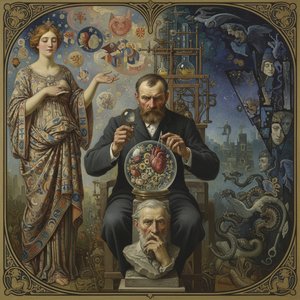
Parade (Max Klinger)
Max Klinger (1857–1920) made Parade.

 Preview

 Hand Made Oil Painting
 Send
 Share
 Guide


 Download
 Similars
 X-Ray
 Diaporama
 Q&A

 Stats
Parade: the essentials
- Title
- Parade
- Artist
- Max Klinger (1857–1920)
- Artist born in
- Leipzig, Germany
- Subject
- events
Parade in high resolution
Max Klinger, Parade. Public domain.
A digital expert checks the colors against the original painting and retouches the file, faithful to the artist's brushwork.
Buy the high-resolution imageQuestions about Parade
What kind of colors does "Parade" use?
"Parade" by Max Klinger uses a neutrals color palette. The palette summarizes the work's overall color character.
Does "Parade" show strong light-dark contrasts?
The contrast level of "Parade" by Max Klinger is statement.
How do I preview a reproduction of "Parade" by Max Klinger?
How do the colors of "Parade" relate to each other?
The color harmony of "Parade" is recorded as unified palette.
Which artist is "Parade" attributed to?
The artist behind "Parade" is Max Klinger. The work is catalogued under Max Klinger's name.
Where do the visitors of "Parade" by Max Klinger come from?
Statistics about "Parade" by Max Klinger are on the artwork's Stats page: monthly visits of the artwork, visits of the artist's works, and country and language breakdowns of recent visitors.
Are there works similar to "Parade"?
The Similars page of "Parade" by Max Klinger presents related artworks.
Can I see "Parade" by Max Klinger under different lights?
The X-Ray view of "Parade" by Max Klinger is on the artwork's X-Ray page: an interactive examination of the image through eleven optical layers.
What is the luminance of "Parade" by Max Klinger?
The colors of "Parade" show a bright balance luminance.
About the artist, Max Klinger

1857–1920, Germany
Max Klinger
The Shadowed World of Max Klinger: A Pioneer of Symbolism Max Klinger, born in Leipzig in 1857, emerged as a pivotal figure bridging the gap between Realism and the burgeoning world of Symbolism. His artistic journey wasn’t one of immediate recognition but rather a gradual unfolding of a unique vision—a descent into the psychological depths that would profoundly influence modern art. Klinger's early training at the Academy of Fine Arts in Karlsruhe, under Karl Gussow, provided him with a solid foundation in traditional techniques, yet it was his fascination with the etchings of artists like Menzel and Goya that truly ignited his imagination. These masters demonstrated the power of printmaking to convey not merely visual representation but also narrative complexity and emotional intensity—qualities Klinger would masterfully employ throughout his career.
 The death peeing
 The Isle of the Dead
 Y sin embargo!
 Presa