Death (Max Klinger)
Max Klinger (1857–1920) made Death.

 Preview

 Hand Made Oil Painting
 Send
 Share
 Guide


 Download
 Similars
 X-Ray
 Diaporama
 Q&A

 Stats
Death: the essentials
- Title
- Death
- Artist
- Max Klinger (1857–1920)
- Artist born in
- Leipzig, Germany
- Subject
- birth and death
Death in high resolution
Max Klinger, Death. Public domain.
A digital expert checks the colors against the original painting and retouches the file, faithful to the artist's brushwork.
Buy the high-resolution imageQuestions about Death
Can I watch "Death" as a full-screen slideshow?
A slideshow is available: the Diaporama page of "Death" by Max Klinger.
What color harmony does "Death" by Max Klinger display?
The color harmony of "Death" is recorded as unified palette.
Toward which tone does "Death" lean?
The dominant hue of "Death" by Max Klinger is ochre to sepia. The hue is the underlying tone of the palette.
How do I discover artworks close to "Death" by Max Klinger?
The Similars page of "Death" by Max Klinger presents related artworks.
How strong is the contrast in "Death" by Max Klinger?
"Death" by Max Klinger shows a statement contrast between its light and dark areas.
How do I preview a reproduction of "Death" by Max Klinger?
A preview of "Death" by Max Klinger is available on the artwork's Preview page.
How do I download the image of "Death" by Max Klinger?
Is "Death" by Max Klinger a bright or a dark artwork?
The perceived brightness of "Death" by Max Klinger is deep_shadow. It can be matched to the light of the intended space.
How intense are the colors in "Death" by Max Klinger?
The color intensity of "Death" is monochromatic. Intensity describes how strong the colors appear.
About the artist, Max Klinger

1857–1920, Germany
Max Klinger
The Shadowed World of Max Klinger: A Pioneer of Symbolism Max Klinger, born in Leipzig in 1857, emerged as a pivotal figure bridging the gap between Realism and the burgeoning world of Symbolism. His artistic journey wasn’t one of immediate recognition but rather a gradual unfolding of a unique vision—a descent into the psychological depths that would profoundly influence modern art. Klinger's early training at the Academy of Fine Arts in Karlsruhe, under Karl Gussow, provided him with a solid foundation in traditional techniques, yet it was his fascination with the etchings of artists like Menzel and Goya that truly ignited his imagination. These masters demonstrated the power of printmaking to convey not merely visual representation but also narrative complexity and emotional intensity—qualities Klinger would masterfully employ throughout his career.
Also by Max Klinger
 The death peeing
 The Isle of the Dead
 Y sin embargo!
 Presa
Essays around Death
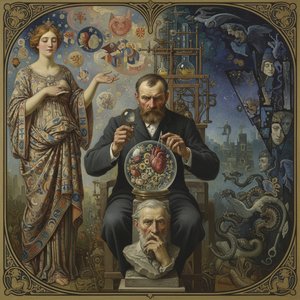 Max Klinger: Symbolism, Science & the Subconscious – A German Master's LegacyExplore the captivating world of Max Klinger, a pivotal German Symbolist artist. Discover his groundbreaking prints, psychological themes, …
 Masterpieces of Darkness and Light: The 25 Best Artworks by Francisco GoyaExplore Goya's haunting masterpieces from courtly grace to dark shadows. Discover the full collection on OriginalUniqueArt.com.
 Unlocking the Unconscious: The Top 25 Masterpieces by Max ErnstStep into the dreamscapes of Max Ernst. Explore 25 iconic Surrealist masterpieces, from pioneering collage to haunting frottage. Find inspi…