Preview
 Send
Send Share
Share
 Details
 Guide
Guide

 Download
 Similars
 X-Ray
X-Ray Diaporama
 Stats
StatsThe Annunciation
 Oil On Panel
- Early Renaissance
 1425
1425- Renaissance
 148.0 x 115.0 cm
 National Gallery of Art
 Read More
Hand Made Oil Reproduction
Hand-painted oil on canvas in your size and frame, made to order by our artists. ( Switch to Print Switch to Digital Image)




P118B $10

P118H $10

P118W $10

P438Z $10

P508JH $12

P508YH $12

P805H $10

P805Z $10

P919BZ $10

P919G $10

P919XJ $10

P959ZH $10

P968JZ $12

W106C $8

W218G $10

W218JH $8

W218Y $10

W307PJ $10

W316G $10

W316PJ $8

W316Y $10

W398PJ $8

W4111J $10

W500HY $15

W500JH $15

W692G $12

W849H $8

W940BG $15

W953PJ $8




Pick from our preset sizes that match the artwork's original proportions.

You may enter your own dimensions to fit a specific frame or space. If your selected size does not match the original image's proportions, we will either crop the artwork or extend the painting with additional hand-painted elements. A digital mockup will be sent for your approval before production begins.
Please note that the on-screen preview does not reflect the actual cropping or extension. Only the mockup will accurately show the final composition.
While custom sizes are available, we recommend selecting a dimension from the predefined list to preserve the original proportions.
After order, OriginalUniqueArt.com team will email client for instructions and provide a mockup preview
Worldwide Delivery () in 3/4 weeks instead of standard 5 weeks. (26 September). No compromise on quality.

Free Worldwide Express Shipping

High-Quality Linen Canvas

Full Shipping Insurance

Customs Tax Refund Guarantee

True Color Matching Guarantee

100-Day Return Policy (Defects Only)

100% Money-Back Guarantee

Bulk Discount Offer
 Glass option is only available in size under 110 CM

The Annunciation
Reproduction Medium
Reproduction Size
-


Total Price
$ 300
The Divine Encounter: An Exploration of Masolino's Annunciation
To gaze upon this depiction of The Annunciation is to step directly into the luminous heart of the early Italian Renaissance. Masolino da Panicale, whose genius bridged the lingering echoes of Gothic splendor with the dawning light of humanism, has captured a moment of profound theological weight: the announcement to Mary that she will conceive the Son of God. The scene unfolds with an exquisite sense of poised stillness, yet beneath this calm surface pulses an undeniable current of divine energy. Notice how the composition guides the eye across the figures—the ethereal angel on one side, and the contemplative Mary on the other—both situated before a doorway that acts not merely as a backdrop, but as a threshold between the earthly realm and the sacred mystery about to unfold.
Mastery in Technique and Form
Masolino’s technical prowess is evident in every delicate brushstroke. While he was a pioneer experimenting with early oil painting techniques alongside his mastery of fresco, this work showcases a remarkable attention to detail that defines his style. The handling of light within the scene is masterful; it seems to emanate from an unseen source, illuminating the drapery folds and lending a palpable glow to the figures' skin. Observe the subtle interplay between the solid architectural elements—the doorway itself—and the weightless quality of the heavenly beings. Even the inclusion of small details, such as the three carefully placed birds fluttering in the air, adds layers of narrative texture, suggesting life breathing within this sacred tableau.
Symbolism and Spiritual Resonance
The symbolism woven into The Annunciation is rich and deeply resonant for the art connoisseur. Mary’s posture speaks volumes of acceptance and quiet contemplation, while the angel embodies divine proclamation. The doorway itself often symbolizes passage or revelation in Renaissance art. Furthermore, the presence of these natural elements—the birds, the architectural framing—are not accidental; they serve to ground the miraculous event within a recognizable, yet elevated, reality. This careful balance between the sublime and the tangible is what gives the piece its enduring emotional power, inviting the viewer into a moment of hushed awe.
A Touch for the Modern Collector
For those seeking an artwork that speaks to both historical depth and timeless beauty, this reproduction offers an unparalleled opportunity. Owning a piece echoing Masolino’s vision means acquiring more than just decoration; it is possessing a narrative steeped in centuries of artistic devotion. The scale of 148 x 115 cm allows the composition to breathe, ensuring that every figure, from the corner witnesses to the central pair, can be appreciated fully. It serves beautifully as a focal point for a grand hall, a private chapel, or any space where one wishes to evoke a sense of profound peace and elevated contemplation.
Artist Biography
The Lyrical Grace of Masolino da Panicale
In the vibrant, transformative atmosphere of the early Florentine Renaissance, few artists captured the delicate transition from Gothic elegance to humanistic realism as poignantly as Masolino da Panicale. Known affectionately by some as “Little Tom,” this master was far more than a mere bridge between eras; he was a painter of profound lyricism and light. Born in the quiet Italian town of Panicale around 1383, his artistic soul was forged in the workshops of Florence, where the shadows of the Middle Ages were beginning to retreat before the dawn of a new, scientifically-minded era. His early training, likely under the legendary Ghiberti, instilled in him a reverence for fine detail and sculptural form that would remain a hallmark of his expressive hand throughout his career.
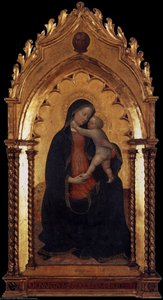
The essence of Masolino’s genius lies in his ability to marry the spiritual sweetness of the International Gothic style with the emerging structural innovations of the Renaissance. While his contemporaries began to obsess over the rigid mathematics of perspective, Masolino maintained a connection to the emotive and the ethereal. This is perhaps most beautifully realized in works such as his Madonna with the Child, where a sense of serene humility and tender devotion radiates from the canvas. In these compositions, the figures possess a soft, rhythmic grace that invites the viewer into a state of quiet contemplation, making him a master of the devotional atmosphere.
A Revolutionary Collaboration
The history of Western art was irrevocably altered by the period between 1424 and 1428, when Masolino shared the monumental task of decorating the Brancacci Chapel in Florence with the formidable Masaccio. This partnership is often viewed through the lens of a stylistic duel, yet it was actually a profound synthesis of two different worlds. While Masaccio pushed the boundaries of heavy, volumetric realism and dramatic light, Masolino provided the necessary lyrical balance. His contributions to the chapel, such as his delicate depiction of Mary Magdalene, offer a breathtaking contrast to the more rugged compositions of his collaborator, injecting a sense of movement and grace that prevented the frescoes from becoming overly austere.
Beyond the walls of the Brancacci Chapel, Masolino’s technical curiosity led him toward the frontiers of medium and method. He is frequently cited as one of the earliest pioneers to experiment with oil painting techniques, a development that allowed for a new depth of color and a more nuanced rendering of light and texture. This experimentation is vividly evident in masterpieces like The Annunciation, where the use of oil lends an unprecedented luminosity to the biblical narrative, capturing the divine moment with a clarity that feels both miraculous and tangibly real.
Legacy and Artistic Significance
The enduring significance of Masolino da Panicale rests in his role as a guardian of beauty during a time of radical change. He did not simply follow the path toward realism; he enriched it with a sense of poetic charm that might otherwise have been lost to the cold precision of geometry. His ability to navigate the complexities of both fresco and early oil painting allowed him to leave behind a body of work that speaks to the multifaceted nature of the human experience—both its physical weight and its spiritual lightness.
As we look back upon his life and achievements, several key elements define his place in the pantheon of great masters:
- The Synthesis of Styles: His unique ability to blend Gothic decorative beauty with Renaissance structural innovation.
- Technical Pioneering: His early and influential experimentation with oil mediums to achieve greater luminosity.
- Collaborative Brilliance: The creation of a transformative artistic dialogue through his work alongside Masaccio in the Brancacci Chapel.
- Emotional Depth: A mastery of depicting religious subjects with a profound, accessible tenderness that resonated with the humanist ideals of his age.
Though his name is sometimes overshadowed by the more radical figures of the Florentine revolution, Masolino remains an indispensable figure. He provided the soul and the grace that allowed the Renaissance to flourish, ensuring that as art moved toward the real, it never lost its connection to the divine.

Masolino da Panicale
1383 - 1447 , Italy
Quick Facts
- Artistic Movement Or Style: Early Renaissance
- Artists Who Influenced This Artist:
- Ghiberti
- Masaccio
- Date Of Birth: c. 1383
- Date Of Death: c. 1447
- Full Name: Masolino da Panicale
- Nationality: Italian
- Notable Artworks:
- Madonna with Child
- St. Anne
- Brancacci Chapel frescoes
- Place Of Birth: Panicale, Italy
Related Articles
Leonardo da Vinci's Masterpieces: Explore 25 Iconic Artworks for Your Home | OriginalUniqueArt
Journey through Leonardo da Vinci's genius with our curated selection of 25 iconic artworks. Explore the stories behind Mona Lisa, The Last Supper & more Renaissance masterpieces. Find museum-quality art reproductions for your home at OriginalUniqueArt.com.

The Fresco as Family Legacy: Preserving Heritage Through Wall Art
Explore the rich history & enduring legacy of fresco painting. Discover how to preserve family heritage through stunning wall art. Expert insights & restoration guidance.

The Enduring Legacy of Fresco: Technique, History & Artistic Expression
Explore the rich history & enduring artistry of fresco painting. Discover techniques from Giotto to Michelangelo, conservation efforts, & modern applications. Learn how OriginalUniqueArt brings this timeless art form to your home.

The Enduring Legacy of Fresco: Technique, History & Artistic Expression Across Cultures
Explore the rich history & enduring legacy of fresco painting! Discover ancient techniques, Giotto's masterpieces, and modern applications. Expert insights for art lovers & professionals.

The Enduring Legacy of Fresco Painting: Techniques, History & Contemporary Relevance
Explore the rich history & enduring artistry of fresco painting – from Giotto to Michelangelo! Discover techniques, conservation efforts, & modern applications. Learn how OriginalUniqueArt brings this timeless art form to your home.