Preview
 Send
Send Share
Share
 Details

 Download
 Similars
 X-Ray
X-Ray Diaporama
 Stats
StatsSt. Andrew


 Read More
Giclée / Art Print
Museum-quality giclée or canvas print with fast production and flexible finish options. ( Buy Hand Made Painting Switch to Digital Image)




P118B $10

P118H $10

P118W $10

P438Z $10

P508JH $12

P508YH $12

P805H $10

P805Z $10

P919BZ $10

P919G $10

P919XJ $10

P959ZH $10

P968JZ $12

W106C $8

W218G $10

W218JH $8

W218Y $10

W307PJ $10

W316G $10

W316PJ $8

W316Y $10

W398PJ $8

W4111J $10

W500HY $15

W500JH $15

W692G $12

W849H $8

W940BG $15

W953PJ $8




Pick from our preset sizes that match the artwork's original proportions.

You may enter your own dimensions to fit a specific frame or space. If your selected size does not match the original image's proportions, we will either crop the artwork or extend the image with a mirrored or solid-fill edge. A digital mockup will be sent for your approval before production begins.
Please note that the on-screen preview does not reflect the actual cropping or extension. Only the mockup will accurately show the final composition.
While custom sizes are available, we recommend selecting a dimension from the predefined list to preserve the original proportions.
Worldwide Delivery () in 2 weeks instead of standard 4/5 weeks. (12 September)

Free Worldwide Express Shipping

High-Quality Linen Canvas

Full Shipping Insurance

Customs Tax Refund Guarantee

True Color Matching Guarantee

100-Day Return Policy (Defects Only)

100% Money-Back Guarantee

Bulk Discount Offer
 Glass option is only available in size under 110 CM

St. Andrew
Giclée / Art Print
Reproduction Size
-


Total Price
$ 81
A Revolutionary Vision of Faith: Masaccio’s St. Andrew
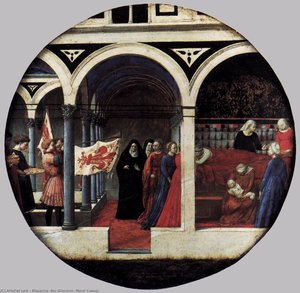
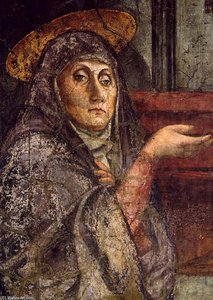
Masaccio's *St. Andrew*, painted in 1426, is a landmark work of the Early Renaissance, embodying the seismic shift towards naturalism and humanistic expression that defined the Quattrocento. This isn’t merely a religious depiction; it’s a profound psychological portrait rendered with groundbreaking artistic skill. The painting presents St. Andrew, one of Jesus Christ's first apostles, in a strikingly intimate manner. He is depicted as a man – not an ethereal saint – with a neatly trimmed beard and wearing a simple green robe. His downward gaze suggests contemplation or prayer, inviting the viewer into his inner world.Technical Mastery & Artistic Innovation
Masaccio’s genius lies in his ability to create a sense of *realism* previously unseen in painting. He achieves this through several key techniques. While the size of the original work is unknown, its impact is immense. The use of chiaroscuro – the dramatic contrast between light and shadow – sculpts Andrew’s face and robe, giving them a tangible three-dimensionality. This technique, combined with his emerging understanding of linear perspective (though not fully developed as in *The Trinity*), creates a sense of depth and presence. The subtle modeling of features and drapery demonstrates Masaccio's meticulous observation of the natural world – a hallmark of Renaissance art. He moves away from the stylized conventions of the International Gothic period, favoring anatomical accuracy and believable form.Symbolism & Religious Context
The composition is rich in symbolic meaning. The two crosses visible in the background immediately signify St. Andrew’s martyrdom – he was crucified on an X-shaped cross. Their placement subtly frames the figure, reminding us of his ultimate sacrifice. The book held in Andrew's hands likely represents knowledge, scripture, or perhaps even the Gospels themselves, emphasizing his role as a foundational figure in Christianity and a disseminator of faith. The green robe, while seemingly simple, can be interpreted as symbolizing hope and renewal – themes central to Christian belief. Masaccio’s choice to depict Andrew with such human vulnerability underscores the accessibility of faith and the relatable nature of even the most revered figures.A Lasting Legacy
Despite his tragically short life (he died at just 27), Masaccio fundamentally altered the course of Western art. His innovations in perspective, realism, and emotional depth profoundly influenced generations of artists, including Michelangelo and Leonardo da Vinci. *St. Andrew* stands as a testament to his revolutionary vision – a powerful blend of religious devotion and humanist inquiry. For collectors and interior designers, a reproduction of this work offers not only aesthetic beauty but also a connection to the very origins of Renaissance art, bringing a sense of historical weight and intellectual sophistication to any space. It’s a piece that invites contemplation and embodies the spirit of artistic innovation.Artist Biography
Masaccio (1401-1428): The Dawn of Renaissance Realism
Tommaso di Ser Giovanni di Simone, better known as Masaccio (meaning "clumsy Tom"), was a pivotal figure in the Early Italian Renaissance. Born on December 21, 1401, in San Giovanni Valdarno, Italy, and dying tragically young in 1428, his brief career revolutionized painting with groundbreaking realism, perspective, and chiaroscuro (the use of strong contrasts between light and dark). Despite his short life, Masaccio’s impact on subsequent generations of artists was profound, establishing a new standard for naturalism and influencing the course of Western art.
Early Life and Training
- Origins: Born to Giovanni di Simone Cassai, a notary, and Jacopa di Martinozzo. His family name, Cassai, derived from his paternal grandfather's trade as a cabinet maker.
- Early Years: Orphaned at age five when his father died, he had a brother, Giovanni (Lo Scheggia), who also became a painter.
- Apprenticeship: The details of Masaccio’s artistic training remain largely unknown, which is unusual for Renaissance artists. It's believed he likely apprenticed around the age of 12, but no definitive master has been identified. This lack of documented training adds to the mystery surrounding his rapid development and innovative techniques.
- Guild Membership: He joined the painters’ guild (Arte de’ Medici e Speziali) in Florence on January 7, 1422, signifying his emergence as an independent master artist.
Artistic Development and Major Works
- Early Influences: Initially influenced by Giotto di Bondone, a predecessor known for his naturalism, Masaccio quickly surpassed him in his understanding of perspective and anatomy. He also drew inspiration from the architectural innovations of Filippo Brunelleschi, particularly Brunelleschi’s rediscovery of linear perspective.
- Key Innovations: Masaccio pioneered several groundbreaking techniques:
- Linear Perspective: Employed vanishing points and mathematical precision to create a convincing illusion of depth on a two-dimensional surface.
- Chiaroscuro: Masterfully used light and shadow to model forms, creating a sense of volume and realism previously unseen in painting.
- Naturalism: Depicted figures with anatomical accuracy and emotional expressiveness, moving away from the stylized representations of earlier periods.
- Significant Works:
- San Giovenale Triptych (c. 1422): An early work demonstrating his developing skill in perspective and naturalistic representation.
- Madonna and Child with St. Anne (c. 1423-1425): A collaboration with Masolino, showcasing Masaccio’s emerging realism alongside Masolino's more traditional style.
- Brancacci Chapel Frescoes (c. 1425-1428): His most celebrated and influential works, located in the Church of Santa Maria del Carmine in Florence. These frescoes, including "The Tribute Money," "Expulsion from Paradise," and "St. Peter Baptizing the Neophytes," are considered masterpieces of Early Renaissance art.
Historical Significance and Legacy
Masaccio’s impact on the course of Western art is immeasurable, despite his tragically short career. His innovations in perspective, chiaroscuro, and naturalism fundamentally altered how artists depicted the world. He effectively bridged the gap between Medieval artistic conventions and the emerging ideals of the Renaissance.
- Influence on Subsequent Artists: Masaccio’s work profoundly influenced generations of painters, including Donatello, Leonardo da Vinci, Michelangelo, and Raphael. They studied his frescoes intently, adopting and adapting his techniques to their own styles.
- Foundation for the High Renaissance: His emphasis on realism and human emotion laid the groundwork for the artistic achievements of the High Renaissance.
- Vasari's Account: The biographer Giorgio Vasari recognized Masaccio’s genius, praising him as "the best painter of his generation" and highlighting his ability to imitate nature with unparalleled skill.
- A Tragic Loss: His death at the young age of 26 was mourned by contemporaries like Filippo Brunelleschi, who lamented the loss of such a remarkable talent.
Conclusion
Masaccio’s legacy endures as one of the most important and influential artists in history. He stands as a pivotal figure in the transition from Medieval to Renaissance art, forever changing the way we perceive and represent the world through painting. His brief but brilliant career serves as a testament to the power of innovation and the enduring impact of artistic genius.

Masaccio
1401 - 1429 , Italy
Quick Facts
- Artistic Movement Or Style: Early Renaissance
- Artists Or Movements Influenced By This Artist: ['Later Renaissance painters']
- Artists Who Influenced This Artist:
- Giotto
- Filippo Brunelleschi
- Donatello
- Date Of Birth: December 21, 1401
- Date Of Death: Summer 1428
- Full Name: Masaccio (Ser Giovanni, Mone Cassai)
- Nationality: Italian
- Notable Artworks:
- The Trinity
- Brancacci Chapel frescoes
- Holy Trinity
- Tribute Money
- Place Of Birth: San Giovanni Valdarno, Italy
Related Articles

The Soul of Impressionism: Why Oil on Canvas Captures Eternal Light and Timeless Emotion
Discover the enchanting alchemy of Impressionism. Explore how the mastery of oil on canvas, through glazing and impasto, captures eternal light and emotion. Perfect for lovers of Monet and Van Gogh seeking the profound depth of hand-painted fine art.

The Enduring Legacy of Oil on Canvas: Technique, History & Aesthetic Impact
Explore the rich history & techniques of oil painting – from Renaissance masters to Impressionism. Discover pigments, layering methods, and why this timeless medium endures. Expert insights for artists & art enthusiasts.

Oil on Canvas: A Historical & Technical Exploration of a Timeless Artistic Medium
Explore the rich history & enduring techniques of oil painting on canvas. Discover the science behind its longevity, conservation practices, and contemporary relevance. Expert insights for art enthusiasts.

The Enduring Legacy of Oil on Canvas: Technique, History & Contemporary Practice
Explore the rich history & enduring techniques of oil painting on canvas. Discover the science behind its longevity, conservation practices, and contemporary relevance. Expert insights for art enthusiasts.
Oil on Canvas Masters: 10 Paintings That Redefined Art History |
Journey through art history with our guide to 10 legendary oil on canvas masterpieces! Explore iconic works by Van Gogh, Monet & Rembrandt. Find museum-quality reproductions and elevate your home decor at . Discover all masterpieces online.