Preview
 Send
Send Share
Share
 Details
 Guide
Guide

 Download
 Similars
 X-Ray
X-Ray Diaporama
 Stats
StatsThe Roman Newsboys


 Read More
Giclée / Art Print
Museum-quality giclée or canvas print with fast production and flexible finish options. ( Buy Hand Made Painting Switch to Digital Image)




P118B $10

P118H $10

P118W $10

P438Z $10

P508JH $12

P508YH $12

P805H $10

P805Z $10

P919BZ $10

P919G $10

P919XJ $10

P959ZH $10

P968JZ $12

W106C $8

W218G $10

W218JH $8

W218Y $10

W307PJ $10

W316G $10

W316PJ $8

W316Y $10

W398PJ $8

W4111J $10

W500HY $15

W500JH $15

W692G $12

W849H $8

W940BG $15

W953PJ $8




Pick from our preset sizes that match the artwork's original proportions.

You may enter your own dimensions to fit a specific frame or space. If your selected size does not match the original image's proportions, we will either crop the artwork or extend the image with a mirrored or solid-fill edge. A digital mockup will be sent for your approval before production begins.
Please note that the on-screen preview does not reflect the actual cropping or extension. Only the mockup will accurately show the final composition.
While custom sizes are available, we recommend selecting a dimension from the predefined list to preserve the original proportions.
Worldwide Delivery () in 2 weeks instead of standard 4/5 weeks. (27 September)

Free Worldwide Express Shipping

High-Quality Linen Canvas

Full Shipping Insurance

Customs Tax Refund Guarantee

True Color Matching Guarantee

100-Day Return Policy (Defects Only)

100% Money-Back Guarantee

Bulk Discount Offer
 Glass option is only available in size under 110 CM

The Roman Newsboys
Giclée / Art Print
Reproduction Size
-


Total Price
$ 81
A Glimpse into an Epoch: The Allure of "The Roman Newsboys"
To stand before Martin Johnson Heade's The Roman Newsboys is to step through the veil of time, transported to a moment suspended between history and daily life. This painting captures not merely two figures against a textured wall, but an entire atmosphere—the vibrant, overheard murmur of a bygone era. The composition centers on a man and woman, their forms imbued with the rich patina of antiquity. They are caught in what appears to be a hushed exchange, their gazes perhaps fixed on the intriguing script adorning the background wall or lost in the shared narrative unfolding between them. The very air seems thick with untold stories, making this piece an immediate conversation starter for any discerning collector.
Mastery of Light and Atmosphere: Heade's Technique
Martin Johnson Heade, a master whose vision was often described as luminous, employs his technique here to great effect. While the subject matter grounds us in a specific historical tableau, the handling of light elevates it to something more universal. Observe how the light seems to emanate from an unseen source, gently illuminating the folds of their old-fashioned garments and catching the delicate detail on the woman's headband. Heade’s ability to render texture—the roughness of the wall, the weave of the cloth, the sheen on a passing bird—is breathtaking. This meticulous attention to surface detail suggests a deep understanding of both natural observation and painterly craft, making any reproduction an homage to his technical brilliance.
Symbolism in the Everyday: Stories Whispered by Art
The inclusion of the newspaper held by the woman, juxtaposed with the writing on the wall, invites layers of symbolic interpretation. Are these newsboys selling ephemeral gossip, or are they discussing enduring truths etched into stone? The two birds fluttering in the background add a touch of poignant naturalism; often in art, birds symbolize freedom, the soul, or messages carried across distances. These subtle elements—the script, the press, the avian life—transform what could be a simple portrait into a rich meditation on communication, time's passage, and the enduring human need to connect over shared information. It is an artwork that rewards prolonged contemplation.
Bringing History Home: Decorating with Narrative Depth
For the interior designer or art enthusiast seeking a piece that anchors a room with intellectual weight, The Roman Newsboys offers unparalleled depth. Its romantic historical flavor complements everything from richly paneled libraries to sun-drenched drawing rooms. Owning this reproduction is not simply acquiring decoration; it is curating an emotional landscape. It suggests a life lived with curiosity, one where the grand sweep of history meets the intimacy of a whispered conversation. Let the gentle drama and luminous quality of Heade’s vision infuse your space with timeless elegance.
Artist Biography
A Luminist’s Quiet Vision: The Life and Art of Martin Johnson Heade
Martin Johnson Heade, born in the tranquil Pennsylvania countryside in 1819, remains a captivating figure in American art history—a painter whose luminous landscapes and intimate depictions of nature gradually emerged from relative obscurity to claim their rightful place among the nation’s most significant artistic achievements. His early life in Lumberville, along the Delaware River, instilled within him a deep appreciation for the natural world, an affection nurtured by initial studies under local artists Edward and possibly Thomas Hicks. These foundational lessons provided Heade with the technical skills that would later blossom into a distinctive style, though his path to recognition was far from direct. Initially focused on portraiture, his early works demonstrate a competent hand but lack the singular vision that would define his mature oeuvre. A period of travel in Europe broadened his artistic horizons, exposing him to diverse influences and setting the stage for his eventual embrace of landscape painting.From Portraiture to Panoramic Light
The pivotal shift in Heade’s artistic direction occurred through encounters with members of the Hudson River School—artists like John Frederick Kensett and Benjamin Champney—who awakened within him a passion for capturing the grandeur and subtle beauty of the American landscape. This influence, combined with his own innate sensitivity to light and atmosphere, led him to develop a style characterized by serene compositions and meticulous attention to detail. Heade’s work began to distinguish itself through its quiet intensity, eschewing the dramatic narratives favored by some of his contemporaries in favor of contemplative studies of marshlands, seascapes, and eventually, tropical flora and fauna. A defining moment came with his travels to Brazil in 1863-1864, a journey that profoundly impacted his artistic output. Immersed in the vibrant colors and exotic forms of the Brazilian rainforest, Heade embarked on a series of small paintings depicting hummingbirds amidst lush orchids—works that showcase both his technical mastery and his fascination with the delicate interplay between life and environment. These “gems of Brazil,” as he called them, were initially intended for publication but remained largely unrealized during his lifetime, yet they stand today as some of his most celebrated creations. Subsequent trips to Central America and Jamaica further fueled his exploration of tropical subjects, enriching his palette and expanding his artistic vocabulary.Marshlands, Magnolias, and the Rediscovery of a Master
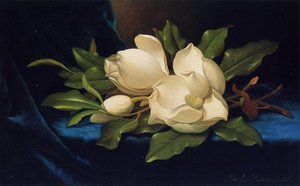
In later years, Heade settled in St. Augustine, Florida, where he turned his attention to still life—particularly exquisite depictions of magnolia blossoms arranged against rich velvet backgrounds. These paintings, with their velvety textures and luminous light, exemplify his mastery of color and form. However, despite producing a substantial body of work throughout his career, Heade remained largely unknown during his lifetime. It wasn’t until the 1940s that scholars began to recognize the significance of his contributions to American art. A remarkable series of rediscoveries—paintings surfacing in unexpected places like garage sales and flea markets—brought renewed attention to his work, revealing a previously overlooked master of Luminism. The term “Luminism” itself, coined to describe the style shared by Heade and artists such as Fitz Henry Lane, captures the essence of his artistic vision: an emphasis on atmospheric effects, subtle gradations of light, and a sense of stillness and tranquility.A Legacy of Quiet Contemplation
Martin Johnson Heade’s legacy extends beyond his technical skill and aesthetic sensibilities. His paintings offer viewers a space for quiet contemplation—an invitation to immerse themselves in the beauty and serenity of the natural world. While he may not have achieved widespread fame during his lifetime, his work has resonated deeply with audiences since its rediscovery, solidifying his position as a major figure in American art. Today, his paintings are held in prominent museum collections worldwide, including the Martin Johnson Heade collection at OriginalUniqueArt, and continue to inspire awe and admiration for their luminous beauty and enduring power. Heade’s ability to capture the ephemeral qualities of light and atmosphere—to transform ordinary scenes into moments of transcendent beauty—ensures his place among the most beloved and influential American painters of the 19th century. His art serves as a poignant reminder of the importance of preserving and appreciating the natural world, and of finding solace in its quiet splendor.Key Characteristics of Heade’s Style
- Luminism: A defining characteristic, emphasizing atmospheric effects and subtle light gradations.
- Serene Compositions: Avoiding dramatic narratives in favor of peaceful scenes.
- Meticulous Detail: Precise rendering of natural forms and textures.
- Subject Matter: Salt marshes, seascapes, tropical birds (especially hummingbirds), magnolias, and still lifes.
- Romantic Approach: A focus on the emotional impact of nature and its beauty.

Martin Johnson Heade
1819 - 1904 , United States of America
Quick Facts
- Artistic Movement Or Style: Luminism
- Artists Who Influenced This Artist:
- Edward Hicks
- John F. Kensett
- Date Of Birth: August 11, 1819
- Date Of Death: September 4, 1904
- Full Name: Martin Johnson Heade
- Nationality: American
- Notable Artworks:
- Orchids & Hummingbird
- Salt Marsh Landscapes
- Hummingbird Blossoms
- Place Of Birth: Lumberville, USA
Related Articles
Martin Johnson Heade: Luminism, American Identity & the Poetic Still Life
Explore the captivating world of Martin Johnson Heade, a master of Luminism. Discover his serene landscapes, vibrant still lifes & profound connection to American identity. Learn about his techniques and legacy.

Luminism: Capturing the Ethereal Glow of Light in American Landscape Painting
Explore the ethereal beauty of Luminism. Discover how 19th-century American masters captured light and atmosphere through profound landscape painting. Learn about this iconic movement and find museum-quality, hand-painted oil reproductions to bring historical brilliance to your home.
Robert Spencer: Luminism, Narrative & the American Landscape Tradition
Explore the captivating world of Luminism & the Hudson River School with our expert analysis. Discover the history, artists, and enduring beauty of 19th-century American landscape painting. Find museum-quality reproductions at OriginalUniqueArt.

American Realism's Defining Works: 10 Masterpieces for Your Home
Explore 10 defining American Realism masterpieces – Hopper, Homer & more. Discover the stories behind these iconic paintings and bring timeless art to your home with OriginalUniqueArt's museum-quality reproductions. Explore the full collection online.

Luminism: Capturing Ephemeral Light & Transcendence in 19th-Century American Landscape Painting
Explore the captivating world of Luminism! Discover the key artists, techniques & legacy of this influential 19th-century American art movement. Expert insights & high-quality reproductions at OriginalUniqueArt.