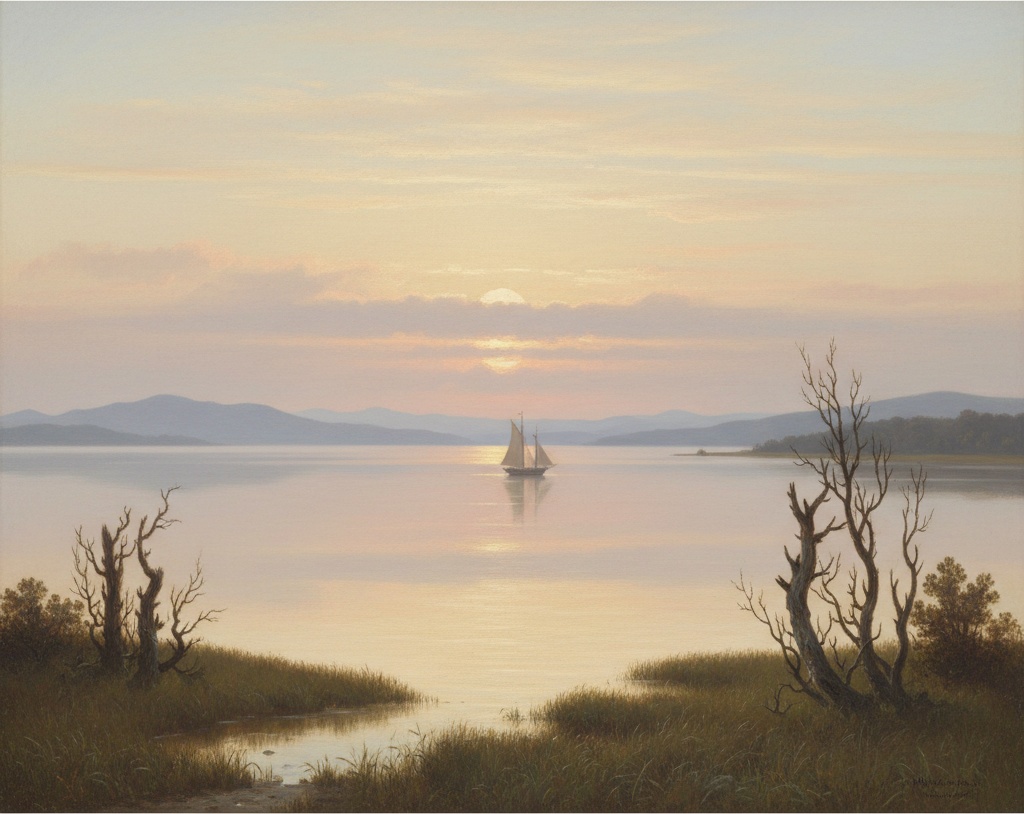
The Rise of Luminism: A Response to Romantic Ideals
The Hudson River School was a mid-19th-century American art movement embodied by a group of landscape painters whose aesthetic vision was influenced by Romanticism. Early on, the paintings typically depicted the Hudson River Valley and the surroundi...
The mid-19th century witnessed a fascinating shift within the American art landscape, a subtle yet profound departure from the dramatic emotionality of Romanticism. While artists like Thomas Cole had established the Hudson River School with its sweeping vistas and allegorical narratives, a new sensibility began to emerge – one focused not on grand pronouncements about nature’s power, but on its quiet, ethereal beauty. This was Luminism, a style characterized by an almost reverent depiction of light and atmosphere, and a meticulous attention to detail that bordered on the scientific. It wasn't a rejection of Romantic ideals entirely, but rather a refinement, a turning inward to explore the more subtle nuances of the natural world. The early pioneers weren’t consciously forming a “school” in the modern sense; instead, they were driven by a shared fascination with capturing the fleeting effects of sunlight on water, land, and sky. This pursuit arose from a uniquely American context – a nation still defining itself through its vast, untamed territories, and seeking to articulate a distinct visual identity.
Key Characteristics of Luminist Painting: Light, Atmosphere & Detail
Aerial perspective, or atmospheric perspective, is the effect the atmosphere has on the appearance of an object as viewed from a distance. As the distance between an object and a viewer increases, the contrast between the object and its background de...
At the heart of Luminism lies an unparalleled mastery of light. Unlike the often turbulent skies and dramatic chiaroscuro of Romantic paintings, Luminist works typically feature calm, serene atmospheres bathed in soft, diffused sunlight. Artists painstakingly rendered the subtle gradations of color and tone, creating a sense of depth and realism that was revolutionary for its time. This wasn’t merely about accurate representation; it was about evoking a specific *feeling* – one of tranquility, contemplation, and even spiritual connection with nature. Aerial perspective, the technique of depicting distant objects as paler and less detailed due to atmospheric haze, became central to their compositions. The effect is often breathtaking: landscapes that seem to recede into an infinite distance, inviting the viewer to lose themselves in the scene. Beyond light, detail was paramount. Whether it was the intricate rigging of a sailing vessel or the delicate foliage of a tree, Luminist painters demonstrated an extraordinary commitment to capturing the textures and forms of the natural world with unwavering precision. This meticulous approach wasn’t simply about technical skill; it reflected a deep respect for the subject matter itself.
Prominent Artists of the Hudson River School & Their Luminist Works
 John William Casilear
John William Casilear (1811-1893): Hudson River School painter of luminous American landscapes. Explore serene scenes & masterful light in his art, found at the Met & National Gallery.
Several artists within the broader Hudson River School embraced Luminist principles, each bringing their unique vision to the style. Albert Bierstadt, though known for his grand panoramic views, often incorporated Luminist techniques into his work, particularly in his depictions of the American West. His painting “Alaska” exemplifies this – muted colors and atmospheric perspective create a sense of awe-inspiring scale and majesty. Jasper Francis Cropsey’s “Farm Along the River” showcases the idyllic rural beauty that characterized much of Luminist art, with soft light illuminating autumnal hues and meticulously rendered details. Thomas Worthington Whittredge’s “Buffalo on the Platte River” is a particularly compelling example, capturing the serene stillness of the American wilderness. Beyond these well-known figures, artists like John William Casilear and William Stanley Haseltine dedicated their careers to exploring the subtleties of light and atmosphere in landscapes of New England and Italy respectively. While James McDougal Hart’s work often included detailed cattle paintings, his idyllic scenes also demonstrate a Luminist sensibility.
Technical Mastery: Achieving Luminous Effects in Oil Painting
The luminous quality of these paintings wasn't accidental; it was the result of painstaking technical skill and a deep understanding of oil painting techniques. Artists employed layering – building up thin glazes of color to create depth and luminosity. This process required patience and precision, as each layer had to be carefully applied to achieve the desired effect. The choice of pigments also played a crucial role. Luminist painters favored colors that were transparent and allowed light to pass through them, enhancing the overall sense of radiance. They often used subtle mixtures of earth tones – ochres, umbers, and siennas – to create realistic depictions of natural light and shadow. The use of varnishes was also critical, as they helped to saturate colors and enhance the painting’s reflective qualities. Many artists meticulously studied the effects of light on different surfaces, observing how it interacted with water, foliage, and rock formations. This dedication to observation allowed them to accurately capture the nuances of natural illumination.
Luminism's Legacy and Enduring Appeal in American Art
Though Luminism’s peak period was relatively short-lived – roughly from 1850 to 1870 – its influence continues to be felt today. The style helped to establish a distinctly American aesthetic, one that celebrated the beauty of the nation’s landscapes and fostered a sense of national pride. The emphasis on tranquility and contemplation also resonated with audiences seeking respite from the rapid industrialization of the era. Luminist paintings offer more than just beautiful scenery; they provide a window into a specific moment in American history – a time when artists were grappling with questions of identity, nature, and spirituality. The enduring appeal of these works lies in their ability to evoke a sense of peace and wonder, reminding us of the power and beauty of the natural world. At OriginalUniqueArt.com, we are proud to offer high-quality reproductions of Luminist masterpieces, allowing you to bring these timeless works into your own home.