Switch to Print
 Read More







































 For artworks or reproductions larger than 105 cm (approximately 41 inches) on any side, the frame will be shipped as a kit, disassembled. This method ensures safe delivery and prevents damage during transport.


A Study in Greed and Ink
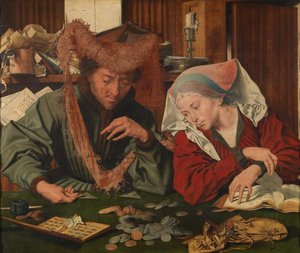
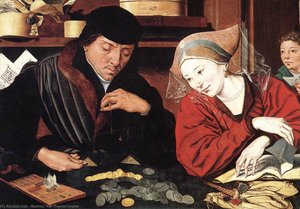
The air in the room feels heavy, thick with the scent of old parchment and the metallic tang of coins. Two men sit hunched over a wooden table, their world narrowed to the scratching of a quill and the silent weight of wealth. On the left, a man with spectacles perched upon his nose leans into his task, his focus entirely consumed by the ledger before him. He writes with a steady hand, his pen capturing the movement of numbers that represent the lifeblood of commerce. Beside him, his companion shifts, looking over his shoulder as if checking for an intruder or perhaps a witness to their transaction. A cup sits nearby, its contents forgotten in the pursuit of the tally. Scattered across the table, books lie open, their pages filled with the complex bureaucracy of a changing era. A bowl rests in the corner, a quiet observer to this intense, private moment of accounting.
The scene unfolds with a sharp, tactile realism that makes the textures of the room feel almost reachable. One can almost hear the rustle of their heavy, old-fashioned garments and the soft thud of a coin hitting the wood. This is a moment frozen in the sixteenth century, a time when the mercantile heart of the Low Countries beats with a new, restless energy. The lighting is diffused, casting soft shadows that define the deep folds of their clothing and the weathered surfaces of the objects surrounding them. Every detail, from the sheen on a metal scale to the intricate grain of the oak panel, grounds this interaction in a tangible, physical reality.
The Weight of the Ledger
There is a tension simmering beneath the surface of this quiet study. While the men appear absorbed in their administrative duties, the composition whispers of a deeper, more unsettling reality. The meticulous rendering of the coins and the ledgers points toward the rising tide of capitalism that began to reshape society during this period. The very act of recording these sums carries a heavy moral weight, hinting at the friction between civic necessity and the allure of personal gain. The heavy fabrics and the cluttered table create a sense of enclosure, as if the men are trapped within the very systems of law and commerce they are tasked to manage.
The artist uses a muted color palette to emphasize the gravity of the scene. Earthy tones and subtle shifts in light draw the eye to the tools of the trade: the pen, the ink, and the money. This focus on the minute textures of manuscripts and legal documents reflects a preoccupation with the tangible markers of status and power. Through this careful observation, the painting captures the intersection of daily life and the complex machinery of governance, leaving the viewer to wonder about the true nature of the wealth being recorded in the dim light of the room.
Questions & Answers
What does "Two tax collectors" by Marinus Van Reymerswaele depict, and in what mood?
"Two tax collectors" by Marinus Van Reymerswaele depicts people, men, table, books, coins, pen, cup, bowl, in a dramatic mood. Subject and atmosphere together describe the work.
What is a reproduction of "Two tax collectors" by Marinus Van Reymerswaele recommended for?
The recommended use of a print of "Two tax collectors" is conversation.
What technique and style characterize "Two tax collectors" by Marinus Van Reymerswaele?
In "Two tax collectors", the oil on panel technique meets the Northern Renaissance movement.
More about this painting
 Preview
 Send
Send Share
Share
 Details
 Guide
Guide

 Download
 Similars
 X-Ray
X-Ray Diaporama
 Q&A
Q&A Stats
Stats