 Send
Send Share
Share
 Details

 Download
 Similars
 Diaporama
Print sample
 Giclée Print
- Digital
- Art Nouveau
 1905
1905- 19th Century
 39.0 x 27.0 cm
 Palazzo Fortuny
 Read More
Hand Made Oil Reproduction
Hand-painted oil on canvas in your size and frame, made to order by our artists. ( Buy Print Buy Image)




































Pick from our preset sizes that match the artwork's original proportions.

You may enter your own dimensions to fit a specific frame or space. If your selected size does not match the original image's proportions, we will either crop the artwork or extend the painting with additional hand-painted elements. A digital mockup will be sent for your approval before production begins.
Please note that the on-screen preview does not reflect the actual cropping or extension. Only the mockup will accurately show the final composition.
While custom sizes are available, we recommend selecting a dimension from the predefined list to preserve the original proportions.
After order, OriginalUniqueArt.com team will email client for instructions and provide a mockup preview
Worldwide Delivery () in 3/4 weeks instead of standard 5 weeks. (17 August). No compromise on quality.

Free Worldwide Express Shipping

High-Quality Linen Canvas

Full Shipping Insurance

Customs Tax Refund Guarantee

True Color Matching Guarantee

60-Day Return Policy (Defects Only)

100% Money-Back Guarantee

Bulk Discount Offer
 Glass option is only available in size under 110 CM

Print sample
Reproduction Medium
Reproduction Size
-


Total Price
$ 300
Artwork Description
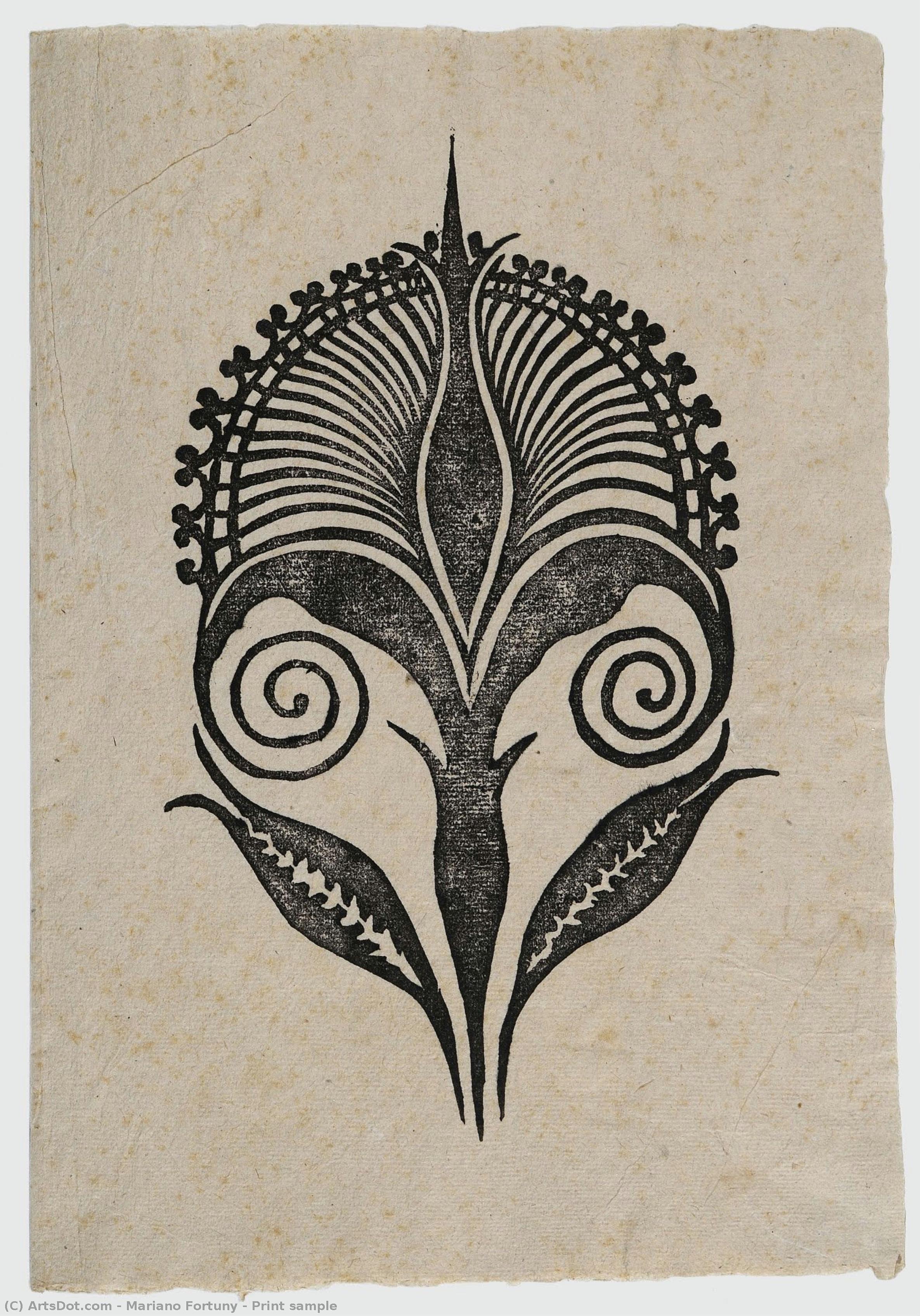
Mariano Fortuny’s “Print Sample”: A Whisper of Venetian Ornamentation
The photograph captures a meticulously crafted print by Mariano Fortuny y Marsal, a Spanish artist who irrevocably altered the landscape of theatrical design and textile artistry. Executed around 1905 in tempera on paper – measuring 396 × 275 mm – “Print Sample” embodies Fortuny’s signature blend of Orientalist influences and geometric precision, offering a glimpse into his artistic vision during a pivotal moment in European art history. Its muted palette and subtle tonal variations speak volumes about the artist's mastery of technique and his dedication to capturing an ethereal beauty.Composition & Technique: Spirals Within Spirals
The print’s central motif is dominated by swirling, spiral patterns emanating from a prominent apex at the top. These spirals gracefully descend towards pointed extensions at the bottom, creating a dynamic visual rhythm that draws the eye inwards. Fine lines weave throughout the design, establishing an intricate framework and contributing to a palpable sense of delicacy. The artist skillfully employs repetition—the spiraling forms reappear across multiple layers—to amplify their impact and generate an illusion of depth. This technique aligns perfectly with Fortuny’s pioneering work in cyclorama projection, where he sought to simulate natural light and create immersive theatrical experiences.Historical Context & Artistic Style: Art Nouveau's Delicate Embrace
Fortuny’s artistic output flourished during the Belle Époque, a period characterized by opulent ornamentation and fascination with exotic cultures—particularly Persia and Morocco. “Print Sample” reflects this aesthetic sensibility through its organic lines reminiscent of Art Nouveau, prioritizing flowing curves and vegetal motifs. The stylized mask-like form at the core of the design carries symbolic weight, hinting at themes of identity, concealment, and ritualistic contemplation – concepts prevalent in Eastern artistic traditions. Fortuny’s meticulous attention to detail—evident in the paper's grain texture and subtle tonal variations—underscores his commitment to capturing a refined aesthetic ideal.Symbolism & Emotional Resonance: An Echo of Transformation
Beyond its formal qualities, “Print Sample” evokes an emotional response rooted in notions of metamorphosis and ethereal beauty. The spiraling patterns symbolize movement, dynamism, and the cyclical nature of existence – mirroring Fortuny’s fascination with natural phenomena and his belief in the transformative power of art. Viewing this print is akin to embarking on a visual journey—a contemplation of form, texture, and subtle color harmonies that linger long after the gaze has moved on. It stands as testament to Fortuny's ability to distill complex ideas into deceptively simple yet profoundly evocative imagery.Materials & Reproduction Considerations
The print itself utilizes tempera paint on paper – a medium favored by Fortuny for its luminosity and ability to achieve nuanced tonal gradations. Reproductions should prioritize archival quality paper stock and pigment inks to faithfully preserve the original artwork's delicate surface texture and subtle color palette. Selecting a reputable printing house ensures that collectors experience the same captivating visual impact as Fortuny himself intended, transporting them into the heart of Venetian artistic innovation.Artist Biography
early life and inspiration
mariano fortuny, a spanish fashion designer, was born on may 11, 1871, in granada, spain. his father, mariano fortuny y marsal, was a genre painter who passed away when mariano was just three years old. this event led to the family's move to paris, france, where mariano's mother introduced him to various textiles and fabrics that would later influence his creativity.artistic talents and inventions
mariano fortuny showcased his artistic talents from a young age, demonstrating skills in painting, photography, sculpting, architecture, etching, and theatrical stage lighting. his inventions, including over twenty patented between 1901 and 1934, revolutionized the world of theater design.- he developed the fortuny cyclorama dome, a quarter dome-shaped structure of plaster or cloth, which used indirect lighting to create a seamless transition between scenes.
- his treatise "eclairage scenique" (1904) described his discovery of reflecting light off different surfaces, changing its color, intensity, and properties.
notable contributions and collaborations
mariano fortuny's work gained widespread recognition in the 1920s. he collaborated with notable figures, including:- richard wagner, a german composer, whose operas inspired mariano to paint scenes.
- the famous opera house, la scala of milan, where he installed his dome, adapting it for the larger theater and inventing a suction fan to maintain its taut structure.
legacy and later life
mariano fortuny passed away on may 3, 1949, in venice, italy. his work inspired french novelist marcel proust, and his life was depicted in pere gimferrer's novel "fortuny." mariano's legacy continues to influence the world of theatrical design.- explore more about mariano fortuny's inventions and designs at OriginalUniqueArt's collection.
- discover the impact of his work on theatrical lighting in the museum destroyed by fire (united states), a story of an unfortunate event that shaped american art history, available at OriginalUniqueArt's blog.
selected paintings by mariano fortuny and other artists
- mariano fortuny: teagown (museum of fine arts, boston, united states), available at OriginalUniqueArt's collection.
- marc chagall: study to 'song of songs iv' (naive art / primitivism), available at OriginalUniqueArt's collection.
- pablo picasso: clarinet (analytical cubism, oil on canvas), available at OriginalUniqueArt's collection.
- vincent van gogh: tree roots (50 x 100 cm, post-impressionism, oil on canvas), available at OriginalUniqueArt's collection.

Mariano Fortuny
1871 - 1949 , Spain
Quick Facts
- Artistic Movement Or Style: Orientalism art
- Artists Or Movements Influenced By This Artist: ['Marcel Proust']
- Artists Who Influenced This Artist: ['Richard Wagner']
- Date Of Birth: May 11, 1871
- Date Of Death: May 3, 1949
- Full Name: Mariano Fortuny y Marsal
- Nationality: Spanish
- Notable Artworks:
- Teagown
- Portrait of Henriette Fortuny
- Place Of Birth: Granada, Spain
Related Articles

OriginalUniqueArt.com F.A.Q.: Elevate Your Decor with Premium Textured Giclée Prints
Discover the distinction of OriginalUniqueArt.com premium textured Giclée prints. Expertly crafted with archival 12-color pigments and museum-grade substrates, our prints offer unparalleled vividness for the discerning collector seeking luxury, durability, and timeless elegance.