Send
Send Share
Share
 Details
 Guide
Guide

 Download
 Similars
 Diaporama
 Stats
StatsCape


 Read More
Giclée / Art Print
Museum-quality giclée or canvas print with fast production and flexible finish options. ( Buy Hand Made Painting Switch to Digital Image)




































Pick from our preset sizes that match the artwork's original proportions.

Type the width and the height you need, to fit your frame or your wall. A print can only be cut, never made bigger than the picture, so a size with a different shape loses a part of the image. We send you a digital mockup to approve before we print anything. The picture shown on this page does not show the real cut — only the mockup does.
Worldwide Delivery () in 2 weeks instead of standard 4/5 weeks. (22 October)

Free Worldwide Express Shipping

High-Quality Linen Canvas

Full Shipping Insurance

Customs Tax Refund Guarantee

True Color Matching Guarantee

100-Day Return Policy (Defects Only)

100% Money-Back Guarantee

Bulk Discount Offer
 Glass option is only available in size under 110 CM

Cape
Giclée / Art Print
Reproduction Size
-


Total Price
$ 81
A Vision of Elegance: The Timeless Allure of Mariano Fortuny’s ‘Cape’
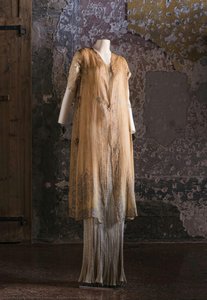
In the realm of textile art, few pieces command the same reverence as Mariano Fortuny’s 1930 masterpiece, ‘Cape.’ This is not merely a garment; it is a profound reimagining of theatrical presentation and a masterful fusion of historical inspiration with avant-garde technique. To behold this work is to witness a moment where fashion transcends utility to become pure sculpture. The piece embodies a sophisticated dialogue between the weight of history and the lightness of innovation, making it an essential inspiration for collectors and designers who seek to infuse their spaces with a sense of storied grandeur.
The soul of the ‘Cape’ lies in its ability to reinterpret antiquity through a modern lens. Fortuny, a true polymath, drew deep inspiration from Greco-Roman mythology, specifically evoking the dramatic drapery associated with Zeus during the siege of Mount Olympus. By translating these epic narratives into fabric, he transformed a mannequin into a conduit for mythological grandeur. The garment serves as a visual spectacle where the heavy, luxurious velvet of the collar and hood meets the ethereal, delicate patterns of a lace-like overlay. This deliberate juxtaposition creates a captivating interplay of surfaces, inviting the eye to wander through layers of texture and light.
Mastery of Texture and the Art of Light
Technique is the heartbeat of this work. Fortuny was as much an inventor as he was a designer, and his mastery over material is evident in every fold of the ‘Cape.’ The way the dark, sumptuous velvet absorbs light stands in stark contrast to the translucent, patterned overlay that allows glimpses of the form beneath to emerge like a half-remembered dream. This interplay mirrors Fortuny’s revolutionary work with the cyclorama dome, where he used reflected light to create seamless, immersive environments in theater. In this piece, the fabric itself acts as a stage, performing a silent drama of shadow and brilliance.
For the interior designer or art enthusiast, the ‘Cape’ offers a rich palette of textures that can elevate any setting. The verticality of the pleated skirt provides a rhythmic stability, while the organic, flowing lines of the draped coat introduce a sense of movement. It is a study in balance—the heavy against the light, the structured against the fluid. This complexity makes a high-quality reproduction of such a work an extraordinary focal point, capable of anchoring a room with its profound sense of craftsmanship and historical weight.
An Emotional Legacy for the Modern Collector
Beyond its physical attributes, the ‘Cape’ carries an emotional resonance that speaks to the enduring human desire for beauty and transcendence. It evokes a sense of timelessness, bridging the gap between the ancient world and the modern era. There is a certain mystery held within its folds, a whisper of the aristocratic intrigue and theatrical magic that defined Fortuny’s life in Venice. To possess or display an homage to this work is to celebrate the spirit of the alchemist of aesthetics—an artist who refused to see boundaries between fashion, stagecraft, and fine art.
Whether integrated into a curated gallery collection or used as a sophisticated element in high-end decor, the ‘Cape’ remains a symbol of refined beauty. It invites viewers to contemplate the intersection of memory and innovation, making it a timeless investment for those who appreciate art that does not merely decorate a space, but breathes life and narrative into it.
Questions & Answers
Is "Cape" by Mariano Fortuny a bright or a dark artwork?
Overall, "Cape" is recorded as deep_shadow. Perceived brightness describes how light or dark the work appears.
How well known is "Cape" by Mariano Fortuny?
The popularity level recorded for "Cape" by Mariano Fortuny is iconic.
What was Mariano Fortuny's age when "Cape" was created?
When "Cape" was created in 1930, Mariano Fortuny - born in 1871 - was 59 years old.
Artist Biography
early life and inspiration
mariano fortuny, a spanish fashion designer, was born on may 11, 1871, in granada, spain. his father, mariano fortuny y marsal, was a genre painter who passed away when mariano was just three years old. this event led to the family's move to paris, france, where mariano's mother introduced him to various textiles and fabrics that would later influence his creativity.artistic talents and inventions
mariano fortuny showcased his artistic talents from a young age, demonstrating skills in painting, photography, sculpting, architecture, etching, and theatrical stage lighting. his inventions, including over twenty patented between 1901 and 1934, revolutionized the world of theater design.- he developed the fortuny cyclorama dome, a quarter dome-shaped structure of plaster or cloth, which used indirect lighting to create a seamless transition between scenes.
- his treatise "eclairage scenique" (1904) described his discovery of reflecting light off different surfaces, changing its color, intensity, and properties.
notable contributions and collaborations
mariano fortuny's work gained widespread recognition in the 1920s. he collaborated with notable figures, including:- richard wagner, a german composer, whose operas inspired mariano to paint scenes.
- the famous opera house, la scala of milan, where he installed his dome, adapting it for the larger theater and inventing a suction fan to maintain its taut structure.
legacy and later life
mariano fortuny passed away on may 3, 1949, in venice, italy. his work inspired french novelist marcel proust, and his life was depicted in pere gimferrer's novel "fortuny." mariano's legacy continues to influence the world of theatrical design.- explore more about mariano fortuny's inventions and designs at OriginalUniqueArt's collection.
- discover the impact of his work on theatrical lighting in the museum destroyed by fire (united states), a story of an unfortunate event that shaped american art history, available at OriginalUniqueArt's blog.
selected paintings by mariano fortuny and other artists
- mariano fortuny: teagown (museum of fine arts, boston, united states), available at OriginalUniqueArt's collection.
- marc chagall: study to 'song of songs iv' (naive art / primitivism), available at OriginalUniqueArt's collection.
- pablo picasso: clarinet (analytical cubism, oil on canvas), available at OriginalUniqueArt's collection.
- vincent van gogh: tree roots (50 x 100 cm, post-impressionism, oil on canvas), available at OriginalUniqueArt's collection.

Mariano Fortuny
1871 - 1949 , Spain
Quick Facts
- Full Name: Mariano Fortuny y Marsal
- Nationality: Spanish
- Date Of Birth: 1871
- Date Of Death: 1949
- Place Of Birth: Reus, Spain
- Notable Artworks:
- Teagown
- Portrait of Henriette Fortuny
- Artistic Movement Or Style: Orientalism art
- Artists Who Influenced This Artist: ['Richard Wagner']
- Artists Or Movements Influenced By This Artist: ['Marcel Proust']
Related Articles
Draped Narratives: Fashion as Symbol & Subject in Historical Art
Explore the fascinating history of fashion as a symbol of power & status in art! Discover masterpieces from Gainsborough to Tissot and learn how clothing shaped societal narratives. Find museum-quality reproductions at OriginalUniqueArt.
Woven Wonders: A Beginner's Guide to Elevating Your New Home with Timeless Textile Art
Discover how to transform your new home with the warmth of textile art. Our expert guide for newlyweds explores handwoven tapestries, tactile fibers, and timeless ways to curate a soulful, sophisticated interior through beautiful woven wonders.

Mariano Fortuny: A Fusion of Art, Fashion & Design – Exploring a Venetian Innovator's Legacy
Explore the captivating world of Mariano Fortuny – artist, designer & innovator. Discover his revolutionary textiles, iconic Delphos gown, and lasting influence on art, fashion & interiors. A collector's guide to a Venetian master.
Style Through the Ages: Iconic Artworks That Defined the Evolution of Fashion Design
Explore the breathtaking intersection of fine art and high fashion. Discover how iconic masterpieces from Art Deco to Impressionism have shaped the world of luxury couture and timeless design in this curated visual journey.
Gianfranco Ferré: Deconstructing Haute Couture – A Legacy of Architectural Form
Explore the revolutionary world of Gianfranco Ferré, 'the architect of fashion.' Discover his architectural approach to haute couture, iconic Dior designs, and lasting influence on luxury style. A deep dive for collectors & enthusiasts.