

 Send
Send Share
Share
 Details
 Guide
Guide

 Download
 Similars
 Diaporama
 Stats
StatsParis Air


 Read More
The artwork displayed on this page is protected by copyright law, which means we cannot legally create or sell an identical reproduction. This protection is enforced under international agreements such as the Berne Convention and by national laws, including those outlined by the U.S. Copyright Law - Title 17.
This method fully complies with copyright regulations because it does not involve copying or duplicating the protected artwork. Instead, it is a creative reinterpretation - a new painting that is influenced by the original but not identical to it.
Giclée / Art Print
Museum-quality giclée or canvas print with fast production and flexible finish options. ( Buy Hand Made Painting Switch to Digital Image)




































Pick from our preset sizes that match the artwork's original proportions.

Type the width and the height you need, to fit your frame or your wall. A print can only be cut, never made bigger than the picture, so a size with a different shape loses a part of the image. We send you a digital mockup to approve before we print anything. The picture shown on this page does not show the real cut — only the mockup does.
Worldwide Delivery () in 2 weeks instead of standard 4/5 weeks. (21 October)

Free Worldwide Express Shipping

High-Quality Linen Canvas

Full Shipping Insurance

Customs Tax Refund Guarantee

True Color Matching Guarantee

100-Day Return Policy (Defects Only)

100% Money-Back Guarantee

Bulk Discount Offer
 Glass option is only available in size under 110 CM

Paris Air
Giclée / Art Print
Reproduction Size
-


Total Price
$ 81
A Breath of Parisian Air: Duchamp’s Conceptual Sculpture
Marcel Duchamp's *Paris Air* (1919) isn’t merely a glass ampoule; it’s an audacious provocation, a distilled moment captured in fragile form. This readymade, born from a seemingly simple souvenir purchased by the artist during his time in Paris, embodies the core tenets of Dadaism and challenges our very understanding of art's definition. Duchamp, ever the iconoclast, took a commonplace object – an empty apothecary vial – and imbued it with profound philosophical weight. He emptied it of its original contents, a physiological serum, and then meticulously refilled it with air from Paris itself, sealing it within the glass as a tangible memory. The resulting sculpture isn’t about beauty or craftsmanship in the traditional sense; instead, it's an exploration of value, perception, and the ephemeral nature of experience. Duchamp deliberately stripped away any illusion of artistic skill, presenting us with an object that demands we question what constitutes “art” – is it the material itself, the process of creation, or the idea behind it? *Paris Air* forces a confrontation with these questions, inviting viewers to contemplate the inherent absurdity and intellectual rigor at the heart of Dada.The Readymade: A Revolutionary Act
Duchamp’s concept of the “readymade” – an object chosen from everyday life and elevated to the status of art simply by its selection and presentation – was revolutionary for its time. Prior to this, artistic value was inextricably linked to skill, labor, and the artist's hand. Duchamp deliberately circumvented these conventions, asserting that the artist’s role lay in the act of choosing and presenting, rather than in creating something entirely new. *Paris Air* exemplifies this perfectly; it requires no technical expertise to appreciate – its beauty lies not in its form but in its conceptual depth. The deliberate choice of an empty vial, a vessel devoid of inherent artistic merit, is precisely what makes the piece so compelling. It’s a statement about the arbitrary nature of value and a rejection of traditional notions of aesthetic judgment. Duchamp wasn't trying to create something visually stunning; he was creating a thought experiment, a challenge to our assumptions about art and its purpose.A Fragile Memory: Materiality and Symbolism
The physical qualities of *Paris Air* are crucial to understanding its impact. The delicate glass ampoule, now meticulously repaired after an accidental breakage in 1949, embodies the fragility of memory and experience. It’s a tangible reminder that even seemingly solid concepts – like the air itself – can be fleeting and easily disrupted. The inscription “Serum Physiologique” on the vial further complicates the work's meaning, blurring the line between reality and representation. Duchamp knowingly misrepresented the contents, creating an illusion of authenticity while simultaneously undermining it. This deliberate ambiguity is characteristic of Dadaism’s playful rejection of logic and reason. The act of sealing the air within a confined space also speaks to themes of containment, isolation, and the desire to preserve something ephemeral – perhaps even a moment in time or a feeling associated with Paris itself.A Legacy of Conceptual Art
*Paris Air* profoundly influenced the development of conceptual art, paving the way for artists who prioritized ideas over traditional artistic techniques. Its impact can be seen in the work of numerous subsequent generations of artists, including Yves Klein and Joseph Kosuth. Duchamp’s willingness to challenge established norms and embrace absurdity continues to resonate today, reminding us that art doesn't have to conform to conventional expectations. *Paris Air* remains a potent symbol of artistic innovation – a small, unassuming object that holds within it a vast and complex philosophical statement. It is a testament to the power of conceptual thinking and a reminder that sometimes, the most profound works of art are those that defy easy definition. Reproductions of this piece offer a unique opportunity to engage with Duchamp’s radical ideas and experience the intellectual thrill of his groundbreaking work.Questions & Answers
How popular is "Paris Air" within Dadaism?
"Paris Air" is recorded as iconic among the Dadaism works in the catalog.
Is a download available for "Paris Air"?
"Paris Air" by Marcel Duchamp can be downloaded from the artwork's Download page, as a high-resolution digital image download.
Are the colors of "Paris Air" by Marcel Duchamp vivid or muted?
"Paris Air" by Marcel Duchamp is recorded with a muted saturation and a monochromatic intensity.
Artist Biography
A Revolutionary Spirit: The Life and Art of Marcel Duchamp
Marcel Duchamp, born Henri-Robert-Marcel Duchamp in 1887 in Blainville-Crevon, Normandy, was more than an artist; he was a philosophical provocateur who fundamentally altered the course of modern art. His early life, though seemingly conventional – nurtured within a family that appreciated artistic expression with both brothers pursuing successful careers as artists – hinted at the iconoclasm to come. Duchamp initially pursued formal training, mastering traditional techniques and experimenting with post-impressionist styles. However, this academic foundation served not as an end in itself, but as a springboard for questioning the very nature of art, its purpose, and its definition. He wasn’t content merely to depict the world; he sought to challenge how we perceive it, and what constitutes artistic value. This restless intellectual curiosity would become the defining characteristic of his prolific career.From Cubism to Dada: A Rejection of Convention
Duchamp's artistic journey was marked by a constant evolution, a deliberate shedding of established norms. His initial engagement with Cubism, evident in works like *Portrait of Chess Players* (1911), demonstrated an interest in fragmented forms and multiple perspectives – a departure from traditional representation. Yet, he quickly moved beyond purely aesthetic concerns, recognizing that simply rearranging visual elements wasn’t enough to address the deeper questions swirling within him. The horrors of World War I fueled this discontent, leading Duchamp to embrace Dadaism, a movement born out of disillusionment and a rejection of logic, reason, and traditional artistic values. It was within the Dadaist framework that Duchamp truly began to dismantle conventional notions of art. He wasn’t interested in creating beautiful objects; he wanted to provoke thought, challenge assumptions, and expose the arbitrariness of aesthetic judgment. This period saw the birth of his most radical innovation: the ‘readymade’.The Readymades and the Subversion of Art
The introduction of readymades – ordinary manufactured objects selected and presented as art – was Duchamp’s most significant contribution to the 20th century. These weren't simply found objects; they were deliberate acts of artistic subversion. By taking an everyday item, like a urinal (*Fountain*, 1917), signing it “R. Mutt,” and submitting it to an art exhibition, Duchamp challenged the very definition of artistic skill and authorship. Was it the artist’s hand that created the work, or was it the artist's *idea*? This question became central to his practice and laid the groundwork for Conceptual Art. Other notable readymades like *L.H.O.O.Q.* (1919), a postcard reproduction of the Mona Lisa defaced with a mustache and goatee, were playful yet pointed critiques of art history and established cultural icons. These works weren’t meant to be admired for their aesthetic qualities; they were intended to provoke debate and force viewers to reconsider their preconceived notions about what constitutes art. Duchamp believed that art should reside in the mind, not merely in the eye.Legacy and Enduring Influence
Marcel Duchamp's impact on subsequent generations of artists is immeasurable. He fundamentally altered our understanding of art, paving the way for movements like Conceptual Art, Minimalism, Pop Art, and countless others. His emphasis on the artist’s idea – the concept behind the work – over its aesthetic qualities continues to inspire artists today.- Cubism: Early exploration of fractured forms and spatial representation.
- Dadaism: Rejection of logic, reason, and traditional artistic values in response to World War I.
- Conceptual Art: Emphasis on the idea behind the artwork rather than its aesthetic qualities.
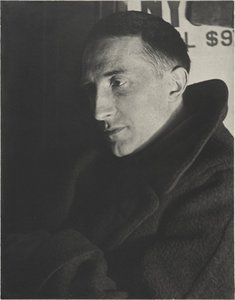
Marcel Duchamp
1887 - 1968 , France
Quick Facts
- Artistic Movement Or Style:
- Cubism
- Dadaism
- Conceptual Art
- Artists Or Movements Influenced By This Artist:
- Conceptual Art
- Minimalism
- Pop Art
- Artists Who Influenced This Artist:
- Cézanne
- Picasso
- Braque
- Full Name: Henri-Robert-Marcel Duchamp
- Nationality: French American
- Notable Artworks:
- Fountain
- Bicycle Wheel
- The Large Glass
- Place Of Birth: Blainville-sur-Mer, France
- Date Of Birth: 1887
- Date Of Death: 1968
Related Articles
Luminous Masterpieces: The Captivating Beauty and Timeless Elegance of Stained Glass Artworks
Embark on a visual journey through the luminous world of stained glass art. Discover the exquisite craftsmanship, historical significance, and captivating beauty of masterworks from Art Nouveau to the Gothic era, curated for the discerning fine art enthusiast.

Bronze Age to Modern Masters: 10 Sculptures That Redefined Art | OriginalUniqueArt
Journey through art history with 10 legendary bronze sculptures – from Michelangelo's David to Rodin’s Thinker. Explore the stories, techniques & timeless beauty of these masterpieces. Find museum-quality reproductions & elevate your home decor on OriginalUniqueArt.com.

The Enduring Form: Exploring Themes & Techniques in Sculpture Across Historical Periods
Explore the rich history of sculpture from ancient masterpieces to contemporary innovations. Discover key techniques, influential artists & investment potential for discerning art collectors.

The Enduring Form: Sculpture Across History, Technique & Emotional Resonance
Explore the rich history of sculpture with OriginalUniqueArt. Discover key techniques, influential artists & investment potential for discerning collectors. Expert insights into valuing and collecting timeless masterpieces.

Bronze Sculptures That Defined Art History | OriginalUniqueArt
Journey through art history with our Top 10 bronze sculptures! Explore masterpieces by Rodin, Michelangelo & more. Discover stories behind iconic statues and find museum-quality reproductions for your home decor at OriginalUniqueArt.com.


