Dadaism
Cigarette (Marcel Duchamp)
Marcel Duchamp (1887–1968) made Cigarette. It belongs to the Dadaism movement. It is made in gelatin silver print.
- Gelatin Silver Print

 Hand Made Oil Painting
 Send
 Share
 Guide


 Download
 Similars
 Diaporama
 Q&A

 Stats
Cigarette: the essentials
- Title
- Cigarette
- Artist
- Marcel Duchamp (1887–1968)
- Artist born in
- Blainville-Crevon, France
- Medium
- Gelatin Silver Print
- Movement
- Dadaism
- Period
- Modern
- Subject
- cigarette, minimalism, duchamp, consumerism, transience, shadow
What does Cigarette depict?
The Poetics of the Mundane: A Study in Stillness
In the quiet, starkly minimalist realm of Marcel Duchamp’s Cigarette, the viewer is invited into an intimate encounter with the overlooked. This photographic study does not seek to dazzle with vibrant color or complex scenery; instead, it finds its power in a profound, almost meditative focus on a single, partially smoked object. Positioned vertically within the frame, the cigarette acts as a singular axis around which the entire composition revolves. The starkness of the presentation strips away the distractions of the outside world, forcing an intense confrontation with the textures of tobacco and paper. A soft, directional light casts a gentle shadow to the right, grounding the subject in a tangible space and providing just enough depth to transform a flat image into a sculptural presence.
The aesthetic experience of this piece is defined by its muted, monochromatic elegance. Shades of beige, grey, and earthy brown dominate the palette, reflecting the natural, organic decay of the object itself. There is a tactile richness found in the granular surface of the cigarette, where the rough, fibrous nature of the tobacco meets the smooth, worn edges of the paper. This interplay of textures—the sharp, irregular lines of the subject contrasted against the soft, diffused blur of its shadow—creates a visual rhythm that is both soothing and intellectually stimulating. For the collector or interior designer, this work offers a sophisticated neutral element that brings a sense of calm, intellectual depth, and understated luxury to any modern space.
Dadaist Echoes and the Art of Choice
To understand Cigarette, one must look toward the revolutionary spirit of its creator. Marcel Duchamp was a primary architect of the Dada movement, a period characterized by a radical rejection of traditional aesthetic values. Through his concept of the "readymade," Duchamp challenged the very definition of art, suggesting that an artist's most potent tool is not their brushstroke, but their choice. By isolating this everyday object and presenting it through the lens of fine art photography, he elevates a transient, disposable item to a position of permanent contemplation. The work serves as a bridge between the mundane reality of daily habit and the elevated realm of artistic significance.
Beyond its historical importance, the piece carries a heavy symbolic weight that resonates with the human condition. The partially smoked cigarette, caught in a moment of mid-consumption, evokes themes of transience, the passage of time, and the ephemeral nature of life's small pleasures. It is a quiet commentary on consumerism and the beauty found within the discarded. For those seeking to decorate a space with art that provokes thought, this reproduction offers more than mere decoration; it provides a window into the twentieth century’s most profound philosophical shifts, making it an essential acquisition for any serious enthusiast of modern art history.
Cigarette in high resolution
Marcel Duchamp, Cigarette.
Questions about Cigarette
In which movement and which era is "Cigarette" by Marcel Duchamp placed?
In "Cigarette" by Marcel Duchamp, the Dadaism movement meets the Modern era.
How is the color composition of "Cigarette" by Marcel Duchamp built?
The color analysis of "Cigarette" by Marcel Duchamp records a balanced contrast and a unified palette harmony.
Does "Cigarette" show strong light-dark contrasts?
The light-dark contrast of "Cigarette" is recorded as balanced. Contrast describes how strongly light and dark areas differ.
Is "Cigarette" by Marcel Duchamp a light or a dark artwork?
"Cigarette" by Marcel Duchamp is recorded as brilliant, with a bright balance luminance.
What mood and emotion does "Cigarette" by Marcel Duchamp express?
In "Cigarette", a minimalist mood accompanies a reflective emotion.
What technique was used for "Cigarette" by Marcel Duchamp?
"Cigarette" is executed in gelatin silver print.
How do the colors of "Cigarette" by Marcel Duchamp relate to its emotion?
"Cigarette" by Marcel Duchamp combines a neutrals palette with a reflective tone.
What technique and style characterize "Cigarette" by Marcel Duchamp?
In "Cigarette", the gelatin silver print technique meets the Dadaism movement.
About the artist, Marcel Duchamp
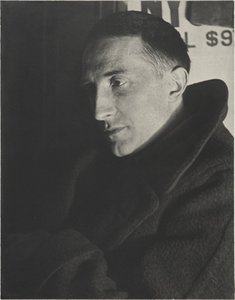
1887–1968, France
Marcel Duchamp
The Life and Art of Marcel Duchamp Born on July 28, 1887, in Blainville, Normandy, France, Marcel Duchamp entered a world where the impulse to create was deeply embedded in his very blood. He was the fourth of seven children born to Eugene and Lucie Duchamp. This was a household of makers and thinkers; his siblings shared this creative restlessness, as his brothers Jacques Villon and Raymond Duchamp-Villon, along with his sister Suzanne Duchamp-Crotti, all pursued lives as artists. While he would eventually become a French American figure of immense complexity, his origins remained rooted in the quietude of Normandy.
Also by Marcel Duchamp
 Nude Descending a Staircase, No.21912
 Sad young man in a train1911
 Given: 1. The Waterfall, 2. The Illuminating Gas1966
 Fountain1917
Essays around Cigarette
 Impressionism's Finest: 10 Masterpieces That Revolutionized Art | OriginalUniqueArtJourney through Impressionism's golden age! Explore 10 masterpieces by Monet, Renoir & Degas that redefined art. Discover the stories behin…
Smoke & Soul: How Tobacco Imagery Shapes Cinematic Drama and Fine ArtExplore how smoke and lighting drive cinematic drama and Baroque mastery. Discover the visual power of atmosphere now.
 Dadaism Explained: The Anti-Art Movement That Redefined ModernityExplore the radical origins of Dadaism. From the chaos of WWI to Marcel Duchamp's revolutionary readymades, discover how this anti-art move…