

 Preview
 Send
Send Share
Share
 Details
 Guide
Guide

 Download
 Similars
 X-Ray
X-Ray Diaporama
 Stats
StatsChocolate Grinder


 Read More
The artwork displayed on this page is protected by copyright law, which means we cannot legally create or sell an identical reproduction. This protection is enforced under international agreements such as the Berne Convention and by national laws, including those outlined by the U.S. Copyright Law - Title 17.
This method fully complies with copyright regulations because it does not involve copying or duplicating the protected artwork. Instead, it is a creative reinterpretation - a new painting that is influenced by the original but not identical to it.
Giclée / Art Print
Museum-quality giclée or canvas print with fast production and flexible finish options. ( Buy Hand Made Painting Switch to Digital Image)




P118B $10

P118H $10

P118W $10

P438Z $10

P508JH $12

P508YH $12

P805H $10

P805Z $10

P919BZ $10

P919G $10

P919XJ $10

P959ZH $10

P968JZ $12

W106C $8

W218G $10

W218JH $8

W218Y $10

W307PJ $10

W316G $10

W316PJ $8

W316Y $10

W398PJ $8

W4111J $10

W500HY $15

W500JH $15

W692G $12

W849H $8

W940BG $15

W953PJ $8




Pick from our preset sizes that match the artwork's original proportions.

Type the width and the height you need, to fit your frame or your wall. A print can only be cut, never made bigger than the picture, so a size with a different shape loses a part of the image. We send you a digital mockup to approve before we print anything. The picture shown on this page does not show the real cut — only the mockup does.
Worldwide Delivery () in 2 weeks instead of standard 4/5 weeks. (23 October)

Free Worldwide Express Shipping

High-Quality Linen Canvas

Full Shipping Insurance

Customs Tax Refund Guarantee

True Color Matching Guarantee

100-Day Return Policy (Defects Only)

100% Money-Back Guarantee

Bulk Discount Offer
 Glass option is only available in size under 110 CM

Chocolate Grinder
Giclée / Art Print
Reproduction Size
-


Total Price
$ 81
A Mechanical Dream: Marcel Duchamp’s *Chocolate Grinder* (1914)
Marcel Duchamp's *Chocolate Grinder*, created in 1914, is a fascinating and enigmatic work that exemplifies the artist’s burgeoning departure from traditional painting towards conceptual art. This isn’t a realistic depiction of an industrial machine; it’s a stylized, almost abstracted vision – a premonition of the mechanical age filtered through a surreal lens.Deconstructing the Industrial Form
The artwork presents a flattened perspective of a chocolate mill, reduced to its essential geometric components: cylinders and basket-like structures. Duchamp deliberately avoids realistic representation, instead opting for simplified forms and angular lines. The composition feels rigidly structured, emphasizing the mechanical nature of the subject matter. While seemingly depicting an object of production, it’s presented with a deliberate lack of detail – we aren't seeing *how* chocolate is made, but rather an *idea* of the process.Style and Technique: A Bridge Between Worlds
The style leans heavily towards both Surrealism and Constructivism. The geometric abstraction echoes the principles of Constructivism, with its emphasis on industrial forms and simplified shapes. However, the dreamlike quality and distortion of reality firmly place it within the emerging Surrealist movement. Duchamp employs a primarily linear technique, using straight lines to define the machine’s components, complemented by subtle shading to suggest volume without fully realizing it. The likely medium – oil or acrylic on canvas – contributes to the work's smooth, almost clinical surface.Historical Context: On the Cusp of Change
Created on the eve of World War I, *Chocolate Grinder* reflects a period of rapid industrialization and societal upheaval. Duchamp, along with other avant-garde artists, was questioning traditional artistic values and exploring new ways to represent the modern world. This work foreshadows his later rejection of “retinal art” – art meant solely for aesthetic pleasure – in favor of works that engaged the intellect. It’s a pivotal piece marking his transition away from purely visual concerns towards conceptual exploration.Symbolism and Interpretation
The chocolate grinder itself is symbolic, representing industrial production and the mechanization of everyday life. However, Duchamp doesn't present it as a celebration of progress. Instead, its abstracted form and dreamlike quality suggest a sense of alienation or detachment from the manufacturing process. The work invites contemplation on the relationship between humans and machines, and the impact of technology on society. It’s not simply *about* a chocolate grinder; it’s about what that machine represents in the modern world.Emotional Impact & Aesthetic Appeal
Despite its mechanical subject matter, *Chocolate Grinder* evokes a surprisingly whimsical feeling. The simplified forms and muted color palette create a sense of calm contemplation. It's an artwork that rewards close viewing, inviting viewers to decipher its hidden meanings and appreciate Duchamp’s innovative approach to representation. Its unique aesthetic – a blend of precision and abstraction – makes it a compelling addition to any collection or interior space.- For Art Lovers: A key example of Duchamp's early experimentation, showcasing his move towards conceptual art.
- For Collectors: A rare opportunity to own a piece that represents a turning point in 20th-century art history.
- For Interior Designers: Its geometric forms and muted palette make it versatile, complementing modern or minimalist interiors. The artwork’s intellectual depth adds a layer of sophistication to any space.
Questions & Answers
What is "Chocolate Grinder" made with, and in which style?
"Chocolate Grinder" by Marcel Duchamp combines the oil on canvas technique with the Surrealism style. Technique and movement describe the making and the style of the work.
How saturated is the palette of "Chocolate Grinder"?
"Chocolate Grinder" by Marcel Duchamp is recorded with a clear color presence saturation.
What placement suits the format of "Chocolate Grinder" by Marcel Duchamp?
Format (portrait) and recommended space (living room) are the two placement facts recorded for "Chocolate Grinder" by Marcel Duchamp.
Artist Biography
A Revolutionary Spirit: The Life and Art of Marcel Duchamp
Marcel Duchamp, born Henri-Robert-Marcel Duchamp in 1887 in Blainville-Crevon, Normandy, was more than an artist; he was a philosophical provocateur who fundamentally altered the course of modern art. His early life, though seemingly conventional – nurtured within a family that appreciated artistic expression with both brothers pursuing successful careers as artists – hinted at the iconoclasm to come. Duchamp initially pursued formal training, mastering traditional techniques and experimenting with post-impressionist styles. However, this academic foundation served not as an end in itself, but as a springboard for questioning the very nature of art, its purpose, and its definition. He wasn’t content merely to depict the world; he sought to challenge how we perceive it, and what constitutes artistic value. This restless intellectual curiosity would become the defining characteristic of his prolific career.From Cubism to Dada: A Rejection of Convention
Duchamp's artistic journey was marked by a constant evolution, a deliberate shedding of established norms. His initial engagement with Cubism, evident in works like *Portrait of Chess Players* (1911), demonstrated an interest in fragmented forms and multiple perspectives – a departure from traditional representation. Yet, he quickly moved beyond purely aesthetic concerns, recognizing that simply rearranging visual elements wasn’t enough to address the deeper questions swirling within him. The horrors of World War I fueled this discontent, leading Duchamp to embrace Dadaism, a movement born out of disillusionment and a rejection of logic, reason, and traditional artistic values. It was within the Dadaist framework that Duchamp truly began to dismantle conventional notions of art. He wasn’t interested in creating beautiful objects; he wanted to provoke thought, challenge assumptions, and expose the arbitrariness of aesthetic judgment. This period saw the birth of his most radical innovation: the ‘readymade’.The Readymades and the Subversion of Art
The introduction of readymades – ordinary manufactured objects selected and presented as art – was Duchamp’s most significant contribution to the 20th century. These weren't simply found objects; they were deliberate acts of artistic subversion. By taking an everyday item, like a urinal (*Fountain*, 1917), signing it “R. Mutt,” and submitting it to an art exhibition, Duchamp challenged the very definition of artistic skill and authorship. Was it the artist’s hand that created the work, or was it the artist's *idea*? This question became central to his practice and laid the groundwork for Conceptual Art. Other notable readymades like *L.H.O.O.Q.* (1919), a postcard reproduction of the Mona Lisa defaced with a mustache and goatee, were playful yet pointed critiques of art history and established cultural icons. These works weren’t meant to be admired for their aesthetic qualities; they were intended to provoke debate and force viewers to reconsider their preconceived notions about what constitutes art. Duchamp believed that art should reside in the mind, not merely in the eye.Legacy and Enduring Influence
Marcel Duchamp's impact on subsequent generations of artists is immeasurable. He fundamentally altered our understanding of art, paving the way for movements like Conceptual Art, Minimalism, Pop Art, and countless others. His emphasis on the artist’s idea – the concept behind the work – over its aesthetic qualities continues to inspire artists today.- Cubism: Early exploration of fractured forms and spatial representation.
- Dadaism: Rejection of logic, reason, and traditional artistic values in response to World War I.
- Conceptual Art: Emphasis on the idea behind the artwork rather than its aesthetic qualities.

Marcel Duchamp
1887 - 1968 , France
Quick Facts
- Artistic Movement Or Style:
- Cubism
- Dadaism
- Conceptual Art
- Artists Or Movements Influenced By This Artist:
- Conceptual Art
- Minimalism
- Pop Art
- Artists Who Influenced This Artist:
- Cézanne
- Picasso
- Braque
- Full Name: Henri-Robert-Marcel Duchamp
- Nationality: French American
- Notable Artworks:
- Fountain
- Bicycle Wheel
- The Large Glass
- Place Of Birth: Blainville-sur-Mer, France
- Date Of Birth: 1887
- Date Of Death: 1968
Related Articles

The Soul of Color: A Journey into the Emotional Resonance of Lyrical Abstraction
Embark on a cultural journey through Lyrical Abstraction. Explore how masters like Kandinsky used color and motion to translate emotion into visual poetry. Discover the profound beauty of abstract expressionism and learn to curate emotional resonance in your own art collection.

Kandinsky's Masterpieces: 25 Paintings That Define Abstract Art | OriginalUniqueArt
Journey through Wassily Kandinsky's 25 most iconic abstract paintings. Explore his revolutionary use of color, form & spiritual expressionism. Find museum-quality Kandinsky reproductions and elevate your home decor with OriginalUniqueArt.com. Discover all masterpieces on OriginalUniqueArt.com!
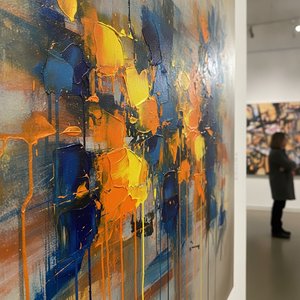
Beyond the Lines: Mastering the High-Impact World of Contemporary Abstraction
Master the high-impact world of contemporary abstraction. Discover how bold colors, textures, and modern movements like Abstract Expressionism can transform your space with premium, high-energy art curated for the design-conscious professional.

Abstract Expressionism's 10 Defining Masterpieces |
Explore 10 defining Abstract Expressionism masterpieces by Pollock, Rothko & de Kooning. Discover the stories behind these iconic paintings and find museum-quality art reproductions to elevate your home decor on .

Geometric Abstraction's 10 Defining Masterpieces | Art for Your Home - OriginalUniqueArt
Explore 10 defining masterpieces of Geometric Abstraction! Discover Kandinsky, Mondrian & Malevich’s iconic works. Find museum-quality art reproductions and curated decor ideas to elevate your home at OriginalUniqueArt.com.


