Expressionism · 1914
Nude Lying Down (Marc Chagall, 1914)
Marc Chagall (1887–1985) made Nude Lying Down. It dates from 1914. It belongs to the Expressionism movement. It is made in oil. It measures 37 × 50 cm.
- 1914
- Oil
- 37 × 50 cm

 Preview

 Hand Made Oil Painting
 Send
 Share
 Guide


 Download
 Similars
 X-Ray
 Diaporama
 Q&A

 Stats
Nude Lying Down: the essentials
- Title
- Nude Lying Down
- Artist
- Marc Chagall (1887–1985)
- Artist born in
- Liozna, Belarus
- Date
- 1914
- Medium
- Oil
- Dimensions
- 37 × 50 cm
- Movement
- Expressionism
- Period
- Modern
- Subject
- nude figure, dreamlike, floral patterns, dark background, fluid lines, symbolism
What does Nude Lying Down depict?
A Dreamscape of Expressionism
In his 1914 masterpiece, Nude Lying Down, Marc Chagall invites the viewer into a realm where the boundaries between reality and the subconscious dissolve. This striking black and white canvas transcends mere representation, embodying the very essence of Expressionist art through a courageous leap into subjective emotion and psychological exploration. The artwork captures a moment of profound stillness amidst an agitated artistic landscape, reflecting the artist's formative years as he grappled with the vibrant cultural tapestry of Vitebsk and his own deeply rooted Jewish heritage. The composition is defined by a dynamic diagonal placement of the nude figure, which deliberately disrupts traditional perspective to prioritize movement and convey an atmosphere of dreamlike disorientation.
The subject, a female figure reclining on her stomach, serves as the emotional anchor of the piece. Her pose suggests a surrender to stillness, inviting viewers to contemplate themes of solitude, vulnerability, and introspection. As she rests against a dark background, she becomes a vessel for the artist's quest for inner peace. The surrounding space is not empty but filled with swirling, amorphous patterns reminiscent of foliage or stylized ornamentation. These elements are more than mere decoration; they symbolize a profound connection to nature and perhaps represent the fluid, often turbulent, movements of the human mind.
Technique and Tactile Resonance
Chagall’s technical execution in Nude Lying Down is a testament to his mastery of the Expressionist style. The painting utilizes a monochromatic palette consisting of shades of black, white, and grey, where subtle tonal variations create depth without relying on conventional spatial techniques. The artist employs visible brushstrokes that create a textured surface, inviting a tactile contemplation of the work. Particularly around the torso of the woman, the application of paint demonstrates impasto—the building up of thick layers of pigment to achieve a palpable physicality that engages the viewer's senses.
The lines within the piece are fluid and expressive rather than precise or realistic. They do not merely delineate forms but actively shape the visual experience, mirroring the fluidity of thought and emotion. While the lines defining the curves of the woman's body provide an anatomical rendering, the background patterns are more decorative and flowing, creating a captivating contrast. This interplay of light and shadow, with soft and diffused lighting emphasizing the contours of the figure against the darkness, creates a dramatic tension that is both haunting and beautiful. For collectors and interior designers, this piece offers a sophisticated presence, bringing a sense of historical depth and an evocative, ethereal atmosphere to any curated space.
Nude Lying Down in high resolution

Marc Chagall, Nude Lying Down (1914).
Questions about Nude Lying Down
At what size is "Nude Lying Down" suggested for a bedroom?
In a bedroom, "Nude Lying Down" is suggested at a small print size.
Is "Nude Lying Down" by Marc Chagall a light or a dark artwork?
"Nude Lying Down" is deep_shadow overall, and its luminance is dark.
Is "Nude Lying Down" by Marc Chagall a bright or a dark artwork?
In terms of perceived brightness, "Nude Lying Down" by Marc Chagall is deep_shadow.
Is "Nude Lying Down" free of copyright?
"Nude Lying Down" by Marc Chagall is still protected by copyright. This status governs how the image of the work may be reproduced.
How popular is "Nude Lying Down" within Expressionism?
"Nude Lying Down" by Marc Chagall is classified as iconic and belongs to the Expressionism movement.
Is there a factsheet about "Nude Lying Down" by Marc Chagall for students?
The Guide page of "Nude Lying Down" by Marc Chagall offers a printable two-sheet factsheet: the artwork with its identity table, a decade band placing it in the artist's lifetime, other works by the artist, the measured color palette, and ready-to-copy citations in four styles.
What technique was used for "Nude Lying Down", and when was it created?
The medium of "Nude Lying Down" by Marc Chagall is oil, and the work is dated 1914.
How do I preview a reproduction of "Nude Lying Down" by Marc Chagall?
A preview of "Nude Lying Down" by Marc Chagall is available on the artwork's Preview page.
Which period of Marc Chagall's career does "Nude Lying Down" belong to?
Within Marc Chagall's career, "Nude Lying Down" falls in the Mature Period. The phase helps compare it with the artist's other works.
About the artist, Marc Chagall
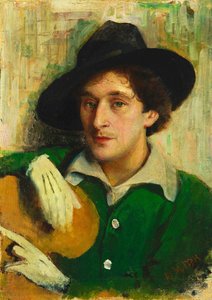
1887–1985, Belarus
Marc Chagall
Early Life, Family and Training Marc Chagall enters the world on July 7, 1887, in Vitebsk, Russian Empire, born Moishe Segal. He is the first of nine children in a modest Jewish family. Life is defined by the rhythms of labor and small-scale commerce. His father, Khatskel Segal, works as a herring pickler at a warehouse, while his mother, Feïga-Ita Tchernina, manages a small grocery store.
Also by Marc Chagall
 I and the Village1911
 White Crucifixion1938
 The Birthday1915
 Over the town1918
Essays around Nude Lying Down
 Belarusian artworks of the 1960sIconic Belarusian artworks of the 1960s, including masterpieces by Marc Chagall. Explore the full collection online at OriginalUniqueArt.co…
 Dreaming in Color: The 25 Most Iconic Masterpieces by Marc ChagallExplore 25 iconic Marc Chagall masterpieces. Discover the dreamlike stories behind his colors on OriginalUniqueArt.com.
 Abstract Harmony: A Professional Guide to Integrating Art Textures with Luxury Furniture and FinishesMaster the integration of abstract textures with luxury finishes. Our expert guide for hotel designers explores matching impasto art with p…