Preview
 Send
Send Share
Share
 Details
 Guide
Guide

 Download
 Similars
 X-Ray
X-Ray Diaporama
 Q&A
Q&A Stats
StatsFigure

- 60.0 x 73.0 cm


 Read More
Giclée / Art Print
Museum-quality giclée or canvas print with fast production and flexible finish options. ( Buy Hand Made Painting Switch to Digital Image)




P118B $10

P118H $10

P118W $10

P438Z $10

P508JH $12

P508YH $12

P805H $10

P805Z $10

P919BZ $10

P919G $10

P919XJ $10

P959ZH $10

P968JZ $12

W106C $8

W218G $10

W218JH $8

W218Y $10

W307PJ $10

W316G $10

W316PJ $8

W316Y $10

W398PJ $8

W4111J $10

W500HY $15

W500JH $15

W692G $12

W849H $8

W940BG $15

W953PJ $8




Pick from our preset sizes that match the artwork's original proportions.

Type the width and the height you need, to fit your frame or your wall. A print can only be cut, never made bigger than the picture, so a size with a different shape loses a part of the image. We send you a digital mockup to approve before we print anything. The picture shown on this page does not show the real cut — only the mockup does.
Worldwide Delivery () in 2 weeks instead of standard 4/5 weeks. (1 November)

Free Worldwide Express Shipping

High-Quality Linen Canvas

Full Shipping Insurance

Customs Tax Refund Guarantee

True Color Matching Guarantee

100-Day Return Policy (Defects Only)

100% Money-Back Guarantee

Bulk Discount Offer
 Glass option is only available in size under 110 CM

Figure
Giclée / Art Print
Reproduction Size
-


Total Price
$ 81
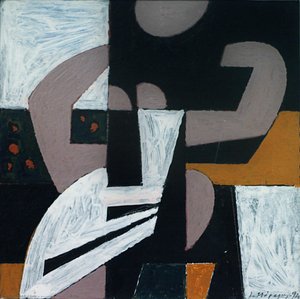
A Glimpse into Intimate Self-Reflection
This captivating portrait, executed in 1927 during the artist's sojourn in France, draws the viewer into a deeply personal and complex psychological space. The subject matter centers on the artist’s wife, Olga Dobrović, whom he regarded as his singular artistic achievement—his "own masterpiece." Yet, to view this work is to look beyond a mere likeness; it becomes an intricate study of self-perception refracted through another's gaze. The very act of painting her transforms the portrait into something akin to an indirect self-portrait, a double reflection where the boundaries between observer and observed blur with exquisite intimacy.
Symbolism and the Artist’s Persona
The relationship documented here is richly layered, suggesting that Olga Dobrović served as a multifaceted symbol for the artist himself. She is simultaneously presented as his wife, his lover, and the mother of his child. This confluence of roles suggests an identity inextricably linked to Vorobyov's own artistic standing and social aspirations. The painting thus participates in a long-standing tradition within art history: the veneration of the artist’s muse. Through this celebrated motif, the artist not only immortalizes his companion but also solidifies his own place within the grand narrative of artistic legitimacy, echoing the echoes of past masters.
Compositional Elements and Atmosphere
The visual evidence presented in the photograph—the woman standing elegantly clad in white, holding an open umbrella while gazing directly out—grounds this psychological depth in a tangible moment. The inclusion of two delicate birds fluttering in the background adds a subtle layer of natural symbolism, perhaps suggesting freedom or fleeting moments of grace against the stillness of the central figure. The open umbrella itself contributes to a sense of dimension and narrative pause. It is a composition that arrests time, capturing a breath held between contemplation and direct address.
Technique and Emotional Resonance
While the artist’s biography speaks of his 19th-century Russian roots, this piece from 1927 showcases an adaptation of technique to capture modern psychological nuance. The execution demands a delicate balance: the technical mastery required for rendering fine detail—the folds of white fabric, the sheen on the umbrella—must serve the emotional core. The overall effect is one of profound stillness, inviting the collector or admirer to pause before the canvas and contemplate the weight of admiration, possession, and self-definition that permeates every brushstroke.
Questions & Answers
What mood and emotion does "Figure" by Максим Никифорович Воробьёв express?
The recorded mood of "Figure" by Максим Никифорович Воробьёв is elegant, and its emotional tone is reflective.
What feeling is "Figure" associated with?
"Figure" is associated with a reflective feeling. The emotional tone describes the impression the work gives.
What size and orientation are recommended for a print of "Figure" by Максим Никифорович Воробьёв?
For "Figure", the recommended print setup is a medium size and a portrait orientation.
Artist Biography
Maxim Vorobyov: A Romantic Observer of Russia and the East
Born in Pskov in 1787, Maxim Nikiforovich Vorobyov’s life was a tapestry woven from military service, artistic apprenticeship, diplomatic missions, and profound personal loss. He wasn't merely a painter; he was an explorer of both landscapes and human experience, capturing the essence of his time with a keen eye for detail and a sensitivity that resonated deeply within his work. His journey, spanning from the historic heartland of Russia to the exotic shores of Palestine and Italy, shaped him into one of the most compelling figures in 19th-century Russian landscape painting.
Vorobyov’s early life was surprisingly humble. The son of a retired soldier who later served as a custodian at the Imperial Academy of Arts, he received his initial artistic training at the tender age of ten. This unconventional start—a young boy apprenticed to the rigorous world of art—laid the foundation for his meticulous approach and deep understanding of composition. He began his formal studies in landscape painting with Fyodor Alekseyev, a master of urban scenes, and further honed his skills under Jean-François Thomas de Thomon, an architect whose influence is evident in Vorobyov’s architectural renderings and his ability to integrate buildings seamlessly into the broader landscape.
His early career was marked by service to the Russian military. In 1809, he joined Alekseyev on an expedition to document the historic regions of Central Russia, a formative experience that instilled in him a deep appreciation for the country’s diverse geography and architectural heritage. This journey culminated in his participation in the campaigns of 1813-1814 alongside the Russian army in Germany and France – experiences that undoubtedly shaped his understanding of war and its impact on the land. These years weren't just about military observation; Vorobyov’s role as an assistant allowed him to develop his artistic skills, sketching battlefields and fortifications with a remarkable level of detail.
Palestine and the Diplomatic Mission
Perhaps the most significant chapter in Vorobyov’s career unfolded during his 1820 mission to Palestine on behalf of Grand Duke Nikolai Pavlovich. This wasn't a simple artistic excursion; it was a carefully orchestrated diplomatic undertaking designed to document the Christian sites of the region for potential reconstruction projects near Moscow. Operating under strict secrecy, often facing interference from Ottoman authorities wary of Russian influence, Vorobyov undertook a remarkable feat of observation and documentation. He meticulously sketched ancient ruins—the remnants of Jerusalem’s Second Temple, the Dead Sea—and contemporary scenes of bustling cities like Jaffa and Smyrna. His watercolors weren't merely representations; they were attempts to capture the spirit and atmosphere of these places, reflecting both their historical significance and their vibrant present.
The resulting collection of over ninety watercolor sheets became a valuable resource for architects and planners. The project demanded discretion, requiring Vorobyov to work in secret, navigating complex political landscapes and cultural sensitivities. This clandestine nature only adds to the intrigue surrounding his work, highlighting the importance he placed on preserving these historical sites.
A Painter of Loss and Reflection
The sudden death of his beloved wife, Cleo, in 1840 plunged Vorobyov into a period of profound grief and alcoholism. This personal tragedy dramatically impacted his artistic output, leading to a decline in the quality and quantity of his work. He retreated into himself, seeking solace through travel—specifically, a journey to Italy between 1844 and 1846. During this time, he produced a series of sketches, driven by an attempt to overcome his sorrow and rediscover inspiration. These later works, though often characterized by a melancholic mood, reveal a continued mastery of technique and a deep sensitivity to light and atmosphere.
Despite the diminished output, Vorobyov’s legacy endures through his evocative depictions of Russian landscapes, historical sites, and the exotic beauty of Palestine. His work stands as a testament to his artistic skill, his adventurous spirit, and his ability to capture the essence of a bygone era. His paintings offer a unique window into 19th-century Russia—a nation grappling with its identity, exploring its past, and venturing into the wider world.
Key Works and Artistic Style
Vorobyov’s artistic style is characterized by meticulous detail, a strong sense of perspective, and a Romantic sensibility. He was particularly adept at capturing the effects of light and shadow, creating atmospheric landscapes that evoke a profound emotional response. His paintings often feature grand vistas, meticulously rendered buildings, and figures engaged in everyday activities—all presented with a remarkable level of realism and sensitivity. Notable works include “View of the Kremlin,” a detailed cityscape showcasing the architectural grandeur of Moscow, and "Inner View Of The Temple In Jerusalem," a dramatic depiction of a religious interior that demonstrates his mastery of perspective and composition.
His dedication to accuracy is evident in his meticulous renderings of architecture, while his landscapes possess an undeniable emotional depth. Vorobyov’s work reflects the artistic trends of his time—a blend of classical realism and Romantic idealism—making him a significant figure in the development of Russian landscape painting.

Максим Никифорович Воробьёв
1787 - 1855 , Russia
Quick Facts
- Full Name: Maxim Nikiforovich Vorobyov
- Nationality: Russian
- Date Of Birth: 1787
- Date Of Death: 1855
- Place Of Birth: Pskov, Russia
- Notable Artworks:
- View of the Kremlin
- Inner View Of The Temple In Jerusalem
- Artistic Movement Or Style: Romantic Landscape
- Artists Who Influenced This Artist:
- Fedor Alexeyev
- Jean-François Thomas de Thomon
Related Articles

Victor Vasnetsov: Myth, Nationalism & the Revival of Russian Fairy Tale Painting
Explore the captivating world of Victor Vasnetsov, a co-founder of Russian folklorist painting. Discover his iconic works, influence on national identity, and lasting legacy in this expert guide.

Fyodor Rokotov: Intimacy & Enlightenment in Russian Portraiture
Explore the captivating portraits of Fyodor Rokotov, a master of 18th-century Russian art. Discover his unique psychological realism, Rococo elegance, and lasting influence on portrait painting. Learn about his iconic works & aristocratic patrons.
Elegant Art: 10 Masterpieces for a Refined Home |
Indulge in elegance with our Top 10 artworks! Explore masterpieces by Monet, Rembrandt & more. Discover timeless beauty, rich history & inspiring color palettes for your home decor. Find museum-quality art reproductions at .

Konstantin Somov: A Master of Russian Aestheticism & Symbolist Elegance
Explore the captivating world of Konstantin Somov, a leading figure of Russian Symbolism & Aestheticism. Discover his exquisite portraits, ballet scenes, and Rococo-inspired masterpieces. Learn about his life, influences, and enduring legacy.

Ivan Bilibin: A Synthesis of Folklore, Modernism & National Identity in Russian Illustration
Explore the enchanting world of Ivan Bilibin, a master Russian illustrator who synthesized folklore, Art Nouveau & national identity. Discover his iconic fairy tale illustrations and legacy with OriginalUniqueArt.