Preview
 Send
Send Share
Share
 Details

 Download
 Similars
 X-Ray
X-Ray Diaporama
Interior with vase


 Read More
Hand Made Oil Reproduction
Hand-painted oil on canvas in your size and frame, made to order by our artists. ( Buy Print Buy Image)




P118B $10

P118H $10

P118W $10

P438Z $10

P508JH $12

P508YH $12

P805H $10

P805Z $10

P919BZ $10

P919G $10

P919XJ $10

P959ZH $10

P968JZ $12

W106C $8

W218G $10

W218JH $8

W218Y $10

W307PJ $10

W316G $10

W316PJ $8

W316Y $10

W398PJ $8

W4111J $10

W500HY $15

W500JH $15

W692G $12

W849H $8

W940BG $15

W953PJ $8




Pick from our preset sizes that match the artwork's original proportions.

You may enter your own dimensions to fit a specific frame or space. If your selected size does not match the original image's proportions, we will either crop the artwork or extend the painting with additional hand-painted elements. A digital mockup will be sent for your approval before production begins.
Please note that the on-screen preview does not reflect the actual cropping or extension. Only the mockup will accurately show the final composition.
While custom sizes are available, we recommend selecting a dimension from the predefined list to preserve the original proportions.
After order, OriginalUniqueArt.com team will email client for instructions and provide a mockup preview
Worldwide Delivery () in 3/4 weeks instead of standard 5 weeks. (28 August). No compromise on quality.

Free Worldwide Express Shipping

High-Quality Linen Canvas

Full Shipping Insurance

Customs Tax Refund Guarantee

True Color Matching Guarantee

60-Day Return Policy (Defects Only)

100% Money-Back Guarantee

Bulk Discount Offer
 Glass option is only available in size under 110 CM

Interior with vase
Reproduction Medium
Reproduction Size
-


Total Price
$ 300
A Quiet Dialogue Between Interior and Nature
In the evocative painting Interior with vase, created in 1972 by the Polish master Maciej Antoni Babinski, we are invited into a sanctuary of profound stillness. The composition centers on a delicate arrangement: a vase resting upon the floor, cradling a singular tree branch that reaches upward toward an unseen light. This central motif serves as a bridge between the structured confines of a domestic space and the untamed vitality of the natural world. As the eye wanders through the scene, it encounters a chair positioned to the left and potted plants that suggest a seamless transition from the indoor sanctuary to an outdoor garden. The presence of a figure in the background, partially obscured and observing the stillness, adds a layer of contemplative depth, transforming the room from a mere physical space into a psychological landscape where memory and presence coexist.
Babinski, a visionary whose work is deeply rooted in the exploration of human consciousness, utilizes this scene to weave a tapestry of serene symbolism. The tree branch within the vase acts as an archetypal symbol of growth and resilience, even when isolated from its roots. Through his masterful command of light and shadow, Babinski captures the way natural elements interact with architectural boundaries, creating an atmosphere that feels both intimate and expansive. For the discerning collector or interior designer, this piece offers more than just visual beauty; it provides a focal point of emotional equilibrium. The painting’s ability to evoke a sense of calm makes it an ideal centerpiece for sophisticated living spaces, where it can serve as a window into a more reflective state of being.
Technically, the work reflects the artist's profound training within the Polish Art Movement, characterized by meticulous detail and a sophisticated understanding of texture. While Babinski is often celebrated for his intense, psychologically charged drawings, his paintings like Interior with vase demonstrate a remarkable ability to use soft transitions and organic forms to create harmony. The interplay between the solid presence of the furniture and the ethereal quality of the light filtering through the window creates a rhythmic balance that guides the viewer's gaze throughout the canvas. This high-quality reproduction preserves the subtle nuances of his brushwork, ensuring that the tension between the domestic interior and the natural world remains palpable, offering an enduring sense of peace to any curated collection.
Artist Biography
A Journey Through the Psyche: The Life and Art of Maciej Antoni Babinski
The life of Maciej Antoni Babinski is a profound testament to the transformative power of displacement and the enduring resilience of the human spirit. Born in 1931 in Poznań, Poland, his early years were shaped by the turbulent winds of mid-century Europe. The onset of World War II forced his family into migration toward England, an experience that would later serve as a foundational layer in his artistic consciousness. This period of wandering and resettlement—moving from the United Kingdom to Montreal, Canada, and eventually to Brazil—did more than just alter his geography; it expanded the very boundaries of his creative vocabulary. Each new landscape and culture acted as a catalyst, infusing his work with a unique blend of European tradition and New World experimentation.
As Babinski settled into his artistic practice, he emerged not merely as a painter or engraver, but as a visual philosopher. His early training in Poland provided him with a rigorous command of classical techniques, yet it was his encounter with the diverse artistic currents of the mid-20th century that truly defined his voice. In Canada, he engaged with the abstract movements surrounding Paul-Émile Borduas, while his long residency in Brazil allowed him to commune with the graphic intensity of masters like Augusto Rodrigues and Oswaldo Goeldi. These varied influences coalesced into a style that remains strikingly singular: a fusion of surrealism and expressionism that seeks to map the uncharted territories of the human subconscious.
The Architecture of Emotion and Symbolism
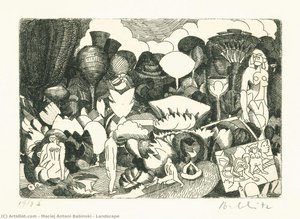
To encounter a work by Babinski is to enter a space where the boundaries between reality and dream dissolve. His oeuvre is characterized by an intense preoccupation with psychological depth, often utilizing the stark contrasts of black and white to evoke a sense of existential tension. He masterfully employs line and form not just to represent subjects, but to communicate internal states of being. Whether through his hauntingly detailed etchings or his vibrant, abstract watercolors, there is a palpable sense of movement and unrest. His use of distortion is never arbitrary; rather, it serves as a deliberate tool to amplify the emotional weight of his compositions, inviting the viewer to confront the complexities of fear, longing, and identity.
The symbolism within his work often draws from archetypal imagery, creating a bridge between personal experience and universal truth. His pieces frequently feature:
- Psychological Tension: The use of crowded or claustrophobic spaces to mirror the internal struggles of the human mind.
- Natural Metaphors: Landscapes and botanical elements that serve as vessels for deeper, often unsettling, symbolic meanings.
- The Human Figure: Portraits and figures that are often "ruffled" or distorted, capturing the raw, unvarnished essence of emotion.
Legacy and Historical Significance
Babinski’s career is marked by both immense creative achievement and the profound impact of political upheaval. His time teaching at the Central Institute of Arts in Brasília was tragically interrupted by political persecution, forcing him to relocate once again within Brazil. Despite these disruptions, his commitment to the pedagogical and artistic community remained steadfast, as seen in his influential tenure at the Federal University of Uberlândia. This period of academic service ensured that his mastery of engraving, illustration, and painting would be passed down to subsequent generations of artists.
Today, the historical significance of Maciej Antoni Babinski lies in his ability to synthesize a globalized perspective into a deeply personal artistic language. His works are not merely artifacts of Polish or Brazilian art history; they are universal explorations of the psyche. From the prestigious collections of the Musée des Valeurs du Banque Central du Brésil to the halls of the Blanton Museum of Art, his legacy continues to resonate. He remains a vital figure for anyone seeking to understand how the movement of a life across continents can result in an art that speaks to the permanent, unmoving truths of the human condition.

maciej antoni babinski
1931 - , Poland
Quick Facts
- Artistic Movement Or Style: Psychological Drawings
- Date Of Birth: 1931
- Full Name: Maciej Antoni Babinski
- Nationality: Polish
- Notable Artworks:
- Eden
- Figures and Animals
- No Title
- Place Of Birth: Poznań, Poland
Related Articles

Arboreal Echoes: A Historical & Artistic Exploration of Trees in Painting
Explore the rich history of trees in painting! Discover symbolism, Romantic masterpieces by Caspar David Friedrich & beyond. A curated journey for art enthusiasts.
Arboreal Echoes: A Historical & Artistic Exploration of Trees in Painting
Explore the rich history of trees in painting! Discover symbolism, Romantic masterpieces by Caspar David Friedrich & beyond. A curated journey for art enthusiasts.

John Constable's Masterpieces: Explore 25 Iconic Landscapes for Your Home
Journey through John Constable's 25 most celebrated landscapes. Explore Romanticism, Dedham Vale & his masterful use of light in iconic paintings like 'Hay Wain'. Find museum-quality art reproductions and elevate your home decor on OriginalUniqueArt.com.

Cézanne's Masterpieces: 25 Iconic Artworks to Transform Your Space
Journey through 25 iconic artworks by Paul Cézanne – a master of Impressionism and Post-Impressionism. Explore his landscapes, still lifes, and the stories behind these timeless masterpieces. Discover museum-quality reproductions & curated decor at OriginalUniqueArt.com.
Monet's Masterpieces: 25 Iconic Artworks to Transform Your Home
Journey through 25 iconic Claude Monet masterpieces! Explore Impressionism’s beauty, from Water Lilies to Rouen Cathedral. Discover stunning art reproductions & curated decor ideas – explore the full collection online at OriginalUniqueArt.com.