

 Preview
 Send
Send Share
Share
 Details
 Guide
Guide

 Download
 Similars
 X-Ray
X-Ray Diaporama
 Q&A
Q&A Stats
StatsC8752


 Read More
The artwork displayed on this page is protected by copyright law, which means we cannot legally create or sell an identical reproduction. This protection is enforced under international agreements such as the Berne Convention and by national laws, including those outlined by the U.S. Copyright Law - Title 17.
This method fully complies with copyright regulations because it does not involve copying or duplicating the protected artwork. Instead, it is a creative reinterpretation - a new painting that is influenced by the original but not identical to it.
Giclée / Art Print
Museum-quality giclée or canvas print with fast production and flexible finish options. ( Buy Hand Made Painting Switch to Digital Image)




P118B $10

P118H $10

P118W $10

P438Z $10

P508JH $12

P508YH $12

P805H $10

P805Z $10

P919BZ $10

P919G $10

P919XJ $10

P959ZH $10

P968JZ $12

W106C $8

W218G $10

W218JH $8

W218Y $10

W307PJ $10

W316G $10

W316PJ $8

W316Y $10

W398PJ $8

W4111J $10

W500HY $15

W500JH $15

W692G $12

W849H $8

W940BG $15

W953PJ $8




Pick from our preset sizes that match the artwork's original proportions.

Type the width and the height you need, to fit your frame or your wall. A print can only be cut, never made bigger than the picture, so a size with a different shape loses a part of the image. We send you a digital mockup to approve before we print anything. The picture shown on this page does not show the real cut — only the mockup does.
Worldwide Delivery () in 2 weeks instead of standard 4/5 weeks. (30 October)

Free Worldwide Express Shipping

High-Quality Linen Canvas

Full Shipping Insurance

Customs Tax Refund Guarantee

True Color Matching Guarantee

100-Day Return Policy (Defects Only)

100% Money-Back Guarantee

Bulk Discount Offer
 Glass option is only available in size under 110 CM

C8752
Giclée / Art Print
Reproduction Size
-


Total Price
$ 81
A Geometric Symphony: Deconstructing C8752 by Luís Gabriel Sacilotto Filho
Luís Gabriel Sacilotto Filho’s “C8752,” painted in 1987, isn't merely a visual arrangement of shapes; it’s an invitation to contemplate the interplay between order and dynamism. This striking Op Art piece, rendered in a bold palette of greens and oranges, immediately commands attention with its dense field of repeating triangular forms. It’s a work that speaks volumes about the Brazilian modernism movement while simultaneously echoing the principles of geometric abstraction championed by artists like Piet Mondrian and Josef Albers.
The composition is meticulously structured around vertical columns of these triangles – a deliberate choice that creates an illusion of receding planes, a hallmark of Op Art. The sharp edges of each form are painted with precision, contributing to the work’s unsettling yet captivating sense of movement. It's as if the canvas itself vibrates with contained energy, pulling the viewer into its intricate grid. The artist masterfully utilizes color blocking; the stark contrast between the verdant greens and fiery oranges not only creates visual excitement but also subtly guides the eye through the composition, reinforcing the underlying geometric structure.
Decoding the Language of Form
Sacilotto’s technique is remarkably clean and controlled. The smooth, flat texture suggests an application of oil paints with a focus on achieving precise edges – a deliberate rejection of traditional brushwork in favor of a more reductive approach. This commitment to geometric accuracy aligns perfectly with the tenets of concrete art, a Brazilian movement that sought to strip away representational imagery and focus solely on the inherent properties of form and color. The work’s simplicity belies a sophisticated understanding of visual perception; it's a testament to how our brains actively interpret and organize information presented to us.
Echoes of Maurice Prendergast and Brazilian Modernism
Understanding Sacilotto’s artistic lineage is crucial to appreciating “C8752.” He was heavily influenced by Maurice Brazil Prendergast, a pivotal figure in Brazilian modern art known for his evocative depictions of urban life. Prendergast's work often explored the dynamism and complexity of the city through bold color palettes and geometric forms – a connection that’s clearly evident in Sacilotto’s approach. Furthermore, “C8752” reflects the broader context of Brazilian modernism, which sought to forge a distinctly national identity through experimentation with form, color, and subject matter, often drawing inspiration from European avant-garde movements while retaining a uniquely Brazilian sensibility.
Symbolic Resonance: Order and Illusion
While ostensibly abstract, “C8752” subtly evokes themes of order, precision, and the illusionary nature of perception. The repetitive geometric patterns can be interpreted as representing systems – perhaps the underlying structure of urban environments or even the human mind itself. The work’s deliberate lack of a clear focal point encourages viewers to engage with it on an intuitive level, allowing their own interpretations to shape their experience. It's not about *seeing* something specific; it’s about *feeling* the dynamic tension between form and space.
A Timeless Piece for Contemporary Spaces
“C8752” remains a compelling work of art today, demonstrating the enduring appeal of geometric abstraction. Its bold colors, precise execution, and captivating visual effects make it an ideal addition to both contemporary and classic interiors. Reproductions offer a wonderful opportunity to bring this dynamic composition into your home or office, injecting a touch of Brazilian modernism and Op Art intrigue into any space.
Questions & Answers
What color leads the composition of "C8752" by Luís Gabriel Sacilotto Filho?
walnut (#9b581f) is the leading color of "C8752" by Luís Gabriel Sacilotto Filho.
Who made "C8752", and when?
"C8752" was created by Luís Gabriel Sacilotto Filho in 1987.
What space is suggested for "C8752" by Luís Gabriel Sacilotto Filho?
The recommended space for "C8752" by Luís Gabriel Sacilotto Filho is a living room. The suggestion can of course be adapted to your interior.
Artist Biography
The Architect of Geometric Precision
Luís Gabriel Sacilotto Filho was a pivotal figure in the landscape of Brazilian modernism, a master of form whose work sought to bridge the gap between the industrial spirit of his era and the pure essence of visual perception. Born in the industrial heart of São Paulo, Brazil, he emerged as a pioneer of the Concrete Art movement, specifically through his involvement with the influential Grupo Ruptura. His artistic journey was not merely one of aesthetic preference but a profound commitment to a constructivist philosophy that viewed art as an objective language capable of communicating within a modernizing society.Evolution of a Constructivist Vision
The trajectory of Sacilotto’s career reflects a deliberate departure from the subjective toward the mathematical. While his early endeavors in the 1940s were touched by the emotional weight of expressionism, he soon found himself drawn to the rigorous discipline of geometric abstraction. This transition was marked by a rejection of representational imagery in favor of exploring the inherent properties of color and shape. His work became a meticulous study of calculation and precision, where the tension between full and empty spaces, and the sharp contrast between figure and background, created a sense of structured dynamism. As his practice matured, Sacilotto’s explorations expanded beyond the traditional canvas. He engaged with a variety of materials—including enamel, plywood, aluminum, brass, and iron—to create works that functioned as both paintings and reliefs. His technique often utilized smooth, flat textures to achieve precise edges, a method that minimized visible brushwork to emphasize the purity of the composition. This controlled approach allowed him to anticipate the optical investigations later popularized by Op Art, playing with the fallibility of human vision through carefully orchestrated tonal variations and geometric grids.Legacy and Artistic Significance
The historical importance of Sacilotto lies in his ability to translate the socio-economic aspirations of mid-century Brazil into a visual language of order and progress. By aligning himself with the poetics of constructivism, he contributed to an era where art was seen as a vital component of national industrialization and intellectual growth. His later works, such as the striking 1987 piece C8752, continue to demonstrate his mastery over the interplay between stability and movement, using bold palettes and repeating forms to create an illusion of receding planes and vibrating energy. Through his disciplined exploration of the geometric symphony, Luís Gabriel Sacilotto Filho remains a cornerstone of Brazilian abstract art.
Luís Gabriel Sacilotto Filho
1924 - 2003 , Brazil
Quick Facts
- Artistic Movement Or Style: Concrete Art, Op Art, Geometric Abstraction
- Artists Who Influenced This Artist:
- Piet Mondrian
- Josef Albers
- Full Name: Luís Gabriel Sacilotto Filho
- Nationality: Brazilian
- Notable Artworks: ['C8752']
- Place Of Birth: Sao Paulo, Brazil
- Date Of Birth: 1924
- Date Of Death: 2003
Related Articles

Neo-Abstract Art: The High-Impact Evolution of Modern Visual Energy and Geometric Sophistication
Discover the power of Neo-Abstract art. Explore how bold geometric forms and high-impact visual energy are redefining modern design. Learn to curate sophisticated, high-energy spaces with the latest trends in contemporary abstraction and structural color.

Beyond Form & Color: Geometric Abstraction's Evolution in 20th/21st Century Art
Explore the evolution of geometric abstraction from Cubism to contemporary art. Discover key artists like Malevich & Mondrian, investment insights, and expert collecting advice at OriginalUniqueArt.

Geometric Abstraction's 10 Defining Masterpieces | Art for Your Home - OriginalUniqueArt
Explore 10 defining masterpieces of Geometric Abstraction! Discover Kandinsky, Mondrian & Malevich’s iconic works. Find museum-quality art reproductions and curated decor ideas to elevate your home at OriginalUniqueArt.com.
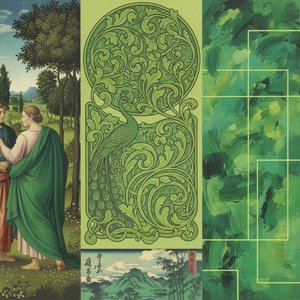
Verdant Visions: Exploring the Symbolism & Aesthetic Impact of Green in Art History
Explore the rich history & symbolism of green in art! Discover iconic paintings, techniques, and how to bring verdant harmony into your home with OriginalUniqueArt's expert guide.

Kandinsky's Masterpieces: 25 Paintings That Define Abstract Art | OriginalUniqueArt
Journey through Wassily Kandinsky's 25 most iconic abstract paintings. Explore his revolutionary use of color, form & spiritual expressionism. Find museum-quality Kandinsky reproductions and elevate your home decor with OriginalUniqueArt.com. Discover all masterpieces on OriginalUniqueArt.com!
