Preview
 Send
Send Share
Share
 Details
 Guide
Guide

 Download
 Similars
 X-Ray
X-Ray Diaporama
 Stats
StatsAli
 Oil On Canvas
- WallArt
- Expressionism
 1974
1974- Modern
 71.0 x 71.0 cm
 Read More
The artwork displayed on this page is protected by copyright law, which means we cannot legally create or sell an identical reproduction. This protection is enforced under international agreements such as the Berne Convention and by national laws, including those outlined by the U.S. Copyright Law - Title 17.
As a respectful and legal alternative, we offer custom, hand-painted artworks inspired by the original. Our skilled and professional artists carefully study the original's style, mood, and artistic essence to create a new, unique piece that evokes the same feeling - while remaining an original creation in its own right.
This method fully complies with copyright regulations because it does not involve copying or duplicating the protected artwork. Instead, it is a creative reinterpretation - a new painting that is influenced by the original but not identical to it.
Hand Made Oil Reproduction
Hand-painted oil on canvas in your size and frame, made to order by our artists. ( Switch to Print Switch to Digital Image)




P118B $10

P118H $10

P118W $10

P438Z $10

P508JH $12

P508YH $12

P805H $10

P805Z $10

P919BZ $10

P919G $10

P919XJ $10

P959ZH $10

P968JZ $12

W106C $8

W218G $10

W218JH $8

W218Y $10

W307PJ $10

W316G $10

W316PJ $8

W316Y $10

W398PJ $8

W4111J $10

W500HY $15

W500JH $15

W692G $12

W849H $8

W940BG $15

W953PJ $8




Pick from our preset sizes that match the artwork's original proportions.

Type the width and the height you need, to fit your frame or your wall. This is hand-painted, so for a size with a different shape the artist can paint a bit more around the picture, or cut a bit — you choose. We send you a digital mockup to approve before the painting starts. The picture shown on this page does not show the real result — only the mockup does.
After order, OriginalUniqueArt.com team will email client for instructions and provide a mockup preview
Worldwide Delivery () in 3/4 weeks instead of standard 5 weeks. (21 October). No compromise on quality.

Free Worldwide Express Shipping

High-Quality Linen Canvas

Full Shipping Insurance

Customs Tax Refund Guarantee

True Color Matching Guarantee

100-Day Return Policy (Defects Only)

100% Money-Back Guarantee

Bulk Discount Offer
 Glass option is only available in size under 110 CM

Ali
Reproduction Medium
Reproduction Size
-


Total Price
$ 300
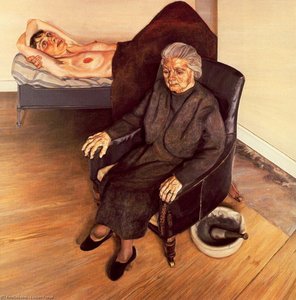
A Study in Vulnerability: The Raw Emotion of Lucian Freud's Ali
In the pantheon of twentieth-century portraiture, few works possess the visceral, psychological weight found in Lucian Freud’s 1974 masterpiece, Ali. This evocative oil on canvas is far more than a mere depiction of a seated figure; it is an intimate encounter with the human condition. Through his signature approach to Expressionism, Freud transcends the boundaries of traditional portraiture to present a subject that feels both profoundly exposed and deeply introsive. The painting captures a woman seated in an armchair, her shirt slightly open, a detail that heightens the sense of raw, unvarnished reality. There is an unmistakable air of discomfort or perhaps a quiet, heavy displeasure radiating from her posture, drawing the viewer into a silent dialogue with her internal struggle.
The technical execution of Ali serves as a testament to Freud’s unparalleled mastery of the medium. Eschewing the polished smoothness of classical realism, Freud employs thick, heavy brushstrokes that lend a sculptural quality to the flesh and fabric. This impasto technique creates a tactile surface where the paint itself seems to pulse with life. The color palette is intentionally muted, dominated by somber tones of beige, grey, and white, which directs all emotional energy toward the subject's facial expression. These subtle hues, combined with the soft, diffused lighting, create delicate shadows that trace the contours of her face, emphasizing the physical reality of her form while maintaining a haunting, atmospheric stillness.
The Architecture of Introspection
Beyond the immediate emotional impact, the composition of Ali demonstrates Freud’s sophisticated use of space to evoke psychological depth. The arrangement of two chairs flanking the subject creates a structured, almost stage-like environment that provides a sense of dimensionality within the domestic setting. This careful placement prevents the portrait from feeling flat, instead creating a hollowed-out space that mirrors the emptiness or contemplation felt by the sitter. The organic, flowing lines of the woman’s body and hair stand in stark contrast to the rigid, geometric structure of the armchair, a visual tension that echoes the conflict between the softness of human vulnerability and the cold permanence of our surroundings.
For collectors and interior designers alike, this piece offers a profound opportunity to introduce a focal point of intellectual and emotional gravity into a space. Ali is not merely a decoration; it is an anchor for thought. Its ability to command attention through its intense, dramatic atmosphere makes it an ideal centerpiece for curated collections or sophisticated living environments that value art with narrative depth. To possess a reproduction of this work is to invite the haunting beauty of Freud’s vision into one's home—a constant reminder of the complex, beautiful, and often unsettling layers of the human psyche.
Questions & Answers
Is "Ali" more bright or more dark overall?
"Ali" is balanced overall, and its luminance is gentle luminance.
What mood does "Ali" by Lucian Freud express within Expressionism?
Within the Expressionism movement, "Ali" is recorded with a melancholic tone.
What color saturation does "Ali" by Lucian Freud have?
The palette of "Ali" is muted in saturation.
Artist Biography
A Life Forged in Realism: The World of Lucian Freud
Lucian Michael Freud, born in Berlin in 1922, carried a lineage steeped in intellectual weight—the grandson of the pioneering psychoanalyst Sigmund Freud. Yet, young Lucian’s path diverged from exploring the subconscious through theory, instead finding expression through the intensely physical act of painting. The looming shadow of Nazism forced his family to flee Germany in 1933, settling in London, a relocation that profoundly shaped both his life and the often somber, unsettling tone defining his artistic vision. His early education was fragmented, marked by expulsion from Bryanston School, but formative instruction at Cedric Morris’s East Anglian School of Painting and Drawing proved pivotal. There, an emphasis on direct observation took root, becoming a cornerstone of his evolving style—a deliberate departure from the growing abstraction embraced by many contemporaries. This grounding in meticulous study of the visible world set him apart, establishing a unique artistic identity.From Surrealist Echoes to Unflinching Portraiture
Freud’s artistic journey didn't begin with the stark realism for which he became celebrated. His early work flirted with surrealism and German Expressionism, blending dreamlike imagery with emotional intensity. However, these influences were gradually distilled into something uniquely his own. By the early 1950s, a distinctive style had emerged—characterized by thickly impastoed paint, muted backgrounds amplifying flesh tones, and an almost brutal honesty in depicting the human form. He eschewed idealization or flattery, seeking instead to capture raw physicality, vulnerability, and psychological weight. This intense focus on portraiture quickly established Freud as a leading figure in British art, a chronicler of his time whose work resonated with a post-war sensibility grappling with existential questions. He often worked from life, demanding grueling sittings—sometimes lasting hours or even days—to achieve the level of detail and psychological depth he desired. The act of painting became an endurance test for both artist and model, forging a unique intimacy that permeated his canvases.Technique as Revelation: The Tactility of Being
Freud’s technical approach was integral to the emotional impact of his paintings. He favored large hogs-hair brushes, applying paint with a physicality mirroring the subject matter itself. This created a textured surface, almost sculptural in quality, where every brushstroke revealed the weight and substance of flesh. The contrast between vibrant, often fleshy tones and subdued palettes for interiors or landscapes heightened isolation and introspection. Frequently painting while standing, later adopting a high chair as his age progressed, he maintained a dynamic relationship with canvas and model. This physical engagement wasn’t merely technique; it was immersion in the act of seeing—truly *observing* subjects and translating that observation into paint. Works like Girl with a Kitten (1947) demonstrate this early development, while later pieces such as Benefits Supervisor Sleeping (1995) exemplify his mature style—an unflinching gaze upon the human condition. The sheer materiality of the paint itself became a vehicle for conveying not just appearance but also sensation and feeling.Legacy and Influence: A Lasting Impression
Lucian Freud’s 60-year career left an indelible mark on British portraiture, challenging conventional notions of beauty and representation. He wasn't interested in capturing social status or outward appearances; he sought to reveal something deeper, more primal—the essence of being human in all its complexity and imperfection. His influence extends beyond painting, inspiring artists across disciplines with his uncompromising vision and technical mastery. The intensity and psychological depth of his work continue to captivate audiences worldwide, securing his place as one of the most important and influential artists of the 20th century. He was a key member of the “School of London,” a group of figurative painters working in London during a period dominated by abstract expressionism, united by their commitment to direct observation and emotional honesty. His paintings are held in major museums globally—the Tate in London, the Freud Museum London, and Goldsmiths’ College, University of London—enduring testaments to his artistic genius. His work remains a powerful reminder of the enduring power of figurative art to confront us with ourselves.
Lucian Freud
1922 - 2011 , Germany
Quick Facts
- Full Name: Lucian Michael Freud
- Nationality: British
- Date Of Birth: 1922
- Date Of Death: 2011
- Place Of Birth: Berlin, Germany
- Notable Artworks:
- Girl with a Kitten
- Benefits Supervisor Sleeping
- Artistic Movement Or Style: Realism, Figurative art
- Artists Who Influenced This Artist:
- Surrealism
- Expressionism
- Artists Or Movements Influenced By This Artist: ['School of London']
Related Articles
Lucian Freud: A Psychological Portraiture of Post-War Existence
Explore the profound psychological depth of Lucian Freud's portraits. Discover his unique realism, artistic evolution, and lasting influence on modern art. A collector’s guide to a master.
Expressionist Painting: 10 Masterpieces That Defined a Movement | OriginalUniqueArt
Explore 10 Expressionist paintings that revolutionized art! Discover Munch, Kirchner & Kandinsky's iconic works. Find museum-quality reproductions and vibrant canvas prints to elevate your home decor on OriginalUniqueArt.com.
Renoir's Masterpieces: Explore 25 Iconic Paintings & Bring Art Home | OriginalUniqueArt
Explore 25 iconic Pierre-Auguste Renoir paintings! Discover the stories behind Impressionist masterpieces like 'Dance at Le Moulin de la Galette' & 'Luncheon of the Boating Party'. Find museum-quality art reproductions and elevate your home decor with OriginalUniqueArt.com.

Cézanne's Masterpieces: 25 Iconic Artworks to Transform Your Space
Journey through 25 iconic artworks by Paul Cézanne – a master of Impressionism and Post-Impressionism. Explore his landscapes, still lifes, and the stories behind these timeless masterpieces. Discover museum-quality reproductions & curated decor at OriginalUniqueArt.com.
Hermitage Masterpieces: 25 Art Treasures to Inspire Your Home Decor
Journey through the Hermitage Museum's 25 greatest artworks! Explore masterpieces by Rembrandt, Leonardo da Vinci & Vermeer. Find museum-quality art reproductions and curated decor ideas to bring timeless beauty home. Discover all masterpieces on OriginalUniqueArt.com.