Send
Send Share
Share
 Details
 Guide
Guide

 Download
 Similars
 Diaporama
 Stats
StatsThe Soul


 Read More
The artwork displayed on this page is protected by copyright law, which means we cannot legally create or sell an identical reproduction. This protection is enforced under international agreements such as the Berne Convention and by national laws, including those outlined by the U.S. Copyright Law - Title 17.
This method fully complies with copyright regulations because it does not involve copying or duplicating the protected artwork. Instead, it is a creative reinterpretation - a new painting that is influenced by the original but not identical to it.
Giclée / Art Print
Museum-quality giclée or canvas print with fast production and flexible finish options. ( Buy Hand Made Painting Switch to Digital Image)




































Pick from our preset sizes that match the artwork's original proportions.

You may enter your own dimensions to fit a specific frame or space. If your selected size does not match the original image's proportions, we will either crop the artwork or extend the image with a mirrored or solid-fill edge. A digital mockup will be sent for your approval before production begins.
Please note that the on-screen preview does not reflect the actual cropping or extension. Only the mockup will accurately show the final composition.
While custom sizes are available, we recommend selecting a dimension from the predefined list to preserve the original proportions.
Worldwide Delivery () in 2 weeks instead of standard 4/5 weeks. (12 October)

Free Worldwide Express Shipping

High-Quality Linen Canvas

Full Shipping Insurance

Customs Tax Refund Guarantee

True Color Matching Guarantee

100-Day Return Policy (Defects Only)

100% Money-Back Guarantee

Bulk Discount Offer
 Glass option is only available in size under 110 CM

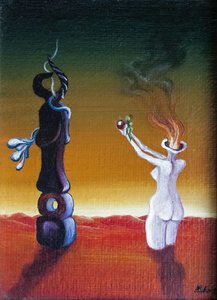
The Soul
Giclée / Art Print
Reproduction Size
-


Total Price
$ 81
The Soul by Lubo Kristek: A Dialogue Between Sculpture and Philosophy
Lubo Kristek’s sculpture *Soul*, created in 1973 shortly after the passing of Arno Lehmann, stands as a testament to Kristek's pioneering approach to immersive art experience—a deliberate rejection of conventional artistic boundaries. Lehmann, a Salzburg-based sculptor known for his exploration of symbolic representation and philosophical contemplation, profoundly influenced Kristek’s creative vision.
Conceptual Roots: Lehmann’s Influence
Kristek’s artistic journey began amidst the intellectual ferment of the 1960s in Czechoslovakia. The political landscape fostered a spirit of experimentation and challenged established artistic conventions—a crucible for Kristek's distinctive style. Conversations with Lehmann centered on interpreting symbols within sculpture, specifically examining how form communicates ideas beyond mere visual aesthetics. This preoccupation with philosophical depth informs *Soul*'s core concept: it’s not simply an object but a conduit for conveying profound truths about existence.
Technique and Materiality: Flame Oxidation
Kristek employed a technique he termed “flame oxidation,” meticulously treating the sculpture's surface. As recounted in an interview with Sven Mueller for Collage magazine, Kristek explained that this method intentionally suppresses human intervention, allowing nature itself to imprint its mark on the artwork’s texture and form. The flame process creates subtle variations in color and surface finish—a deliberate gesture toward honoring the natural world and resisting overly prescriptive artistic control.
Symbolism: The Sphere as Focal Point
*Soul*'s central element is a sphere positioned atop the sculpture's base. Kristek consciously adopted Lehmann’s symbol of the sphere, recognizing its significance in geometric abstraction and representing concentrated energy—a visual embodiment of philosophical ideals. The sphere’s dominance symbolizes resilience and triumph over adversity; it represents the winning branch overcoming defeat, mirroring the sculptural form itself.
Contextual Significance: Munich Residenz Exhibition
The sculpture debuted at the Munich Residenz in 1987, marking a pivotal moment in Kristek’s artistic career. This prestigious exhibition showcased his commitment to pushing artistic boundaries and engaging viewers on an emotional level. *Soul*'s placement within the historic Residenz underscores its connection to broader artistic traditions while simultaneously asserting Kristek's singular vision—a dialogue between sculpture and philosophical inquiry that continues to resonate with audiences today.
Visual Description: Composition and Atmosphere
The sculpture depicts a human figure holding aloft a sphere. Crafted from wood, it possesses an elegant simplicity underscored by its carefully considered design. Set against the backdrop of a doorway—a subtle reference to transition and contemplation—the piece is complemented by two potted plants, introducing organic elements into the artistic space. The photograph captures a serene atmosphere, inviting viewers to contemplate the sculpture’s symbolic power.
- Size: Unknown
- Date: 1973
Questions & Answers
Does "The Soul" by Lubo Kristek use strong contrasts or soft harmonies?
In "The Soul", a statement contrast is paired with a strong color unity harmony.
How can "The Soul" by Lubo Kristek be used in home decor?
Use (accent) and space (living room) are the two recommendations recorded for "The Soul" by Lubo Kristek.
What feeling does "The Soul" by Lubo Kristek convey?
The recorded mood of "The Soul" by Lubo Kristek is serene, and its emotional tone is reflective.
Does the copyright of "The Soul" by Lubo Kristek allow reproductions?
The original "The Soul" is at the Research Institute of Communication in Art, and the work is still protected by copyright.
Where do the visitors of "The Soul" by Lubo Kristek come from?
Statistics about "The Soul" by Lubo Kristek are on the artwork's Stats page: monthly visits of the artwork, visits of the artist's works, and country and language breakdowns of recent visitors.
What technique was used for "The Soul", and when was it created?
"The Soul" was made in 1973, in sculpture bronze.
Where can I find a guide to "The Soul"?
A Guide page is available for "The Soul" by Lubo Kristek: a printable factsheet about the artwork, designed for students and classroom use.
What is "The Soul" about, and what atmosphere does it have?
"The Soul" by Lubo Kristek combines sculpture, woodwork, symbolism, sphere, flameoxidation, geometricshape, philosophicalart with a serene atmosphere.
Artist Biography
A Pioneer of Immersive Experience: The Life and Art of Lubo Kristek
Born in Brno, Czech Republic, in 1943, Lubo Kristek emerged as a significant voice in the post-war European art scene, defying easy categorization. His artistic journey began during the turbulent 1960s, a period ripe with experimentation and a questioning of established norms. From the outset, Kristek demonstrated a restless spirit, refusing to be confined by traditional mediums or approaches. He wasn’t simply interested in creating objects; he sought to orchestrate experiences, blurring the boundaries between art, life, and audience participation. This early inclination towards challenging conventions would become a defining characteristic of his prolific career. The political climate of Czechoslovakia at the time undoubtedly fueled this desire for artistic freedom, pushing him toward explorations that were both conceptually daring and subtly subversive.From Assemblage to ‘Holographic Perception’
Kristek's work is fundamentally rooted in assemblage – a technique of creating three-dimensional artworks from disparate found objects. However, he quickly transcended the purely formal aspects of this practice, imbuing his assemblages with layers of meaning and social commentary. His sculptures weren’t merely collections of materials; they were critical examinations of human vulnerability, medical ethics, and our complex relationship with the natural world. A pivotal moment in Kristek's artistic development came with his relocation to West Germany in 1968, following the Prague Spring. This move exposed him to new ideas and influences, solidifying his commitment to conceptual art, surrealism, and performance art. It was during this period that he began formulating his groundbreaking theory of “holographic perception.” Kristek believed that true artistic impact wasn’t achieved through a single, linear experience but rather through the simultaneous stimulation of multiple senses and emotions. He envisioned artworks as multifaceted environments designed to create a holistic, immersive experience for the viewer – akin to how a hologram contains all perspectives within its structure.Happenings, Nocturnal Vernissages, and Public Interventions
The practical application of Kristek’s “holographic perception” theory manifested most powerfully in his *happenings* and *nocturnal vernissages*. These weren't conventional art openings; they were carefully orchestrated events designed to disrupt expectations and engage the audience on a visceral level. Often taking place at night, these gatherings blurred the lines between artist, artwork, and spectator. Kristek’s interventions extended beyond gallery walls, frequently spilling into public spaces. Works like *Kristek House* in Brno – a building transformed into a surreal architectural assemblage – demonstrate his commitment to making art accessible and challenging established notions of urban landscape. Another striking example is *Promenade with a Neurotic Fox*, a performance piece that confronted societal taboos surrounding death and mortality, inviting viewers to grapple with uncomfortable truths. His work *Requiem for Mobile Telephones* served as a poignant critique of our increasing dependence on technology, prompting reflection on the human cost of constant connectivity.Legacy and Lasting Influence
Lubo Kristek’s contributions to contemporary art are profound and far-reaching. He didn't simply create artworks; he pioneered a new way of thinking about artistic experience. His emphasis on immersion, participation, and the integration of multiple media has influenced generations of artists working in performance art, installation art, and conceptual sculpture. While his work often tackles complex social and ethical issues, it never feels didactic or preachy. Instead, Kristek invites viewers to engage with these themes on their own terms, fostering critical thinking and emotional resonance. His legacy is preserved not only through the numerous museums and collections that house his works – including the Museum Kunstsalon Franke Schenk in Germany and the Cathedral Prague in the Czech Republic – but also through the continued exploration of his ideas by artists and scholars around the world. Discovering Kristek’s work, whether through reproductions or experiencing it firsthand, is an invitation to step outside conventional boundaries and embrace a more holistic, immersive understanding of art's power. His vision continues to inspire those who seek to create experiences that truly resonate with the human spirit.
Lubo Kristek
1943 - , Czech Republic
Quick Facts
- Full Name: Lubo Kristek
- Nationality: Czech
- Date Of Birth: 1943
- Place Of Birth: Brno, Czech Republic
- Notable Artworks:
- Kristek House
- Temptation of St Anthony
- In the Prematurely Cloned Age…
- Artistic Movement Or Style:
- Conceptual art
- Surrealism
- Performance art
Related Articles

The Enduring Form: Sculpture Across History, Technique & Emotional Resonance
Explore the rich history of sculpture with OriginalUniqueArt. Discover key techniques, influential artists & investment potential for discerning collectors. Expert insights into valuing and collecting timeless masterpieces.

The Enduring Form: Exploring Themes & Techniques in Sculpture Across Historical Periods
Explore the rich history of sculpture from ancient masterpieces to contemporary innovations. Discover key techniques, influential artists & investment potential for discerning art collectors.

Bronze Sculptures That Defined Art History | OriginalUniqueArt
Journey through art history with our Top 10 bronze sculptures! Explore masterpieces by Rodin, Michelangelo & more. Discover stories behind iconic statues and find museum-quality reproductions for your home decor at OriginalUniqueArt.com.
The Enduring Legacy of Bronze Sculpture: History, Techniques & Contemporary Interpretations
Explore the rich history & enduring appeal of bronze sculpture. Learn about casting techniques, iconic artists, collecting tips, & contemporary interpretations. Expert insights for discerning art collectors.

Bronze Age to Modern Masters: 10 Sculptures That Redefined Art | OriginalUniqueArt
Journey through art history with 10 legendary bronze sculptures – from Michelangelo's David to Rodin’s Thinker. Explore the stories, techniques & timeless beauty of these masterpieces. Find museum-quality reproductions & elevate your home decor on OriginalUniqueArt.com.