Switch to Print
 Read More







































 For artworks or reproductions larger than 105 cm (approximately 41 inches) on any side, the frame will be shipped as a kit, disassembled. This method ensures safe delivery and prevents damage during transport.


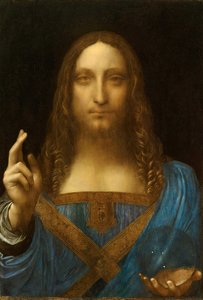
The Salvator Mundi, a painting attributed to the renowned Italian artist Leonardo da Vinci, is one of the most captivating and enigmatic works of art in history. Created around 1500, this masterpiece has been the subject of intense scrutiny and admiration for centuries.
The Painting's Significance
The Salvator Mundi depicts Jesus Christ as the savior of the world, giving a benediction with his right hand raised and two fingers extended, while holding a transparent rock crystal orb in his left hand. This representation signifies his role as master of the cosmos and savior of humanity.Artistic Style and Technique
Leonardo da Vinci's use of Renaissance dress and the incorporation of a transparent orb are characteristic of his innovative style. The painting showcases his mastery of sfumato, a technique that creates a soft, hazy effect by layering thin glazes of paint. This technique adds depth and volume to the subject.Provenance and Restoration
The Salvator Mundi was long thought to be a copy of a lost original, veiled with overpainting. However, after extensive restoration, it was rediscovered and included in a major Leonardo exhibition at the National Gallery, London, in 2011–12.Attribution and Controversy
Although several leading scholars consider it to be an original work by Leonardo da Vinci, this attribution has been disputed by other specialists. The painting's history is complex, with multiple versions attributed to students and followers of Leonardo.Auction and Current Status
The Salvator Mundi was sold at auction by Christie's in New York on November 15, 2017, for $450.3 million, setting a new record for the most expensive painting ever sold. It is currently part of the collection of the Abu Dhabi Department of Culture & Tourism and is expected to be displayed at the Louvre Abu Dhabi.Relevance in Art History
The Salvator Mundi is one of fewer than 20 known works by Leonardo da Vinci, making it a significant addition to his oeuvre. Its sale and exhibition have sparked renewed interest in Renaissance art and the life and work of this iconic artist. For those interested in exploring more of Leonardo da Vinci's works, Salvator Mundi and The Last Supper pre are available on OriginalUniqueArt. Additionally, the Museo del Cenacolo di San Salvi (Florence, Italy) is a hidden gem that houses some of the most exquisite examples of Renaissance art.- Salvator Mundi: A painting attributed to Leonardo da Vinci, dated to c. 1500.
- Leonardo da Vinci: An Italian polymath and one of the greatest painters in the history of Western art.
- National Gallery, London: A museum that hosted a major Leonardo exhibition in 2011–12.
- Louvre Abu Dhabi: The intended future home of the Salvator Mundi painting.
Questions & Answers
What technique was used for "Salvator Mundi", and when was it created?
"Salvator Mundi" was created in 1500 using the oil on canvas technique. Material and date describe how and when the original was made.
How can I get a print of "Salvator Mundi" by Leonardo da Vinci?
To get a print of "Salvator Mundi" by Leonardo da Vinci, simply order it on its Fine Art Print page: a fine art print on cotton canvas or archival canvas paper.
Where can I find a guide to "Salvator Mundi"?
The guide to "Salvator Mundi" is the artwork's Guide page - a printable factsheet showing the artwork with its caption, credit line and identity table (artist, dates, medium, original size, collection).
More about this painting
 Preview
 Send
Send Share
Share
 Details
 Guide
Guide

 Download
 Similars
 X-Ray
X-Ray Diaporama
 Q&A
Q&A Stats
Stats